

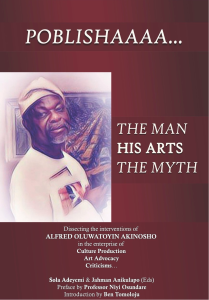
Tributes
by
Toni Kan | Steve Ayorinde | Femi Odugbemi | Tade Ipadeola
“…his mindset is young, perspective ever fresh”
… he is one of those elderly men who will never get old because their mindset is young, their perspective is ever fresh and their outlook on life is constantly renewing itself
Toni Kan
LAGOS is a city of parvenus, nouveaux riches and arrivistes. It has been so since Oba Oroghua of Benin foisted Ashipa as Oba of Lagos over the Aworis in the 17th century.
Since then, many men and women have migrated from far afield to Lagos hoping that the ship of their destiny will dock somewhere in this city by the Lagoon. They come turgid with hope and buoyed by ambition as they lay claim to their patch of Lagos.
And no one knows about these claimants to the soul of Lagos like Toyin Akinosho, geologist by training, writer by choice and culture activist by inclination.
BORN 60 years ago, Toyin Akinosho is a polymath, a member of that unique specie of human beings, who can best be described as — a sponge for knowledge and a human reservoir of insights.
Toyin Akinosho knows things. Plenty things.
Ask him about Hotel Bobby and even if he was too young to have been a regular, he will have a true story about a cousin or uncle who was a regular.
Inquire about FESTAC 77 and ask whether he knew a guy called the “Minister of Enjoyment” and Toyin will tell you his real name was Admiral Fingesi, the man whose remit it was to build Festac Town in time for the FESTAC festivities.
Present a query about the first deep offshore well to be spudded in Nigeria and Mr. Akinosho will tell you that while Shell’s Bonga often lays claim to that feat, it is actually not based on facts but on PR because as he puts it, “Shell is a bigger company and had more media power, so it was easy for them to be seen as the flagship of deep water exploration in Nigeria. In terms of delivery to first oil Aboh delivered before Bonga.”
Be stuck in your hotel room on a Friday night in Accra, Cape Town, Dakar or Vienna and wondering where to spend the night in a fun and convivial space? Call Uncle Toyin and he will tell you which club jumps and at what time it begins to jump.
When you google Renaissance Man, then click on “Image” the photo that jumps out at you is of Toyin Akinosho.
Go on, try it.
Uncle Toyin who insists on not being called Uncle Toyin because as he puts it – “I am not your uncle” – is one of those elderly men who will never get old because their mindset is young, their perspective is ever fresh and their outlook on life is constantly renewing itself.
But, of course, there is a middle age spread coalescing into a paunch, his stubble is now more grey than black and his hair which he keeps well-trimmed is losing the battle to those pesky things Wole Soyinka once described as “frail invaders of the undergrowth.”
Uncle Toyin is turning grey.
I DO not remember when I first met Toyin Akinosho. But I know he was with Jahman Anikulapo, his brother from another mother. I am clear that it predated Freedom Park and must have been during the Abacha years.
I must have seen him first at a CORA event, one of those rowdy and irreverent Art Stampedes where you were sure to meet whoever mattered on the Lagos art scene.
Toyin Akinosho would usually be the man in the black trousers and check shirt, usually black or blue and white check shirt. He didn’t care whether it was short or long sleeved. I remember him as always ARMED with a book, fiction or non-fiction; it didn’t matter. Memory tells me he was the one who always had a question to ask but before he asked his question, he always insisted on reading a passage from whatever book he had with him.
But I remember clearly that he was the one who was always ready to interrupt Jahman Anikulapo, who most times was Master of Ceremony.
“Mr. Man you are wasting too much time on that issue,” Toyin Akinosho would bellow.
The first time I saw it happen, I was so sure that Jahman would take offence, but he had smiled good naturedly and said “Don’t mind Toyin, he wants me to give him the microphone. But I won’t. I am the MC.”
Some context is needed at this time.
Jahman Anikulapo was THE Jahman Anikulapo. Culture Advocate, Editor of The Guardian on Sunday and a man I had been trying to make my friend for years. And this man just interrupted him as Fela would sing – Just Like Dat!
A few months later, while I had still not gotten a handle on the unusual dynamic between the duo of Jahman and Toyin, I was invited by Obi Nwakanma to a party in Festac Town at a place called MARS House.
I would discover on arrival that Mars House was Toyin Akinosho’s house or to borrow from Coleridge, “his stately pleasure dome.”
MARS House was a place where the beer never ran out, where there was always food ready to please your palate and quell your hunger and where any creative arriving in Lagos and seeking a place to lay his head was always assured of a room and a bed.
And oh my, the books.
The only other place that functioned like that was Odia Ofeimun’s former house on Sanyaolu street in Oregun.
It was at that party, with Obi Nwakanma regaling us with ribald poems and jokes and stories that I found out Toyin Akinosho was no ordinary journalist. I discovered that he was indeed a geologist in the employ of the Chevron and was moonlighting as a journalist nay columnist for The Guardian on Sunday.
He was, as I would discover many years later, the man behind the Artsville column in The Guardian. This was an amazing discovery because living in Kano as a teenager with a hard-on for Lagos and all things literary, the little I gleaned about the Lagos cultural and literary elite came from the Artsville in The Guardian on Sunday as well as from Tony Okonedo’s columns in Vanguard. Then, much later, from Prime/Vintage People and FAME.
BUT even though I had met Toyin Akinosho, been to his house and was running into him at different art and literary fora, we never had a conversation until one afternoon, maybe it was the day the late Bisi Silva launched CCA or the day South African queer photographer, Zanele Muholi opened her exhibition. I know it was at CCA for sure and I was standing and talking to a female acquaintance when Toyin Akinosho pointed at me and said to someone next to him – “That is the famous author, Toni Kan.”
I was taken aback. I felt a sting in the introduction. I was no famous author even though I had a collection of poems and a novella under my belt. I felt Mr. Akinosho was slighted that I did not come over to greet him but the truth was that I had been standing there and shooting the breeze and waiting for an opportunity to introduce myself for the umpteenth time and maybe strike up a conversation which I am horrible at. As a child, I had a stutter and it made me self-conscious and not so sociable, something people often mistake for arrogance or aloofness. I felt Mr. Akinosho, whom I had been dying to make a mentor and friend, had assumed wrongly.
Somehow, we had a conversation and then we had another and another and many more and Toyin Akinosho was suddenly my uncle, the one who would see me and hail and say – “Baba Toni” as he shook me multiple times – then frown and pull away as soon as I called him Uncle.
I had achieved my literary aim in Lagos to be close to arbiters of literary and cultural taste — Odia Ofeimun, Jahman Anikulapo, Maik Nwosu, Nduka Otiono, Uzor Maxim Uzoatu and Toyin Akinosho
TOYIN Akinosho studied geology at Ife and as he tells it, he was an undergrad and was working on his final year project in GeoChemistry when he published his first piece in The Guardian and was paid N25.
“My father used to give me N60 a month and as far as I was concerned, he could just go away. I was making good money. My feeding allowance was N45 for the whole month at Ife and I was making N25 from a story. I became extremely rich.”
How did a geologist become a writer for the flagship of Nigerian journalism? Toyin Akinosho, as they say, had joined bad gang.
“My department was not far from the Theatre Arts department and sitting there I would hear all that noise from down there and that was how I got acquainted with all those characters like Uzor Maxim and Tejumola Olaniyan. They would be drumming and all that and I was excited by what they were doing but even though I was thrilled I still had my samples to run back to.”
So, once he finished his degree, he served at Elf Petroleum, then ditched his Geology degree and went into journalism because of happening Ife boys like Greg Obong-Oshotse. Toyin Akinosho was just 26 and was soon made Acting Features Editor.
At The Guardian, he was mentored by veterans like Ted Iwere, Femi Kusa and Ben Tomoloju who joined The Guardian from Democrat Weekly and introduced, what we now know as, the Arts and Culture pages.
“I went to The Guardian the same way I went to Ife. I went to Ife because the boys that were happening at Federal School Science were at Ife. Then suddenly we had people like Greg Obong-Oshotse and all these guys were living together at Fajuyi Hall (while in Ife) at The Guardian. They were showing off so I said I would join them.”
Toyin Akinosho could have risen through the ranks to become an Editor of one of the titles at The Guardian but for a wrong move with Sonala Olumhense and eight others who went to work for Nduka Obaigbena.
“We wanted to make a generational statement,” Akinosho recalls, “but Nduka had other plans. Immediately I got to ThisWeek, I knew I had made a mistake. He ended up owing salaries. It was a different life from The Guardian which was structured.”
Broke and with salaries in abeyance, his family prevailed on him to ditch journalism for Geology and in 1988 Toyin Akinosho, at 28, caved in and went to work for Gulf oil (Chevron) where he spent 20 years.
But during that time, he stayed in love with the arts publishing Festac News and novels like Akin Adesokan’s award winning Roots in The Sky. Today, many admirers still refer to him as Publisher (pronounced Poblisha).
AT 60, Toyin Akinosho is Africa’s foremost oil and gas reporter. The publisher of the authoritative Africa Oil+Gas Report, Akinosho is a recipient of the CNN African journalist Award in Economics and Business category
In 2012, Akinosho was named alongside seven others as a fellow of the Nigerian Association of Petroleum Explorationists (NAPE) where he had served for many years as Secretary and in 2015 he received the “top award of the latest edition of the “Big Five Awards” conferred on distinguished oil industry players at the annual Africa Oil Week in Cape Town.
The week-long conference is one of the most prestigious gatherings of operators and regulatory authorities on the continent… On the 18th anniversary of the awards, Duncan Clarke, Chairman and CEO of Global Pacific & Partners, organisers of the 22-year old conference, announced the 2015 winners for their contribution to excellence in Africa’s petroleum industry. The winners included Toyin Akinosho, Publisher of Africa Oil+Gas Report, who bagged the Distinguished Contribution to the African Industry award.”
Toyin Akinosho received the award for what the organisers described as “having the courage of his convictions.”
The award was a richly deserved one by a man who has had a rewarding and multifaceted 32 years long professional career in the oil industry, “20 of those were spent as a petroleum geologist with wide and increasingly diverse experience in Chevron, where he retired in 2008. He publishes the widely read Africa Oil+Gas Report, which has shown uncommon courage and candour in its coverage of the industry. Toyin has demonstrated keen interpretation of issues and trends in the technology, fiscal and strategic aspects of the oil industry, leading his magazine to establish rankings of top independent foreign and local producers and the emergence of African indigenous independents.”
AS Toyin Akinosho celebrates his 60th birthday, I am proud to rejoice with a geologist, columnist, raconteur, bon vivant, Lagos lover, co-founder of Committee of Relevant Art (CORA), past winner of the CNN African Journalist award and all-round Renaissance man.
Happy birthday, Uncle Toyin.
* Toni Kan, writer, journalist, publisher and Public Relations practitioner, Toni Kan is author of Night of the Creaking Bed; and The Carnivorous City, among other titles.
*****
“…he speaks truth to power… at grave danger to his life”
Poblisha stands proudly to be counted for his love for the arts and in using the media and publishing to express himself and agitate for a better society in the two sectors his name has come to be identified with. He should be encouraged to continue to devote his life to those two causes
Steve Ayorinde
I DID not meet Mr. Toyin Akinosho when I joined The Guardian in 1991.
But he was an unofficial member of the Arts Desk who was always around and was quite chummy with our boss, Mr. Ben Tomoloju and his Assistant, Jahman Anikulapo.
He looked every inch a typical journalist, the first day I met him. Less formally dressed, shaking the same person’s hand repeatedly and laughing rather animatedly.
But after two other encounters, his ties, which were new and choicy and his shoes, somewhat pricey and eye-catching gave him away. If he was a journalist at all, he wouldn’t be an ordinary reporter; at worst he would be a senior hand on the business desk, I thought, until I got to know he was an ex-staff who had moved on to Chevron after leaving ThisWeek magazine.
Chevron????
Wow!!!
What a big boy, I thought.
After we formally got introduced to each other; he actually sought me out, wanting to know more about the new test candidate on the desk who would be covering music and the film industry. It didn’t take long to know this gentleman would be my kind of guy – cerebral, cultured, sociable, large-hearted and given to the good life.
It was the year in which Mr. Akinosho and a few other collaborators, including my bosses on the Arts Desk, founded the Committee for Relevant Art (CORA), a thoughtful and enduring arts advocacy.
It is a fitting testimony to his commitment to the art advocacy cause that the maiden edition of CORA Arts Stampede, a quarterly gathering of the arts and cultural intelligentsia, was held on the front lawn of his Block 4 A’ Close 22 Road house in Festac Town. He lived in Flat 3 on the ground floor, his mother lived in another flat on the second floor.
This was in 1991, four years after he joined Chevron.
By 1993, the big boy had arrived, and moved into one of a two-wing duplex on a more polished neighbourhood of 1st Avenue.
That was MARS House overlooking the Festac Town canal.
Although Festac Town was far, at least for journalists without personal cars at the time, Akinosho’s MARS House, became a regular hangout for the boys.
The usual suspects of course would always be led by Jahman (Anikulapo). Other regular faces included Kole Ade-Odutola, Nduka Otiono, Akin Adesokan, Olayiwola Adeniji, Sola Balogun and yours truly.
Being proudly single like the rest of us with the exception of one or two, he obviously wanted (our) company quite often. But it should have been apparent to him that he was the big boy among us, and we loved his huge, comfortable house, with all the appurtenances of free food and booze.
In the mid-1990s when he floated the Festac News, a culture-centric community newspaper focusing on life within the mini city where he resided, it was obvious that how he would thenceforth be addressed had changed.
No more Mr. Akinosho, Toyin or T.A.
Publisher (pronounced Poblishaa) had become his preferred and well-earned, even if only in a jocular sense, new title and prefix.
He wanted Festac News to be entertaining and so he was kind to have invited me as a contributor, on the side, to the fortnightly publication.
First, he wanted the story of the Musical Society of Nigeria told like never before, given that I was the only print journalist privileged to have been invited to cover the opening ceremony of the MUSON Centre at Onikan in 1994. And then he wanted an interview with the ultimate diva of the film industry at the time, Liz Benson.
“Stevo”, he would say, “please let’s see from this interview with ‘anti yen’ (that lady) the type of a thing we see in Liz Taylor.”
Whenever Poblisha used the phrase “anti yen”, you didn’t need a ginger ball to know that he had more than a passing interest in the lady under reference.
Perhaps, because his geological work at Chevron didn’t entail much writing, Poblisha just loved to write in the press. He never got tired of writing.
His Artsville column in The Sunday Guardian was a must-read, for the language, craft and information.
REMARKABLY, professionalism has always been his watchword even if you might not totally agree with his reviews or submissions.
I recall that sometimes in early 2018 when he called me on phone to get the Lagos State’s side regarding a complaint by a certain arts promoter in Europe who claimed LASG pulled out of a sponsorship proposition on a trip to South Africa at the last minute.
I explained to him that the claim was news to me and that in the absence of an approval or a letter of commitment, it was unlikely that what was being described qualified as something under consideration let alone a commitment that was reneged on. I’d rather he let it slide.
But he explained it was important to publish and reflect all sides so that the claimants would have learnt an important lesson in how things worked in public service.
He was right and his article reflected that wisdom.
I am forever happy that he was able to float another publication dedicated to the oil and gas sector, his other love. And that he was courageous enough to speak truth to power in decent language, sometimes at grave danger to his life.
A good legacy is when one is able to stand for something.
Poblisha stands proudly to be counted for his love for the arts and in using the media and publishing to express himself and agitate for a better society in the two sectors his name has come to be identify with.
He should be encouraged to continue to devote his life to those two causes and to consider a revisit of the Lagos The City Guide, a quarterly exploratory publication into the heart of Lagos metropolis, which he once published in collaboration with his arty soulmate, Jahman Anikulapo.
TEN years ago, when his 50th anniversary was celebrated at Terra Kulture in Victoria Island, Lagos, the feeling of joie de vevre was palpable.
The same Terra Kulture has continued to define itself as one of Nigeria’s premium arts spaces and has indeed recreated itself in multiple fold through a collaboration with Lagos State Government in 2018-2019 that saw four exact replicas of the multi-purpose arena springing forth in different parts of the state as Lagos Theatres.
Sadly, however, Terra Kulture Arena, like all other arts spaces in Lagos, are now closed and quiet in the birth month of one of the men who wrote them into prominence, albeit temporarily, no thanks to the rampaging pandemic redefining the way we now live and interact, and, invariably how deserving citizens are celebrated.
Thankfully, what the deadly virus has not denied us is our ability to think, write and employ digital technology as our new diamond.
This is why Mr. Akinosho’s diamond jubilee anniversary is special, as a feast of renewal in a way, literarily and digitally, with the assurance that special people can never be forgotten, no matter the challenges of the time.
And so, to our amiable Poblisha, diamonds are forever, and may he continue to shine brightly like a diamond in the arts and media as indeed in the oil and gas firmaments for many more years.
Happy birthday Egbon!
Steve Ayorinde, immediate-past Commissioner for Tourism Arts & Culture for Lagos State, is the Publisher of The Culture Newspaper (TCN) and promoter of The Museum of News Africa. He was Managing Director/Editor-in-Chief of National Mirror and Editor of The Punch.
*****
“Go on TA… we like your Trouble”
…when I met TA for the first time, I just knew he would be nothing but trouble. He smiled a lot, but his eyes betrayed a deep cold curiosity of a newshound. He asked too many questions. He doubted every answer. He probed and pushed…
Femi Odugbemi
I FIRST met Toyin Akinosho sometime in 2002 back in the heady days of the Independent Television Producers Association (ITPAN) interventions. I think it was at one of the Lagos Forum on Video and Film in Africa, which held at the French Cultural Centre in Ikoyi in those days. Toyin was back then publishing the Festac News, and along with Jahman Anikulapo, they programmed the Committee for Relevant Arts Stampede series at the National Theatre Iganmu.
First impressions are big with me. I never seem to lose my instinctive reading of anyone I meet for the first time and it tends to stay with me as a measuring compass to my future assessment of the character of that person and the purpose and possibility of our future partnership. And when I met TA for the first time, I just knew he would be nothing but trouble. He smiled a lot, but his eyes betrayed a deep cold curiosity of a newshound. He asked too many questions. He doubted every answer. He probed and pushed, constantly demanding to know what plans the ITPAN Executive had for the emerging Nollywood industry that was seemingly a fringe outgrowth of the more formal structures of ITPAN membership companies of the time.
Toyin was one of the early culture industry activists back then who did not mince words about Nollywood’s quality, but he always saw its massive potential and advocated strongly for an active agenda in training and professional development. The ITPAN Executive led by Uncle Steve Rhodes had acquired a grant for that same purpose. The succeeding President Chief Tunde Oloyede led the team that fully established the ITPAN Training School in Gbagada at the time. And when after him, I was elected President of ITPAN in 2002, professional training was entirely my big focus because one of the industry voices loudest in my head was always that of Toyin Akinosho.
TA’s ‘voice’ as a conscience of the art and culture community has created the biggest quantum leaps in how our industry’s advocacy platforms engaged government, the media, the public but more importantly ourselves. The capacity to question interventions beyond rhetoric, to demand clarity of purpose of industry leaders, to critique process and hold to account artistic influences and trends will be the rich legacy of his work. None of that of course should surprise us. TA by profession is a geologist, trained to dig into multiple layers of earth to unearth hidden valuables and natural resources. And by all account he is a natural, by instincts and training, but also as a matter of interest and character.
The programming of the Committee for Relevant Arts has been for decades a crusty shovel that has unearthed a thousand creative gems in literature, theatre, music, poetry and dance. Many of our best performers, authors and creatives found their voice or were first introduced to the world through one of the CORA’s platforms. Side by side to that, and perhaps of far more lasting value is the leadership of TA in the documentation of our cultural histories and artistic influences, across the cultural strata. From academia to the street. Across the many languages and cultures. From the obscure to the prominent. The trove of news, reviews, interviews, exchanges, books, videos and audio assets that have amassed from the CORA intervention is a remarkable contribution to our nation’s archives. Of course, CORA winning the Prince Claus award in December 2006 underscores the power of this legacy as something that has served as a worthy example and enriched artistes all over the world as well.
There is an unknown but interesting personal memory of that evening on the lawn by the lagoon in Ikoyi when TA and Jahman stood on a podium to accept the Prince Claus award formally. A few weeks prior, I along with Jaiye Ojo and Lemmy Adebule had led the team that pitched a new TV series to the Africa Magic Channel Manager Ms. Allison Triegaard. It was the hottestly pursued project commission of Nigerian TV ever as it would be a yearlong daily series which had the potential to create and energise a new generation of creatives, actors and crew. The rumour mill was agog that my team wasn’t even in the shortlist. But as I sat at that event and TA began an acceptance speech of the Prince Claus award, my Blackberry rang. It was Allison on the line with the news that my team had won the pitch to produce the now famous long-running series called TINSEL. It is a moment that forever embedded TA’s name and voice with a very significant professional win for me.
When our founding team for the IREPRESENT International Documentary Film Festival began that journey as well, TA was quick to suggest and accept a special collaboration with CORA that presented a Stampede on the final day of the 4-day festival every year. And a decade has passed with the CORA Stampede anchored by TA becoming a star attraction in the quality of theme, guest speakers and the audience turn-out.
As we celebrate TA at 60, there’s a lot we owe to his vision, his curiosity, his passion. We owe much more to his commitment and sacrifice to bring to everything he does, his everything. I owe him a world of thanks for the many years of holding my feet to the fire and keeping a suspicious eye on me, so I never let up. I end this by confessing that one of my proudest moment was a couple of years ago at a LABAF evening at Freedom Park being invited onto the Advisory Committee of CORA. Once again, the voice of Toyin Akinosho sound tracked for me a memorable moment. Happy birthday TA. May you live another next 60 years in health and happiness…yes, we like your trouble!
Femi Odugbemi, Storyteller, Content Producer, Creative Entrepreneur, is CEO/Founder Zuri 24 Media
*****
Being Citizen Akinosho
The mind that chronicles runs steady still at sixty, satisfied with nothing but the entry of those things we miss because we’re ill prepared for moments which the sentry by long habit captures as they come, little or large, ugly or handsome.
Tade Ipadeola
WHAT books might be on his nightstand? His table? These are good guesses at any point in time and a great way to begin exploring the theme of being Toyin Akinosho. A veritable reader of rich picks, eclectic to the elastic point of variety itself, his intellectual roaming skirts the turf of randomness but a careful look at the stack will show a curious mind at work, an expansive imagination at play, a consciousness in lockstep with the state of the world and its reinvention according to the best thinking happening anywhere on the planet. As for his bookshelf, the guess is easy. Every book is on the shelf. This is conjecture backed by primary evidence and not mere hearsay. Citizen Akinosho, our toast at sixty, avuncular and graceful, has ascended what the Yoruba call the Heights of the Elders in matters of the mind.
There is a quality to the way Citizen Akinosho relates to issues of art and culture that is almost alien to the contemporary Nigerian way. Where the Nigerian is loud, he is laconic, where his countrymen are reckless, he is mindful, where they are sold on the foreign, he is invested in all things of value wherever they come from on the map of the world, home or away. He is one of those men who accomplishes far more with a whisper than crowds do with all the jostling and shouting. There are lenses through which, as perhaps the quietest curator of our culture into the 21st century, the works of Mr. Akinosho enable us to make discoveries that are of epiphanic dimensions. To possess sensibilities so fine, literal artistic antennae so keen and a faculty for the relevant so broad are things which, with due respect to all recipients of contemporary scientific education, we seldom associate with geologists. We fully expect these things from professors of art history, yes — with archaeologists, rightfully so, but hardly ever with practitioners of the natural sciences. Citizen Akinosho is our own Helen Vendler with the distinction of belonging very prominently in the Town section rather than the Gown section of Metropolis.
As broad and wide-ranging as his engagements with culture have proven to be, he has shown consistently that the same focus that made him a geologist is actually still at work, working over material. I find a parallel, curiously, only in the labours of Bishop Samuel Ajayi Crowther who worked quietly for four decades before gifting his people and culture with the unforgettable document known as the Bible in Yoruba.
Fortunate indeed is the man who finds direction early in life and Mr. Akinosho is one man who did and, what is more, never strayed. From his days at the university, he had decided that the highest and best of all that his culture produces will form his provenance and that his dealing with the minds and imagination from within his culture must extend to what other minds and other dreamers and visionaries are doing elsewhere in the world. Much has been observed and recorded on this binocular vision and quality of seeing but perhaps in no other person are the finest ideals of this disposition better realized than in Citizen Akinosho who not only exercised his mind in the sciences as a geologist but as a memoirist of culture as well.
In the midst of a culture as extraverted as contemporary Nigerian culture has become in the late 20th to early 21st century, it becomes clear that the culture needs not one-man armies but a core of people that share Mr Akinosho’s sensibilities. To participate in a CORA event in the last 20 years is to get a feel for what is possible when there is such a critical mass — even if Citizen Akinosho and his confederates do their best all the time to saunter into their own events and mix with audiences the way any regular attendee or guest would. It is one of the charms of Citizen Akinosho and a trait many observers have made comments upon — this involvement in the zeitgeist that is free of proprietorial reins. The gathering of like minds in CORA has given Nigeria a most unique event on the culture calendar most notably in LABAF, the Lagos Book & Arts Festival, where the book and culture take centrestage rather than personalities or egos.
II
A PERSON sometimes embodies the finest values of his age (as some no doubt embody the worst vices). Such persons are products of both personal drive and specific nurture.
What are the chances that the same individual will know where in a large city such as Lagos Dede Mabiaku is playing at the weekend? Which year PEC Theatre staged the last performance? When Angola began awarding its major literary prizes? Which minnows are in the running for Mozambique’s oil and gas fields? Why the rig count of the majors is shrinking in the Gulf of Guinea? When the conversation between Tony Allen and the Lagos crowd took place? The new poets to whom South African culture circles are turning for enlightenment? What culture events will be happening this coming week all around the country, and when? Who and who are the best Afrobeat dancers left in the continent? The obvious answer is that the chance is very slim, and one would be right, except of course for Citizen Akinosho. He has maintained an amiable nexus of contacts and information flow in the lines of his preoccupation such that it is actually quite natural to turn to this fount of Nigerian cultural information.
When the Nigeria Magazine went out of print after going and coming over several seasons, the loss of that institutional presence on the landscape was deeply felt by everyone concerned. Into the void stepped Citizen Akinosho and with steadiness he has over the course of decades proved that he is no flash in the pan but in the running for the long haul. It is the rare educated Nigerian to whom one can turn for Nigerian books whether published by Fourth Dimension or Onibon-Oje, Drum or Spear. What is it that makes a man a collector of all these artefacts from within his own culture and the rest of the world?
Public contributions to culture generally and Nigerian culture in particular abound in newspapers, periodicals and recorded appearances in notable art projects in the past four decades. What distinguishes Citizen Akinosho’s unique fingerprint is the very quality that is almost laissez fair but which is nevertheless meticulous. Beyond strictures of scholastic aptitude or cultural impositions, some individuals through sheer force of personal drive emerge in every generation to embrace the totality of who they are and what the world into which they were born is. We know them fairly readily because their interests as well as their contributions are characterized, even marked by a certain boundlessness of plenitude. Out of these numbers, however, are a subset which in spite of their outstanding gifts and perspectives, court simplicity and even anonymity. I have sometimes wondered whether this tendency in Citizen Akinosho is his ploy to escape writing a memoir. If it is, he is hereby put on notice that we have seen through the very clever attempt, but we insist on a memoir. There is perhaps no better time than now to make a request of Citizen Akinosho regarding a memoir. He owes the culture one or as many as he can now bring out in the coming years.
III
I WILL conclude my appreciation of just what kind of impact Mr. Akinosho has had on the imagination of his times by relating a personal experience. Sometime in the year 2009, I began writing my volume of poetry, The Sahara Testaments, in earnest. I had a rough map of the journey in my head, but I knew I needed guides. I turned to Mr. Akinosho and discussed my broad plans for the volume with him. He liked the idea of a chronicle of life in the desert. I then asked him what he thought I needed to keep in mind when tackling a geologic phenomenon such as the Sahara Desert. His answer remains as memorable in my mind today as when he first delivered it over drinks more than a decade ago. Have I considered the particular impact of the Aeolian in sculpting landscapes and human behaviour? Have I tried to map human migration – voluntary and involuntary – across the Sahara? Have I retrieved any stories, myths, legends of note from the desert? Have I compared the features of the Sahara with other deserts in the world?
It was the ease with which Mr. Akinosho rolled out his checklist that intrigued me. It was as if he had anticipated that I would ask the question. I was glad I asked him the question and can now disclose that of the few people whose opinions I sought during that period of seeking a structure for my work, his questions proved invaluable in not only providing alternative pathways to neural nuggets but also in interrogating motive and drive. We need more pillars for our culture. We already have the template in Citizen Akinosho, Borokini awon Publisher, Eegun senujeje muti, all-round gentleman.
Ipadeola, poet, lawyer is the author of the poetry volume, The Sahara Testaments, winner of the Nigeria Prize for Literature 2014.

