

The sacred role of art persists, but it now operates through new media—social media platforms like Twitter, Facebook, and Instagram. While this allows art to reach wider audiences and democratises performance spaces, it also poses a challenge: the once-committed artist has been overwhelmed by commercial interest due to economic vulnerability. Too often, artists are now constrained by the maxim: “He who pays the piper calls the tune.” Only a few artists remain steadfast in their social commitment
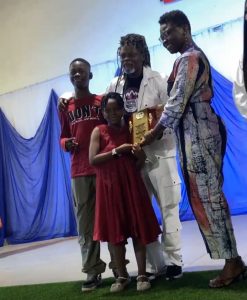
Being presented the LSA 2025 Distinguished Personality Award by Prof Abosede George, LSA co-founder, on Friday night. with him are his children
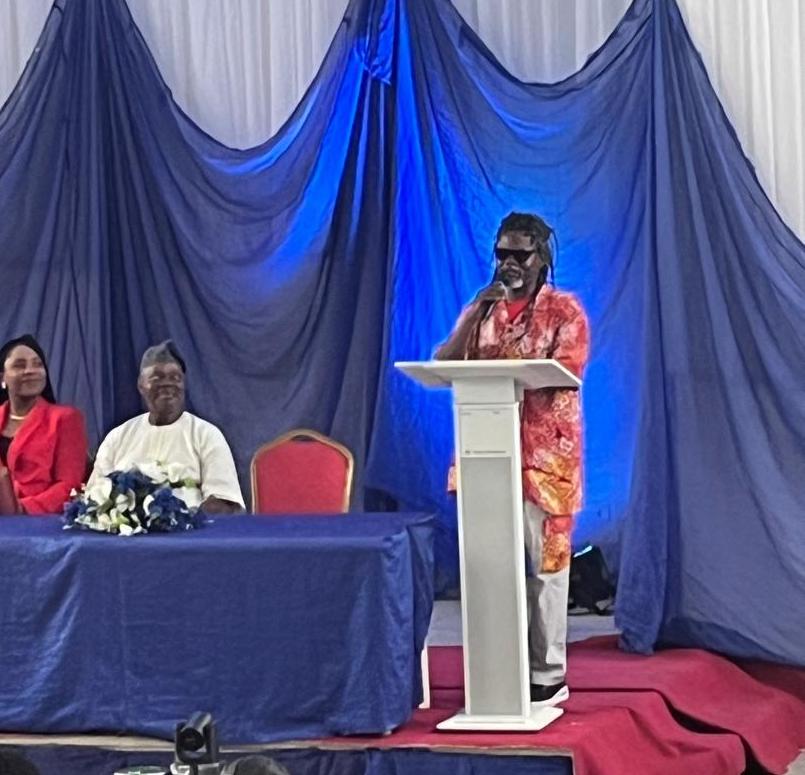
DISTINGUISHED members of the Lagos Studies Association, ladies and gentlemen, I stand before you today with all sense of humility mixed with pride and profound gratitude to this esteemed Association for this great honour.
I want to thank the LSA for the excellent work being done to center Lagos as a significant hub for robust intellectual exchange and knowledge making. It is indeed a great honor to be in conversation with you.
At the same time, I still wonder what a roving dancer or Alajota like me is doing in the midst of esteemed scholars who have gathered both here in Lagos and online, but when I remember that to be scholarly is to be curious and to choose the life of the mind seriously, I am comforted, knowing I am among fellow comrades in the field of knowledge.
My preference as you all may know would be to perform this keynote address but I believe a little talk before the work would not hurt. So, please bear with me as I try to navigate this terrain by addressing a pressing concern through this great platform you have graciously offered me.
My carefully chosen topic is: Feetless Dancers: Baton Exchange in the Roles of Art and Artists in Social Rejuvenation. A keen social observer may want to ask some pertinent questions such as:
Why are those who wish to dance “feetless,” while those who have the ability to “dance” seem to refuse to dance?
In the wise words of those who came before us, ‘Aida ko ni ko da, aimo pe aida o da ni ko da” what is bad is not what is really bad but not knowing that what is bad, is bad is what is really bad. I repeat: Aida ko ni ko da, aimo pe aida o da ni ko da” what is bad is not what is really bad but not knowing that what is bad, is bad is what is really bad.
It is my firm belief that our collective continuous reflections on and appraisal of our values would help us immensely towards charting the course we desire and perhaps deserve.
So when, in my reckoning do those who should Dance become feetles? It is when the artist refuses to rise up to his or her traditional role.
As my people would say, “Agba kii wa l’oja k’ori omo tuntun wo.” Toddlers’ heads can not be twisted while straddled on the backs of their mothers in a market brimming with elders. Yes. Where there are elders in the market, a baby strapped to its mother’s back will not have its head wrongly tilted. The elders are always present in the market to correct any anomaly, ensuring that the order of life remains intact. In the same way, every society, including our artistic community, requires the attention of ‘elders’ to ensure proper direction, continuity and vision. It is indeed a voiceless society where there are no artists.
Whether the community is based on a concrete location, such as Akoka, Bariga, or on social status such as the economically disadvantaged and violence-prone areas or indeed an activist community spread all over the world, participation and access to information are of great necessity.
Thus, I want to reflect here on the crucial role that the arts and artists play in social rejuvenation. While my focus will be on the performance arts, please consider this a testament to the fact that no art form stands alone in my culture. The literary, visual, and other artistic expressions usually converge to form a holistic reflection of our society.
For us, art, in its truest sense, is a voice that echoes across seasons—whether in times of jubilation or tribulation. By art, I speak of the syncretic, holistic art traditions of Africa, where various genres come together to create a unified whole. Take, for example, the masquerade tradition, a great influence on the artistic inclinations of the Crown Troupe. The masquerade is an art form deeply rooted in African culture and spirituality. It represents the ancestors, and its performance is not merely for entertainment; it is a multi-functional expression that serves as a guardian of the community’s well-being. The masquerade chants, dances, sings, and “acts” to ward off evil and usher in good tidings. A masquerade that serves these is held in high esteem. To borrow a line from Olu Obafemi’s Night of a Mystical Beast, ‘When our masquerade dances well, we are elated’.
Our understanding of Yorùbá culture and the masquerade tradition is why I have constantly described myself as the “lead masquerader” of Crown Troupe of Africa, but I am the first to admit that even a masquerade’s performance occurs in the presence of other people and actors. The masquerade exists in the community and for the community.
A vibrant community of talented young performers have helped to sustain our project as a prominent and avant-garde dance collective in the country. Based on the masquerade logic, our work at Crown Troupe is characterised by a Yorùbá self-awareness that curates the dreams and dances of the ancestors in radical performances and improvisations, allowing for constant aesthetic experimentation across multiple media forms and spaces.
Beyond entertainment, the masquerade holds a moral responsibility—it speaks truth to the conscience of society, including rulers. As the Yoruba saying goes, “Oba kii pa Okorin”—”A king does not behead a bard who speaks truth to power.”
To illustrate my point, may I remind us of a time before now when the watchdogs of the early African societies were the custodians of their traditions. They were the priests, the bards, the griots, the musicians and other artisans. It was on their shoulders that the responsibility for checks and balances and the continuance of order in times of ruptures etc., rested. They did not merely strive to exist; they existed for the purpose of their essence in their societies. For them, functionality was the essence of their existence.
Such arts have INTENTIONALITY at its core.
Achebe sums this up in his famous book, THERE WAS A COUNTRY, that:
“…art and community in Africa are clearly linked. African art as we understand it has not been distilled or purified or refined to the point where it has lost all traces of real life, lost the vitality of the street like art from some advanced societies and academic art tend to be. In Africa the tendency is to keep art involved with the people.”
Yet, today, these ancient voices seem to have been muffled by the heavy fabric of modernisation and over-commercialisation. The role of the artist has shifted. As tastes change, the socially engaging aspects of art are losing ground. What was once a tool for societal critique and moral guidance has now bowed to the logics of capital, reduced in some quarters to mere entertainment.
While there is no inherent wrong in entertainment, this shift leaves a gash on the rejuvenating power of the arts.
As Onuora Nzekwu aptly puts it: “Today, masquerading has lost most of the religious ideas that brought it into being. Yet, at first glance, it still appears to have the essence, vitality, and prestige of its glorious past.”
This shift is especially evident in this era of ‘globalised influences’, where progress is often measured by how much we alienate ourselves from indigenous intelligence, rather than embrace and project them.
The sacred role of art persists, but it now operates through new media—social media platforms like Twitter, Facebook, and Instagram. While this allows art to reach wider audiences and democratises performance spaces, it also poses a challenge: the once-committed artist has been overwhelmed by commercial interest due to economic vulnerability. Too often, artists are now constrained by the maxim: “He who pays the piper calls the tune.” Only a few artists remain steadfast in their social commitment. These few, however, are vulnerable, as we have seen throughout history—no one is immune to the system.
So, I pose the question: When will we see artists who are unwavering in their social commitment? When will the next Ogunde emerge?
The late Hubert Ogunde, the doyen of Nigerian theatre, was a true social commentator, using his plays to address the socio-political issues of his time. Ebun Clark’s work, Ogunde Theatre: The Rise of Contemporary Professional Theatre in Nigeria, showcases how the doyen’s plays, such as Tiger’s Empire, Mr. Devil’s Money, Human Parasites, and other,s bravely but artistically confronted the powers of the time. Despite being arrested, fined, or banned, Ogunde remained undeterred.
Similarly, when would we see another Fela Anikulapo-Kuti, whose music relentlessly confronted corruption and injustice? Fela’s songs like Original Sufferhead, Suffering and Smiling, Army Arrangement, and Teacher Don’t Teach Me Nonsense continue to resonate, decades after his passing. The question remains: did we listen to his warnings?
Since its inception and following the footpaths of these precursors, Crown Troupe has, over the years, been engaged in using performances to express and recapture a new paradigm of the masquerade and festival ethos and its commitment to social critiques.
Through a creative repertoire of several theatres and media forms, including dance, acting, music and poetry, our works emphasise the possibilities for a ‘festival’ of people of different social groups and classes, with hierarchies questioned and challenged through these art forms.
Therefore, you may say that Crown Troupe performances intervene symbolically in the Nigerian public space to unsettle, resist and revise systems of domination and rule.
The prior iterations of this approach are evident in the historical theatre of Ogunde. Ogunde’s Yorùbá Operatic travelling theatre of the 1930s performed political dramas in urban locations that not only pushed back at colonial powers but also inspired the dramaturgic sensibilities of later performers such as dramatists Kola Ogunmola and Duro Lapido in the 1950s.
What Ogunde’s theatre was to colonial Nigeria is what we have strived to make Crown Troupe become to postcolonial Nigeria, as both confront the impositions of power structures in urban contexts.
Like the scholar and LSA member Ying Cheng has argued in her research on Crown Trope, our work offers a vital regeneration of this earlier performance tradition, asking audiences across Nigeria to think about the transformative power of art that was seen in elders like Ogunde and others.
As the scholar Chukuwuma Okoye has argued, important postcolonial perspectives may be distilled from the performances of contemporary African theatre, and whether it is through adaptation of literary classics or through our annual Eko Theatre Carnival, Crown Troupe takes seriously this social commitment with very little regard for market forces.
Dan Yaskinsky once said, “The storyteller has always been to help us hear the footsteps coming, whether the consequences be joyful or tragic.”
This is why we believe we must stay alert. We need to revisit the role of the artist and mentor in our society or risk the great consequence of á diminishing intellectual heritage.
Our market cannot continue to ignore the absence of elders. For too long, Nigeria’s performance spaces have been filled with younger artists who, while talented, lack the guiding influence of veterans.
Without the mentorship of experienced elders, we remain feetless dancers—our movements uncoordinated, our progress uncertain. Our country needs art that is alive to the needs of its people, art that speaks truth to power and promotes social justice and change. Art that takes responsibility for its society.
At the risk of sounding repetitive, I call upon the elders among us and all the artists present to rise to the occasion. Let us re-examine our roles in light of our socio-political realities. Let us ask ourselves: “Se na like dis e go dey go?” (Is this how it will continue?)
Thank you.
Adefila, dancer/choreographer and theatre-maker, is founder of the Crown Troupe of Africa, and President of the Guild of Nigeria Dancers, GOND
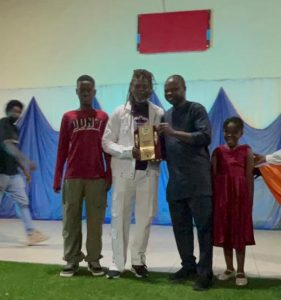
Adefila and his children with Professor Saheed Aderinto, LSA co-Founder

