
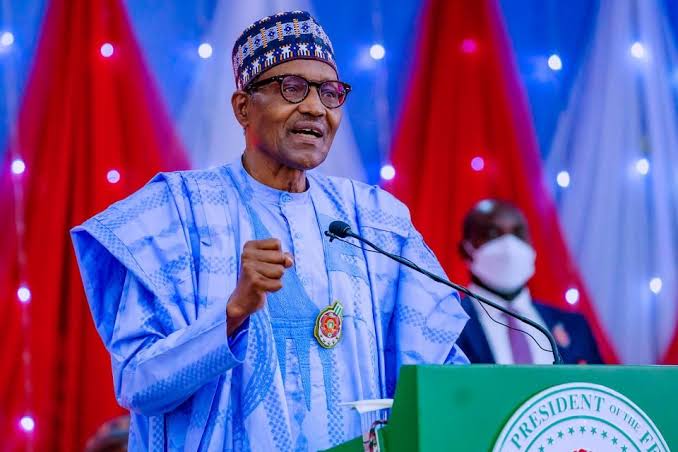

PRESIDENT Buhari has written to the House of Representatives to notify them that the deficit in the 2022 Appropriation Act has risen by N965.42 billion to N7.35 trillion.
As a result, the President stated that the federal government will borrow money to close the shortfall.
He then demanded that the Federal Government’s budget and fiscal framework for 2022 be amended.
At the plenary on Thursday, Speaker of the House Femi Gbajabiamila read the cover letter on the executive bill, headed “Submission of the Revised 2022 Fiscal Framework” and dated April 5, 2022.
According to the President, significant developments in both the world and domestic economies demanded a revision of the 2022 Fiscal Framework, which served as the foundation for the 2022 budget.
Buhari said, “These developments include spikes in the market price of crude oil, aggravated by the Russian-Ukraine war, significantly lower oil production volume due principally to production shut-ins as a result of massive theft of crude oil between the production platforms and the terminals. The decision to suspend the removal of Premium Motor Spirit (PMS) subsidy at a time when high crude oil prices have elevated the subsidy cost has significantly eroded government revenues.
“There is also the need to make adequate provisions for the recent enhancements of allowances for officers and men of the Nigeria Police Force to boost their morale as they grapple with heightened security challenges in the country.
Following these developments, it has become necessary to adjust the fiscal framework and accordingly amend the 2022 Appropriation Act to ensure its successful implementation.”
The President said the changes to the 2022 Fiscal Framework include an increase of $11 per barrel in the projected oil price benchmark, from $62 to $73 per barrel; a reduction of 283,000 barrels per day in the projected oil production volume, from 1.883 million barrels per day to 1.600 million barrels per day; and an increase of N3.557 trillion in the estimated provision for PMS subsidy for 2022, from N442.72 billion to N4 trillion.
Other changes include a N200 billion reduction in the provision for federally-funded upstream projects currently being implemented, from N352.80 billion to N152.80 billion; an N400 billion increase in the projection for Federal Government independent revenue; and a N182.45 billion increase in the provision for the Nigeria Police Force.
The letter partly read, “Based on the above adjustments, the Federation Account (main pool) revenue for the three tiers of government is projected to decline by N2.418tn, while FGN‘s share from the account (net of transfer to the Federal Capital Territory and other statutory deductions) is projected to reduce by N1.173tn.
“However, the amount available to fund the FGN Budget is projected to decline by N772.91bn due to the increase in the projection for independent revenue (Operating Surplus Remittance) by N400bn.
“Aggregate expenditure is projected to increase by N192.52bn, due to increase in personnel cost by N161.40bn and other service wide votes by N21.05bn (both for the Nigeria Police Force), additional domestic debt service provision of N76.13bn, and net reductions in statutory transfers by N66.07bn.”
NDDC by N13.46 billion, from N102.78 billion to N89.32 billion; NEDC by N6.30 billion, from N48.08 billion to N41.78 billion; UBEC by N23.16 billion, from N112.29 billion to N89.13 billion; Basic Health Care Fund by N11.58 billion, from N56.14 billion to N44.56 billion; and NASENI by N11.58 billion, from N56.14 billion to N44.56 billion.
He said, “Total budget deficit is projected to increase by N965.42bn to N7.35tn, representing 3.99 per cent of the GDP. The incremental deficit will be financed by new borrowings from the domestic market.
“Given the urgency of the request for revision of the 2022 Fiscal Framework and the 2022 budget amendments, I seek the cooperation of the National Assembly for expeditious legislative action on this request.”
Meanwhile, the House Committee on Customs released its report on the Nigeria Customs Service’s budget for 2022.
On Thursday, the committee’s chairman, Leke Abejide, presented the findings to the plenary.
For the year ending December 31, 2022, the committee suggested a total of N369,136,090,650 from the Nigeria Customs Service’s Statutory Revenue Fund, of which N108,853,901,275.62 is for personnel costs, N45,896,807,993.81 is for overhead costs, and N214,294,269,945.73 is for capital projects.

