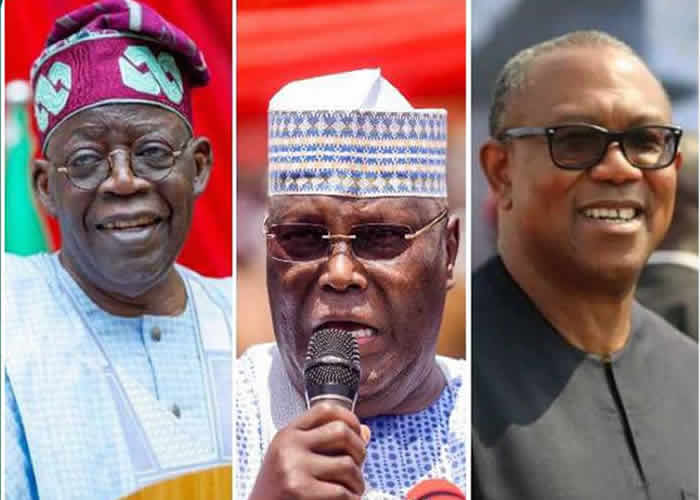

‘The task before Nigeria’s electorate now is to deliver an electoral verdict that re-establishes the dream of the genuine nationalist imperative of representative governance, which the founding fathers of the nation visualized when they declared that unity in diversity should rule supreme’
THE outcome of the recent cycle of conventions engaged in by Nigerian political parties has been to provide the electorate in Africa’s most populous nation with a slate of controversial leadership choices.
Although the nation is now over sixty years old as an independent ex-British colony recent events indicate that it is still at a very uncertain stage of true nationhood.
Insurgent groups of various stripes and origins have proliferated in the last two decades and kidnapping of random victims for ransom as well as violent attacks on rural communities especially in parts of the North have become endemic.
In addition, allegations of the looting of the public coffers by corrupt officials have reached an unprecedented level with arecently dismissed Accountant General for example being accused of spiriting away the sum of 80 billion naira, which is about thirteen and a half million dollars.While the exposure of this level of irregularity might suggest that the incumbent government headed by a former Army general Muhammadu Buhari who is famed for his anti-corruption stance is attempting to establish and implement a program of accountability the truth is that economic opportunism has become the central aspect of the conduct of public affairs in the nation.When the ruling party the All Progressives Congress (APC) announced that anyone who wished to contest for its presidential ticket should pay one hundred million naira to its account without having to explain how they earned it, it was immediately clear that unexplained wealth would not disqualify anyone who wishes to seek power. Several political appointees whose annual salaries were less than the levy required announced their intention to stand in the primaries as soon as the process was ratified.
This threw the race open to a plethora of ambitious political opportunists. The amount required by other parties was far less than that announced by the APC but the former ruling party the Peoples Democratic Party (PDP) that had been defeated in the 2015 elections also announced a substantial levy of forty million naira for the chance to pick its own ticket. As a consequence, the personal wealth of the aspirants in both parties became an essential factor in establishing the criteria of qualification for leadership. Serious issues such as regional origin and zonal relevance were given short shrift in the run-up to the selection process and this led to the emergence of the former Vice President of the country Alhaji Atiku Abubakar even though he is a Northerner and would not have been expected to succeed his fellow Northerner General Buhari under the traditional concept of the regional rotation of power.
The major consequence of Atiku’s emergence in the PDP was the resignation from the party of the former Governor of the South-Eastern state of Anambra Mr, Peter Obi, a major Ibo leader. In the APC an interesting contest developed in which Alhaji Bola Ahmed Tinubu the former Governor of Nigeria’s most densely populated state Lagos State staked a claim on leadership on the basis that he had played an important role in delivering victory for Buhari in 2015,and expected to be compensated for his support with endorsement this time around. Interestingly the only two contestants who managed to mount a credible challenge in the APC were transport Minister Chibuike Rotimi Amaechi and Vice President Yemi Osinbajo. In spite of the credibility of their challenge Tinubu was a convincing victor.
However, a closer look at the result of the party conventions reveals interesting elements of public perception of the aspirants’ qualities that raises issues about Nigerian political values and formulae at this time. Peter Obi’s decision to leave the PDP virtually in protest over the near coronation of former Vice President Atiku Abubakar is a case in point.
Among issues raised by his disenchantment, the allegation that the choice of an Ibo aspirant from the South-Eastern geo-political zone is overdue reverberates with the younger generation. It is over fifty years since the civil war that pitted Nigeria against the breakaway Ibos of the secessionist state of Biafra.
The core of what was supposed to be Biafra is now the five Ibo states of the south-east and since the war no Ibo aspirant has been successfully elected as Head of the national Government. After thewithdrawal of the colonial power the installation of truly representative national government was truncated by the intervention of the colonial Trojan horse the military after just over five years of independence. The breakdown of regional trust provoked by the first coup that was led by an Ibo Major led to a brutal civil war out of which Nigeria set itself the task of building a more equitable nation but failed even though it did manage to maintain its regional unity.
Internal professional jealousy and half-digested political strains and stresses were the major elements that drove the existence of more than thirty years of military rule as the nation struggled to find its feet.
This unfortunate circumstance set the parameters for the eventual installation of Nigeria’s present democratic dispensation. As a result, the present electorate, which is largely made up of people younger than fifty years of age regards the system as being dangerously flawed. Most of Nigeria’s voters especially in urban communities around the nation consider the electoral privilege an opportunity to express public will and install change that will establish public control of the principles of governance for the creation of a more harmonious life experience.
As a consequence of the sea change in public perceptions of governance in Nigeria the popular response to the outcome of the selection process has been reflected in very revelatory ways in the very active arena of social media in Nigeria. Before the party conventions held there were a number of speculative reports that touted the return of the former President Dr. Goodluck Jonathan who had the dubious honour of being the first incumbent to have been voted out of office. This surprising development revealed that Jonathan not only still had a viable following among the populace but also that many Nigerians in the North and parts of the South-East, both areas outside of his home constituency the oil-rich South-South zone, regarded his defeat as having been the product of fraudulent electoral practices. Jonathan however maintained a studied silence and showed no inclination to participate in the contest. Interestingly those who touted his re-entry into the race suggested that he would find viable repose if he joined the ruling party and solicited the support of General Buhari but he did not succumb to the blandishments of such promoters. Instead Jonathan has gradually occupied a niche as one of West Africa’s most highly respected elder statesmen whose advice is sought on tough issues throughout Africa.
However, this interlude of speculative concern served to draw the attention of a wide audience of curious and interested observers so that by the time the actualaspirantsemergedpublic interest had attained unprecedented heights.
This was especially so when the ruling party mounted its own operation after the PDP. The major challenge to Atiku’s seemingly easy race in the PDP was from Rivers State Governor Nyesom Wike arelative newcomer to National politics, Ironically, most observers have assumed that the contest was just a test of personal resources, and many people claim that in both the APC and the PDP it was the clandestine distribution of bundles of both local and foreign currency that carried the day. Since the closure of the contest and the emergence of the three gladiators Nigeria’s social media has exploded with opinions and more speculations concerning the viability or resilience of the candidates. However, the truth is that unlike Peter Obi whose demeanour and record has shown him to be an extremely modest and humble competitor especially when compared to his two main adversaries, the APC’s Tinubu and the PDP’s Atiku, these two contestants enter the contest with serious baggage weighing against them.
Tinubu is often accused of serial looting of the property of Lagos State when he was governor, while Atiku’s untrustworthy nature and supposed dishonesty has been publicised by his former boss President Olusegun Obasanjo. Listening to the acceptance speeches of both Tinubu and Atiku one was immediately struck by the similarity of their attitudetowards political office as both spoke with a clear sense of the presumption of entitlement as if they had been prepared to hold office for a long time and had just been waiting to be enshrined. After accepting the ticket of the Labour Party Peter Obi on the other hand presented himself as a servant leader whose objective is to listen to the complaints of the public and to attempt to solve the problems that the people articulate. However, while the APC and the PDP appear to have an advantage based on structural and economic assets that are far superior to that of the little known Labour Party the response of public opinion since the emergence of the contestants has been very interesting.
Attention has largely been given to the political machinations of the more conventional establishment figures in choosing their running mates, while Peter Obi’s viewpoint has attracted consideration from a substantial movement of younger and more nationalistic voters calling themselves the Obidient Generation. The social media posts in response to the emergence of the main presidential contestants have revealed that the democratic process in Nigeria couldbecomeanimportant vehicle for the installation of transformative government. The decision of Tinubu, a Yoruba Muslim from the South to stand with a fellow Muslim, from the North, as his running mate is one of the most controversial issues arising from the process.
The Muslim Atiku’s selection of the Christian governor of the Southern Delta State as his own running mate appears to be much more acceptable to the generality of the electorate. Peter Obi’s search for a vice has caught the imagination of the populace although his apparent inability to attract a popular collaborator worries some of his supporters. The outcome of the selection process is regarded as the symptom of how the leaders evaluate extant contemporary experiences of national life. Tinubu’s argument that religious affiliation should be ignored in the choice of representation is unrealistic under the circumstances that exist in modern day Nigeria.
If the assets available to the incumbent government are deployed to help Tinubu prevail in the race that strategy is likely to aggravate and provoke public disenchantment. For the average citizen of Nigeria this could lead to a proliferation of the climate of insecurity which has sadly been the consequence of the attempt to install true democratic governance over the last two decades. The task before Nigeria’s electorate now is to deliver an electoral verdict that re-establishes the dream of the genuine nationalist imperative of representative governance, which the founding fathers of thenation visualized when they declared that unity in diversity should rule supreme.