
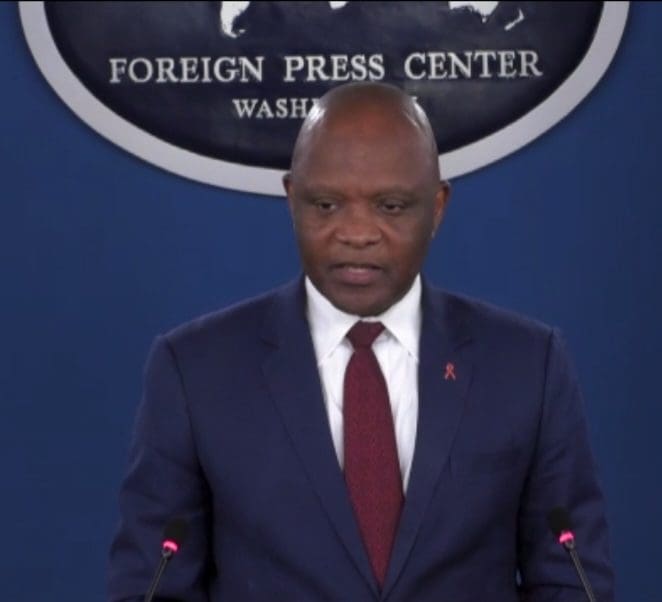

AMBASSADOR Dr. John Nkengasong is the U.S. Global AIDS Coordinator and Special Representative for Health Diplomacy. Ambassador Nkengasong, at a briefing with members of the Foreign Press Center, speaks on the new five-year strategy of U.S. President’s Emergency Plan for AIDS Relief, which was released December 1 because the fight against HIV/AIDS is far from over. Excerpts:
The latest results from PEPFAR
The U.S. President’s Emergency Plan for AIDS Relief is a program that has been going on for close to 20 years in the fight against HIV/AIDS. So let me start with the latest numbers on PEPFAR. I think, first of all, I would like to take a moment and say that today is World AIDS Day, which – it has a lot of significance because HIV/AIDS – we’ve come a long way in the fight against HIV/AIDS. For those who have followed the journey of the response or fight against HIV/AIDS over the last 20 years will agree that we’ve changed the trajectory of HIV/AIDS – thanks to the support of the U.S. Government through PEPFAR and the Global Fund and other donors, but very importantly of partner countries that we work in.
Those who have followed the field of HIV/AIDS will also recognize that HIV/AIDS was an ugly disease 20 years ago. It was a serious threat to the region, to countries that were most affected. It was a serious economic threat, and it was a serious security threat for the continent, for those countries that we supported. Today the situation has changed significantly, and we must pause today to reflect on those gains but also remember that the fight is still on. The fight against this pandemic is still on, and we have a long way to go to achieving our target by the year 2030*, which is a target we’ve agreed to bring HIV/AIDS to an end as a global – as a threat, a public health threat, all over the world.
But let’s celebrate the results. Today PEPFAR is announcing that, thanks to our programming, 25 million lives have been saved – 25 million lives have been saved; 5.5 million babies have been born free of HIV/AIDS thanks to PEPFAR investments. About 2.9 million adolescent girls, young women, have been reached through comprehensive programming called DREAMS. DREAMS is a program that targets young adolescent girls and young women and enable them, capacitate them so that they can actually be – conduct independent activities and prevent them from being vulnerable to HIV.
You also see in the report we’ve just published that 20.1 million women, men, children receive lifesaving antiretroviral treatment last year alone. That is compared to 19 million in 2021. That 2.8 million individuals on antiretroviral treatment completed their TB treatment, so it’s not just HIV; we’re treating those associated infections. Thirty million voluntary male medical circumcisions have occurred, and we know that that is a very powerful intervention to reduce the transmission of HIV/AIDS; 1.5 million clients were – received PrEP, which is pre-exposure prophylaxis to HIV – to prevent HIV. And very importantly, that about 340 million health care workers have been trained thanks to PEPFAR programming there.
PEPFAR
A program like PEPFAR is an expression of the best of humanity, when we apply our minds at best, and is the best of what in public health and global health I’ve seen in my 32 years’ practice, where a single country, the United States, applied its generosity to fighting a disease, a single disease. In the history of infectious diseases, I don’t recall any of that. That is important, because without such political leadership, such commitment, we would never have been able to change the face of HIV/AIDS in the world.
It was scary 20 years ago; it was pitiful. Twenty years ago, I was a young man in Ivory Coast, working at the U.S. CDC at the infectious disease clinic. And I saw across my window every day how people would drop their loved ones because they were HIV-infected, and they would just die. We saw that across the continent of Africa, and today those beds are no longer occupied by people infected with HIV/AIDS, but infected with other things, or affected with other things. So, we must pause to celebrate.
But where do we go from here? It is clear that the fight against HIV/AIDS is far from over. You probably heard the UN – the Joint United Nations Programme on AIDS, commonly called UNAIDS, published a report that stated clearly that the response is in danger. COVID has affected the response to an extent, because we don’t see the danger that we did obviously 20 years, 25 years ago. That political visibility and leadership that was there 20 years ago in countries that are affected is not there. We need to revive that, bring that back. So okay, bring that – those commitment back, so that they see that the fight against HIV/AIDS is not over. It’s still a pandemic out there.
Where do we go from here? We’ve now released today a strategy, what we call a five years PEPFAR strategy that will guide the way we respond to this pandemic in the next five years. The strategy is summarized in five pillars and three enablers. The five pillars include knowing the gaps and closing the gaps of inequities in three priority populations – the children, adolescent girls and young women, and key populations.
The rationale there is simple. In Sub-Saharan Africa, about 60 percent of the infections are in adolescent girls and young women. The progress we are seeing in adults in terms of reaching the 90-90-90, which is identifying 90 percent of people that are infected, that they know their status, put them – put 90 percent on treatment, and then ensure that 90 percent of them reach viral load suppression, is lagging behind tremendously in children. So that is great inequity there.
The new target
We’ve now moved that target to – because that was a 2020 target. We’ve now moved that target to 95-95-95, which is 95 percent of the people that are infected know that they’re infected; 95 of those – percent of those are put on treatment; and 95 percent of those suppress their level of virus. That is the new target. That is what we should be aiming at and pushing our countries and pushing our partnerships to get there. So that is pillar number one, which is the priority populations.
Pillar number two is sustaining the response. I just indicated that we cannot leave our eyes off the ball. We’ve made tremendous gains. We are projecting and imagining that by 2030, we could possibly bring this pandemic to an end, which is making it less a public health threat. Let’s stay focused on it in three dimensions – elevate the political leadership; elevate programmatic sustainability; and continue to make sure that there’s not only donors financing but domestic financing.
The third pillar is health systems. That you see in this report that we just published is that services do not deliver themselves. Services that deliver through functional and efficient health systems. And health systems by themselves do not function; they rely on strong institutions. So there’s a strong relationship between strong institutions, strong health systems, and delivery. We want to elevate that and project that in order to protect the gains that we’ve made in the last 20 years, but very importantly to position these assets such that when you have an Ebola outbreak, a COVID outbreak, monkeypox outbreak, these assets can be used very quickly and leveraged on to respond quickly, so that we clean that outbreak out, that what I call disruptive outbreak, and then focus on the business of HIV/AIDS, which is a silent pandemic.
Then we have partnerships. Partnerships are key. And the partnerships should be a very comprehensive, holistic way of looking at partnerships, not partnerships only in the United States but partnerships on the continent of Africa, partnerships in Southeast Asia where we operate, partnerships in the Americas where we operate, and look at the development banks, look at foundations, look at the private sector in that area and build the partnerships that will allow us to get to that 95/95/95.
And lastly, the science. It’s remarkable. I have spent more than 25 years in the fight against HIV/AIDS and I have seen the remarkable work that science has done. In 1996 when highly active antiretroviral therapies were made available, it was a cocktail. So, a patient would wake up in the morning and take a cocktail of drugs. Today, because of science, we are able to administer a pill or so to a patient a day. So, it’s become almost like treating a normal chronic disease, i.e., hypertension, diabetes, or other (inaudible). So, it’s possible that we continue to believe in the power of science that who knows, in the next coming years science can enable us to develop drugs that where an HIV patient can take maybe every two months and every three months. We already have a pipeline of PrEP, that is pre-exposure prophylactics that people can take for two months or for three months. I think that is it.
So these are three pillars of the new strategy. The five pillars of the new strategy. The three enablers are community leadership. It starts in the community, it ends in the community. So, let’s empower the communities that they take ownership of this response.
The need for innovation
Second is innovation. We have to innovate and innovate. We saw great innovation during the COVID response where we said ah, it is difficult for a patient during the COVID crisis to go out and get their treatment, so let’s make sure that when they come in we give them a three-month quantity of drugs, what we call multi-month dispensation. And that was innovation. That is the kind of innovation that would push us to the next level.
And lastly, leading with data. Data, accurate data, is the oxygen of any good programming. If we know the data, we know where the pandemic is, we know where the burden of the disease is, and we can allocate resources more adequately and use them efficiently.
UNAIDS Report
The UNAIDS report is up, and that is why if we look at our strategy it aligns very well with that of UNAIDS. This first pillar is addressing the inequities, which is know your gaps and address those gaps. Where are the gaps? Children. As we strive to achieve 95/95/95, again just to repeat what it is, to make sure that 95 percent of people who are HIV infected know their status, put 95 percent of those in treatment, and make sure that you maintain them on treatment to the extent that 95 percent of them have viral load suppressed. It’s so important. When it’s suppressed viral load, transmission is less; the person is – the individual is healthy. And that is why is so important that side.
But there’s a lot of inequities in that in three different areas. I think one I’ve mentioned: Children. Children, inasmuch as the adults are making progress towards that 95/95/95, children are far behind that. I think the average is probably around 40/40/40, so there is a huge inequity gap.
Then you look at the burden of the disease. In Sub-Saharan Africa, it is mainly adolescent girls and young women that bear about 60 percent of the burden of HIV. That is a big inequity gap there. What are we doing and why is that so? So – and where is the infection so that we can get to our first 95, second 95, and last 95. Key population – the LGBTQI population is a conversation that we have been having, and we have to make sure that issues of discrimination, issues that deal with criminalization, issues that deal with segregation are eliminated. Wrong poor policies in global health leads to poor outcomes. The enemy is the virus, not the individual.
So, we have to have our focus right. So we have to make sure that those – the poor policies that are driving these – the discrimination, stigmatization, and criminalisation should be dismantled, and that is a collective appeal to everybody. Otherwise, we will not bring HIV/AIDS to an end. I think that is true for the epidemic that is outside of the continent of Africa since you mentioned Africa, but it’s also true in Africa. There’s a lot of key populations – men who have sex with men in Africa, LGBTQI populations that are driven underground – and because of discriminatory laws and poor policies, we don’t reach that population. We will not eliminate HIV/AIDS if it’s not eliminated everywhere.
What do we need to fight HIV/AIDS in Africa? Of course, you need the Global Fund to continue to invest. You need PEPFAR to continue to invest. It is my hope and belief that PEPFAR will be reauthorized next year for the next five years, but it is also an appeal to the political leadership of the continent to apply domestic resources as well because Global Fund, PEPFAR alone or donor resources will not be enough to sustain the fight.
About 21 years ago in Abuja, the head of states of the continent of Africa came together under the leadership of President Obasanjo and the late Kofi Annan who was the UN secretary general, and issued the Abuja Declaration, which they commit themselves to fighting HIV/AIDS and also committed that they were agreeing to allocate 15 percent of their national budgets to fighting – for health, including HIV/AIDS. I think a lot of progress has occurred since then – tremendous progress. It is time for us to rally back, circle back with those leaders and say, look, let’s evaluate the progress made so far, see the challenges – especially with the emergence of COVID-19, the disruption that COVID-19 has created – and reset the button and see where we are with the HIV response and how much we need to finish the fight against HIV.
And let me just end with a note of optimism. As I said earlier, I would never have imagined that in my lifetime we will sit here and be projecting that by the year 2030 we could, could possibly, bring HIV/AIDS to an end as a public health threat. We are not yet there. The last mile in the fight against any infectious disease is the most challenging, but the prospects that we can bring HIV/AIDS to an end is something that we should think of and continue to recommit ourselves to that, to that struggle.
HIV/AIDS is not a death sentence
HIV/AIDS, again, is not a death sentence in the developed countries. It is also not a death sentence in the developing countries. Remarkable progress that science has, I mean, but we’ve come a long way. It used to be a death sentence in both the developed countries and developing countries. But as you heard me assert in 1996, science enabled us to come out with the highly active antiretroviral treatment, which is the drugs for HIV. And it took about ten years for those drugs to be fully available in countries that – in developing – in some developing countries. That’s also an inequity gap or inequality gap. But today as we speak, drugs are available in all countries in a simplified format. Either you can get those treatments through the national government, or through Global Fund, or through PEPFAR.
What is the problem now? The death sentence now is the discrimination, is the stigmatization, is the criminalization of key population, is the inequality that exists in strengthening health system that can deliver those drugs through the last mile. That is the death sentence now. It’s no longer the availability of drugs but rather the access to (inaudible). So let me just say that weak health systems create an opportunity for inequity. Poor policies, especially those that discriminate key populations, enable inequities. I think those are the barriers to access, and if there are barriers to access, those are the factors that become the death sentence, not the lack of drugs themselves.
Traditional medicine
Traditional medicine is not part of our five-year strategic plan which we are launching, but I recognize the importance of traditional medicine, the role it plays in overall health care services or health care delivery in Africa. I think that it has been for many years. And during my time at the Africa CDC, if you recall, with WHO we had a working – we stood up a working group to look into the role of traditional medicine. I hope that group continues to provide guidance.

