

NIGERIA is not just West Africa and Africa’s most populous nation, it is home to the continent’s richest man, Aliko Dangote. It is also home to some of the continent’s best novelists.
In light of the election that produced Senator Bola Ahmed Tinubu of the ruling party, the All Progressives Congress, APC, as President-elect, the need to address the country’s many challenges are on the front burner. Quite a number of these challenges have been treated in novels.
Here are six novels that have interrogated this culturally-diverse nation.
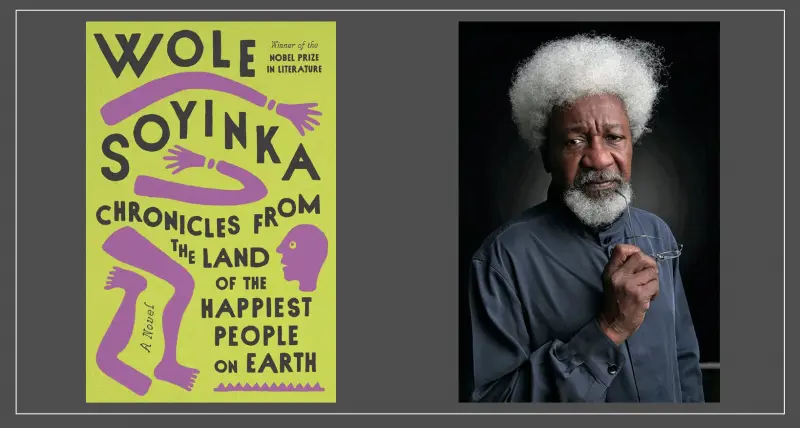
1. Wole Soyinka’s ‘Chronicles of the Happiest People on Earth’
THE novel is about the Gang of Four. One of them is Menka, a celebrated surgeon who as a Corps member, was made to cut the wrist of a thief for violating Sharia. At a point, he was approached by merchants of human parts with a partnership. He was distraught to find out his staff (nurses, cleaners and others) had been selling menstrual pads, pre-operation shaved pubic hair, clipped toe-nails, washed down blood from the emergency room and other intimate stuff from patients to these merchants who assumed he was in on the business. He resigned after this encounter and decided to leave Jos.
As the reader progresses into the core of this luminous, complex narrative, certain things are bound to become clear: This is largely a tale of four friends thrown into the murky waters of life and embedded within their experiences and the people trying to wreck them are codes or cryptic messages that anyone familiar with Nigeria can decode.
‘Chronicles of the Happiest People on Earth’ unfolds a narrative of modern Nigeria – encompassing the hand-sanitiser-cum-nose-mask era as well as a few of its early years – through the successes and failures of the Gang of Four: Menka, Badetona, Duyole and Farodion.
Duyole is a brilliant engineer whose work in public service is above the board. He soon gets a big job at the UN, which the Prime Minister is not happy about.
Faro is perhaps the biggest dreamer of the Gang of Four. Long before Nollywood, he dreamt of launching a film industry. The man, who is described as tending to speak in riddles, dropped out of sight and had the rest of the clan wondering what became of the smooth talker whose popularity with the ladies was legendary.
Badetona, the finance guru, is a moderate drinker. His gripping ordeal in the hands of the security agents is howl-inspiring. A series of events, including a bloody one on Ikorodu Road, forces him to visit the Ekumenika, the enclave where Papa Davida, who also answers to Teribogo, is the lord and saviour; he is a con-man on the pulpit with links to the seat of power. He is close to Prime Minister Godfrey Danfere, another character who makes the plot tick.
The Number 2 man is petty and cherishes his ego being massaged. He is a good example of men who should be far away from power because of the evil they use it for. His shenanigans over Duyole’s UN job are cringe-worthy.
The author’s handling of the drama is bound to keep the heart racing, due largely to both the skilful writing and the eagerness to find out if that is the end of Duyole or whether he will survive or die like Dele Giwa, one of the trio the book is dedicated to.
Aside from being (in one breath) the story of the Gang of Four, Soyinka has rendered in harrowing details the story of Nigerians and how they have come to be known as the happiest people on earth despite decades of failed leadership, nepotism, corruption, favouritism and what not.
Soyinka delivers a fascinating, rousing novel, which evokes history from people’s memories in a way no textbook can. Glaringly, Soyinka’s achievement with this harmonic presentation with several voices, is truly, truly remarkable. He is a storyteller in a class of his own.
2. Eghosa Imasuen’s ‘Fine Boys’
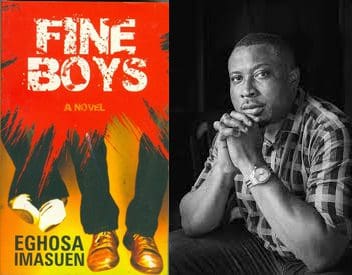
THE fine boys in Imasuen’s second novel love blood and violence and they feel insecure without the badge of the confraternity. Confra, as they like to abbreviate their affiliation, is life. The truth is: these are not fine boys, but bad boys.
Killings. Violence. Fighting over girls. Gang battles. These are not the kinds of stuff you identify with as being fine. Being fine connotes beauty, glowing and generally radiating and being the cynosure of all eyes for positive reasons. So, it is ironic that fine boys will be caught shedding blood, fighting over girls and doing gang battles.
The novel is about the children of the Nigeria of that benighted era when the International Monetary Fund (IMF) dictated our economy’s pace to our detriment. It was an era when the middle class thinned out because of the Structural Adjustment Programme (SAP), it was the era when notorious gangs took over universities all over Nigeria in the 1990s, it was the era our universities collapsed, and students studied under very harsh conditions.
Built around real political, social and academic events, the novel is a coming-of-age tale narrated by Ewaen, a teenager, growing up in Warri, Delta State. He has younger twin siblings, a girl (Eniye) and a boy (Osaze).
Ewaen’s parents are no longer happy together and the disharmony at home makes him look forward to getting away.
Ewaen says of her parent’s marriage: “Daddy and Mommy had their major quarrels every two years. It was like clockwork. Every even year I could remember, ’82, ’84, ’86, ’88, ’90, all had a month or two when we packed up and left with Mom to our granny’s, Nene. Most times this displacement was preceded by a night of terror from which Mom emerged with a black eye here or a bruise there. But she always came back.”
Their incessant quarrelling is a major reason for his excitement at being admitted into the University of Benin. But life in the university proves to be another kettle of fish. He makes new friends and together they relish their newfound freedom. Soon the violence at home pales in comparison to the cult wars on campus.
The early days are good and they enjoy hanging out in parking lots and sharing jokes in English language and Pidgin English. The Austerity Measures of the government of the day see lecturers embarking on strikes and the strikes usher in mayhem from violent confraternities. Student leaders are bribed by politicians, lecturers force students to buy hand-outs and hell is a step away. The fear of the confras becomes the beginning of wisdom and Ewaen and his new friends have no choice but to adapt so as not to fall prey to the marauding cultists.
The fight between Back Axe and Cosa Nostra result in the mauling of Wilhelm, Ewaen’s childhood pal with whom he had vowed never to join the “confras”. The death of “one-half of my crew of best friends” chases Ewaen and his brother Osaze away from the University of Benin and beyond.
Using the journeys of the characters, Imasuen relives the pro-democracy riots of the military era, the June 12 crisis and the evil of the General Sani Abacha years, and he does it so well that even those who did not witness these events can get a grasp of them. He also captures the frequent riots organised by student leaders over “attacks on our democracy, to the annulment of June 12, the stepping down of the gap-toothed general we called Maradona, the inauguration of the interim national government and its overthrow by General Abacha.”
The use of real events gives the narration blood to survive on. For instance, we see MKO Abiola in jail: “While MKO was in jail, while the Italians were shaming Nigeria out of the World Cup, while the universities burned, while students sat idle at home, a paradigm was shifting in the delta… Just over a year ago, the arrest of Ken Saro Wiwa on allegations of incitement to murder had made him a cause célèbre for the aspirations of the people of the delta.”
In another instance, we see Saro-Wiwa being killed: “November was a very memorable month. It was also the month Saro Wiwa was executed, hanged and finally pronounced dead after five attempts. He and his men were then bathed in sulphuric acid to make identifying them remain impossible for their families. If that was not enough, the men were buried in secret unmarked graves to prevent the site from becoming a shrine. The international community was in an uproar.”
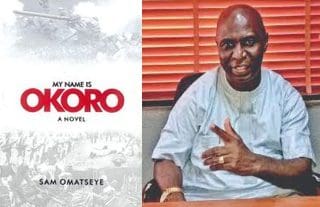
3. Sam Omatseye’s ‘My Name is Okoro’
This novel is the story of the Nigerian civil war. There are many civil war fictions, including Chimamanda Adichie’s ‘Half of a Yellow Sun’, which has been made into a movie of the same title. But, there is something different about Omatseye’s civil war novel. Yes, like the others, it is violence-filled. What is different is what appears like a protest in the book. It is from a minority’s point of view. Instances abound in its efforts to properly situate the feelings of the minorities of the South.
At a point in the story, Okoro asks: “Why do the newspapers keep writing about Igbo pogrom when they killed everyone who was southerner except the Yorubas?”
In chapter five, a woman from the South has come to the North in search of her son. She is married to an Ukwani man and narrowly escapes being wasted because she has Yoruba tribal marks.
“Ukwanis are not Igbos,” she says.” The animals are killing everyone… Ukwanis can understand the Igbo language but they can distinguish who is speaking Ukwani and who is speaking Igbo. The Igbos know who is speaking Ukwani as distinct from who is speaking Igbo.”
Then wait for this from Okoro: “But is it not worse when the language is not even close but seems to sound the same but is not Yoruba or Hausa? For instance, the Anang and Ibibio.”
Chief Subomi, who hides Okoro in his Kaduna house after he escaped Lieutenant Abdullahi’s bullets, adds: “They were not spared. They were lumped together with the Igbos in the slaughter.”
Then the ironic situation of these minorities is worsened at the point when Okoro returns home and Okungbowa is briefing him about the imminence of war.
“His father, you know, lived in Aba and there is this thing going on there called ‘leave town’. It began with criminals and never-do-wells out of the city. Now, they are asking those who are not Igbo enough to leave. It included those across Niger. So, he heard that his father and his other relations from Asaba had been forced to leave town.”
To Okungbowa’s statement, Okoro raises a poser: “What did they mean by not Igbo enough? In the north, everyone, including people like me were haunted and killed for being Igbo.”
There is also the Barclays Bank lady who loses her Isoko uncle in the ‘Igbo pogrom’ in Kaduna who wonders why no one was talking about that.
My Name is Okoro shocks and excites all at once. The elegance of the language adds to its appeal. It is filled with beautiful expressions such as: “The warrior about his loins would have found rest in Nneka”; “He shot when she was not looking”; “It took about seven months into their sojourn in Umunze before Okoro unlocked his dam”; “He let himself loose in the curves and dips of Clara’s body”.
Beneath the protest in the book lies the story of passion, love and lust in a time of war. It shines a light on what it means to be human in wartime Igboland rived by man’s inhumanity to man. Okoro finds Clara and with time, the warriors in his loins exhibit his prowess. Again and again, even when they try to stop, failure stars them in the face. The brute called Lieutenant Abdullahi also falls in love with Nneka and for love, he surrenders almost all.
The novel emphasises the futility of war. Okoro’s wife says: “That (time wasting) is the meaning of this war. People died, families were destroyed and cities were on their knees. We have returned to where we started without all the things we started with.”
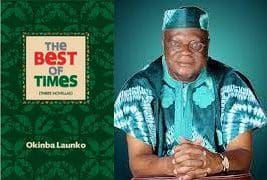
4. Okinba Launko’s ‘The Best of Times’
‘THE Best of Times’ is a collection of three novellas: Kolera Kolej, Ma’ami and Cordelia.
Kolera Kolej is satirical. It is set in a country where cholera breaks out at the university leading to deaths. The leader of this country, which has the same mannerisms as Nigerian leaders, abdicates his responsibility by granting guided autonomy to the university. Intrigues ensue in picking the pioneer leader for the new republic and all kinds of factors, except merit, come into play. Blackmail is not in short supply in the new republic. In the end, not much is achieved because favouritism, egotism, and many anti-development sentiments dictate the pace.
This novella is funny. The ridiculousness of the decisions taken by the leaders of the college and the country displays the lack of foresight and patriotism that many Nigerian leaders is famous for.
The second novella, Ma’ami, which inspired a film of the same title by veteran filmmaker Tunde Kelani, is about the extent a mother can go to get her child his needs. It is also about poverty and how some see occultism as a way out. Reading the novella makes me feel like seeing Kelani’s cinematic representation all over again. The points of divergence also easily hit me, in the sense that I can easily identify the additions to the film version.
This novella, narrated in the first person by the son, is not just about the mother’s love, it vividly paints the extent people can go to make money. Imagine a father sacrificing his son for a money-making ritual! It also tells the corruption of government officials who allow extraneous factors in deciding who has a space in the market and who does not. This novella also shows the importance of a father figure in a child’s life. Despite all Ma’ami does for her ‘Termogene’ of a son, all it takes to test his loyalty is the sight of his father and the evidence of his filthy lucre.
It is filled with drama and the author resolves the conflicts brilliantly. Telling the tale in the present tense gives it immediacy and I just love it. The end of this story will have you asking yourself questions. You may even re-read to get a second opinion.
In the third, Cordelia, romance meets politics, politics of the men in military fatigue with all its attendant dangers. This novella starts with a lecturer in a disturbed state about his marriage. His once-sweet wife has become the devil’s envoy. In the opening pages of the story, we see clear evidence of the lecturer’s state of mind, including his inability to teach his students. One of them later confronts him in his office about his shoddy lecture. Like a typical man, he sees no reason to discuss such a matter, especially with his student. The student in question is accompanied to the lecturer’s office by another student named Cordelia. Unknown to the lecturer, Cordelia is about to be at the centre of a major riot in the institution following a radio announcement.
With fellow students about to lynch her, Cordelia’s friend begs the lecturer to save her by hiding her in his office. While Cordelia’s friend is still trying to convince the lecturer to help save her from the mob; his wife comes into the office and accuses him of having an affair with his student. With no explanation acceptable to her, he eventually locks her up in the office to go and save the girl in danger. He returns to find out that his aggrieved wife has turned his office upside down. She even tore his research papers which sets him back many years.
‘Ma’ami’ and ‘Cordelia’ are suspense-filled with each chapter ending with a cliffhanger and thus luring the reader to the next page and, in the process, getting him or her hooked like a hard drug user. This is certainly not easy to pull off but the author achieves this with magisterial competence which made the novellas must-read back in the 80s when they were serialised in The Guardian on Sunday.
Okinba Launko (Professor Femi Osofisan’s pen name) delivers a set of entertaining and educative novellas, which are bound to stay with a reader long after closing the last page.
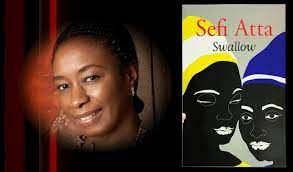
5. Sefi Atta’s ‘Swallow’
ON the 65th page of ‘Swallow’, a novel that brings alive military era Lagos, a boy is believed to have fallen into a septic tank. He was last seen jumping on its weak surface. His mother, a nurse in a government-owned but inadequately-funded hospital, is distraught. Neighbours are in shock and chaos takes centre stage. The mother rips her white uniform through the collar. She slaps a woman who tries to cover her up. Her bra and girdle are out for all eyes to see. She is soon screaming ‘Jesus of Nazareth. Lord, have mercy on me. Please have mercy…’ Does God answer her prayer? You have to read the book to find out.
Some 10 pages later, a drunk Rose and his ex, Johnny Walker, are at each other’s jugular— with Rose eventually pulling a knife and threatening to kill him.
These are some of the dramatic moments that enliven Sefi Atta’s third novel, which has become a Netflix Original movie directed by the phenomenal Kunle Afolayan of the ‘Citation’ and ‘October 1st’ fame. The novel became a movie at a time when Nigeria is led by Muhammadu Buhari, the man who was also Head of State at the time Atta set the didactic work and the social malaise treated in the book are driving Nigerians bonkers.
In this novel, Atta’s achievement in style and form is superb. Narrated by a daughter (Tolani) and her mother (Arike), each renders her account in the first person singular. The mother’s narration is about the sixties and before. The Daughter’s is about the War Against Indiscipline era and all its shenanigans. The daughter talks about Lagos, the mother about Makoku, an Egba settlement not far-flung from the city of aquatic splendour.
The novel is the heart-breaking story of Tolani and Rose, two young women struggling in Lagos. Told in a readable voice, it shows how two very different people try to cohabit in the bustle, chaos and fast rhythm of Lagos Island and Lagos mainland.
The novel takes off the day Rose, Tolani’s flatmate and colleague, loses her job at a bank on the Island. After Rose’s sack, her boss, the morally-bankrupt Mr Salako, instigates Tolani’s transfer to his office. Before long, he starts trying to touch her inappropriately and she finds a smart way to resist him.
The now jobless Rose, who will never pledge to a country like Nigeria, gets enmeshed in a deal she tries to get Tolani involved. This tempting deal puts Tolani in a dilemma.
Arike’s perspective has the oral narration feel with all its rawness and originality. Her story is very instructive. A woman, a strong one at that, refuses to marry a king and decides to marry a drummer who despite his versatility and closeness to a renowned juju maestro prefers the village life to the madness of Lagos, a carnivorous city that eventually consumes him.
Arike typifies a woman of class. Going against the grain, she makes history as the first woman in Makoku to ride a Vespa motorcycle and she is self-taught. Through her, we see the pressure married women are put under when they will become mothers as though the decision is solely theirs to make. We also see how society envies independent-minded cum, successful women. And there are very searing debates about religion and faith. The advent of Pentecostalism and prosperity preaching availed enough room.
The pages of this book are redolent with social commentaries. Nigeria, its leaders and its citizens are not spared from appropriate blows. Our craze for foreign fabrics and everything foreign and the abandonment of the rustic for the urban do not escape Atta’s scrutiny.
‘Swallow’ portrays Atta as a great painter, and with words, she brings out the colours, the smells and the flavours of the city. The Lagos Atta paints is where roads are filled with potholes, where soldiers flog civilians, where there are austerity measures in place, where people like to shout; mothers shout at their kids, where hawkers shout to attract customers, drivers shout at pedestrians, friends shout at each other, where passengers rush to board buses, and where prosperity preachers are on the loose. General madness, everywhere!
In this work, there is so much to see: we see corruption and superstition, we see deceit and loyalty and plots are unfolded stunningly with a style that benefits from layered and tempered storytelling that takes you on routes not anticipated. We also see gender, class, and intrigues. We equally see a government’s attempt to stop doctors and nurses from getting their dues and ultimately making the health system better.
The author writes lyrically and eloquently about ordinary life using the right dosage of suspense to keep the reader going. It beats with concise astuteness and denouement. On the novel’s pages, Atta takes charge, dictates and endears her narration to us with the skills of an adept chronicler.
Of all her novels (‘Everything Good Will Come’, ‘A Bit of Difference’ and ‘The Bead Collector’), ‘Swallow’ appears to shine brighter in form, style, and content. It is pure magic that even at the end, a reader is still left searching for an answer to a particular question Arike keeps dodging and Tolani is left with no choice but to stop pestering.
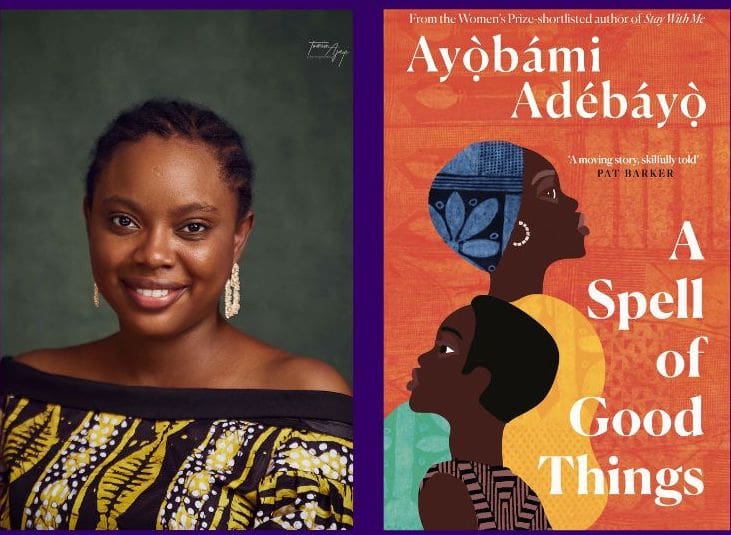
6. Ayobami Adebayo’s ‘A Spell of Good Things’
THE novel is a radical departure from the author’s first book, ‘Stay With Me’. She probes politics and classism and how the poor and the powerful have consigned to the dustbin can be their undoing.
This novel is built around Eniola and Wuraola. Eniola and Wuraola first cross paths loosely, but their choices seal their fates. The convergence at the end is devastating.
Eniola is a secondary school boy, whose teacher’s father is out of a job because the government of the day deems History and a number of subjects unimportant. So, Eniola’s father and several of his colleagues are shown the exit, a situation which leaves many of them dead ‘after a brief illness’. After losing his job, Eniola’s father apparently becomes depressed and stays most time on his bed and staring at the ceiling from where he one day dashes under the bed when the landlord comes asking for the rent.
Paying school fees for Eniola and his brilliant sister, Busola, feeding them, clothing them and doing anything that requires money become herculean for Eniola’s father, and his mother is forced to resort to picking recyclables on a refuse dump to get cash to support the family. It peaks when Eniola’s mother coerces her kids into street begging, a plan she might have thought of after discovering that a supposedly blind beggar isn’t blind after all.
Wuraola, a freshly-minted medical doctor, lives in affluence. Her father, Makinwa, is a successful business owner who indulges his wife’s, Yeye’s, obsession with gold jewelry.

