
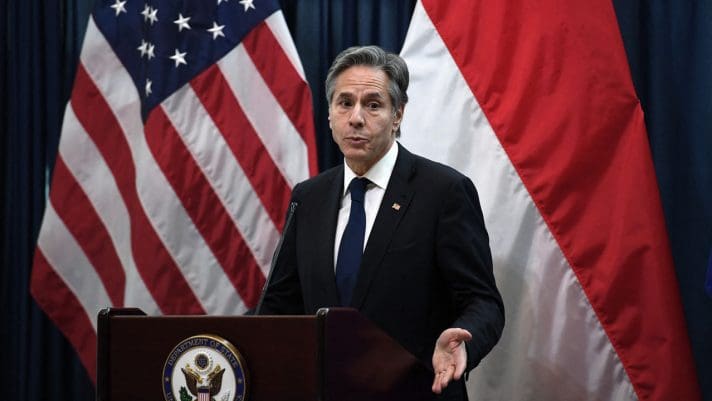

THE United States Secretary of State Antony J. Blinken has outlined reasons his country must compete with China.
Blinken spoke on Tuesday when he appeared before the Senate committee on Appropriations.
He said China represents the most consequential geopolitical challenge facing America with the intent and capability to challenge its vision for a free, open, secure, and prosperous international order.
The Secretary of State said in the post-Cold War era, there is an intense competition underway to shape what comes next.
America, he said, cannot dictate Beijing’s path but it cannot wait for China to change its trajectory.
“But we can put ourselves in a position of strength to compete intensely to shape the broader strategic environment around China and to advance our vision.
“We do not seek conflict with China or a new Cold War. We’re not trying to contain China. And in fact, the United States continues to have a comprehensive trade and investment relationship with China, as do most of our allies and partners. We are, however, resolutely for de-risking and diversifying, not decoupling. That means investing in our own capacities and in a secure, resilient supply chain, pushing for a level playing field for our workers and companies, defending against harmful trade practices, and ensuring that the United States and allied technology is not used against us.
“We’re also committed to working with allies and partners to advance a free and open Indo-Pacific – one that is at peace and grounded in respect for a rules-based international order.
“When we talk about “free and open,” what we mean is this: We mean countries being free to choose their own path and their own partners, and that problems will be dealt with openly, not coercively. Rules will be reached transparently and applied fairly. Goods, ideas, and people will flow lawfully and freely across the land, the seas, the skies, and cyberspace,” Blinken said.
He added that it was in America’s interest to manage its relationship with China responsibly.
Security, prosperity and solutions, he said, must be protected in the management of the relationship.
According to him, America has made historic investments in the bipartisan infrastructure law, the CHIPS and Science Act, the Inflation Reduction Act to strengthen its ability to compete with China.
He said the country has aligned its approach with key partners in Europe and Asia and beyond to elevate its engagement around the world and has achieved greater convergence on how to deal with the challenges that China poses.
Blinken said: “we compete, we will work to maintain open lines of communication at all levels with the PRC to avoid miscalculation, to prevent competition from veering into conflict. Senior-level engagements over the past few weeks demonstrate that commitment.
“We will purposefully engage China, not as a favor, or with engagement as an end in and of itself, but in ways that reflect our values and where we can find areas of cooperation that are in our mutual interest. That’s what the world expects of responsible powers.
“So we’ll push for progress on priorities like the climate crisis, macroeconomic stability, public health. We’ll continue to press the need to curb the flow of precursors that exacerbate fentanyl and synthetic opioids and the crisis that they pose. And I very much appreciate the leadership of this committee on this most urgent challenge for the United States.
“We’ve heard from members in both parties, on both sides of the Hill, that this unprecedented challenge requires an ambitious resource strategy. We very much agree. That’s what the President’s proposed FY2024 State Department budget aims to do: to give us the resources and the agility to advance our strategy.
“This budget positions the United States to up our game in the Indo-Pacific: the frontline of our competition with China. The Indo-Pacific is the most dynamic and fastest-growing region in the world – 50 percent of the world’s population, 60 percent of global GDP, eight of the top 15 U.S. export markets. It supports 3 million jobs here in the United States, provides about $900 billion in foreign direct investment to our country, and it’s driven about 75 percent of global economic growth over the last five years.”
China, he said, invests 50 percent of its assistance and economic and diplomatic resources in the Indo-Pacific.
The budget proposal, according to him, will allow America to further deepen its diplomatic footprint in the Indo-Pacific.
He said China has invested heavily in building up its own diplomatic capacity, its own diplomatic reach, and increased its diplomatic budget last year at a faster rate than its military one.
“And today, it has more diplomatic posts around the world than the United States. If we’re serious about this competition, we have to demonstrate the same diplomatic seriousness of purpose across the board.
“Now, we’re not demanding that other countries “choose” between us and China – but rather, we aim to offer a more attractive choice. If we can spark a race to the top, so much the better. That would be to everyone’s benefit. Our budget sets us up to work with likeminded partners to strengthen our offer, and ensure it’s relevant and responsive to the needs and aspirations of people around the world.
“That’s why the budget includes $2 billion in new investments in high-quality, sustainable infrastructure, rather than low-quality, opaque, extractive projects that leave countries mired in debt.
“It would invest $2 billion to bolster Indo-Pacific economies and help the United States compete in areas where the PRC currently dominates and in key priorities for the region, including maritime security, disease surveillance, clean energy, digital technology, underseas communications cables, critical mineral mining.
“And it contains over $7 billion to extend our economic engagement with the Freely Associated States via the Compacts of Free Association. That’s a critical component of our Indo-Pacific and National Security Strategy,” he said.
He went on: “Altogether, these funding streams ensure that we can meet a generational challenge and demonstrate our long-term commitment on issues that matter most to key countries in the region – so that the United States remains the partner of choice.
“During this decisive decade, our efforts and investments – together with our partners – will determine whether we succeed in advancing our shared affirmative vision for the international system, or whether the PRC can erode or replace the global rules and norms that guarantee peace, security, and stability in the world.”

