
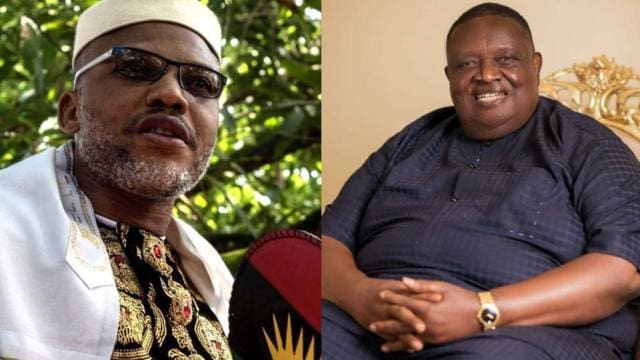

THE President of Ohaneze Ndi-Igbo, Emmanuel Iwuanyanwu, has distanced both himself and the detained leader of the Indigenous People of Biafra (IPOB), Nnamdi Kanu, from the recent killings of soldiers in various parts of the South-East.
Describing the incident as tragic, he clarified that Kanu did not issue the directive for the sit-at-home order.
Following his visit to the detained leader held by the Department of State Services (DSS) today, Iwuanyanwu urged President Bola Tinubu to use his political influence to secure Kanu’s release, while also advocating for the restructuring of the nation.
Last week, IPOB designated May 30 as a sit-at-home day in the South-East to commemorate “our heroes and heroines” who perished in the Nigerian Civil War between 1967 and 1970.
The sit-at-home directive for “Biafran Heroes Day,” announced by the proscribed organization, resulted in the disruption of commercial and economic activities in regions of Anambra, Enugu, Imo, Abia, and Ebonyi States, with closures observed in banks, schools, markets, motor parks, fuel stations, and other public spaces today.
Nigeria officials often attribute attacks in the South-East to the banned Indigenous People of Biafra movement (IPOB) and its militant wing, the Eastern Security Network.
Despite continuous denials of involvement in the violence by IPOB, the group’s leader, Nnamdi Kanu, remains in custody and is facing treason charges following his overseas detention and subsequent extradition to Nigeria.
The issue of separatism remains delicate in Nigeria, with the declaration of an independent Biafra Republic by Igbo military officers in the South-East in 1967 leading to a devastating three-year civil conflict that claimed over one million lives.
In addition to the turmoil in the South-East, Nigerian security forces are grappling with a multitude of challenges including a long-standing jihadist insurgency in the northeast, criminal gangs involved in kidnapping and violence in the northwest and central regions, as well as piracy incidents in the Gulf of Guinea.

