

As one of the most recognised public intellectuals and crusaders for social justice, the arts and culture convenings to celebrate him have attracted enormous goodwill from institutions and corporate bodies around the world. Little wonder, no stone has been left unturned in rolling out the drums. Culture enthusiasts have therefore had a plenitude of beats to dance to, just as they have enjoyed the rhythms of the season’s poetic melodies and dramatic cadences
FROM Lagos to Abuja, Rabat, and London, the deluge of cultural and artistic expressions to mark Nobel laureate, Professor Wole Soyinka’s 90th birthday has gripped the imagination of arts and literature lovers across the globe. The feverish pace of culture-related dialogues, performances, exhibitions, film screenings, and readings have reflected the resolve of organizers to pull no stop. Everyone involved has exuded the ecstasy of witnessing the literary icon’s ascension to the 9th floor of his storied and impactful life.
As one of the most recognised public intellectuals and crusaders for social justice, the arts and culture convenings to celebrate him have attracted enormous goodwill from institutions and corporate bodies around the world. Little wonder, no stone has been left unturned in rolling out the drums. Culture enthusiasts have therefore had a plenitude of beats to dance to, just as they have enjoyed the rhythms of the season’s poetic melodies and dramatic cadences.
Screening of The Man Died
ONE of the very first offerings on the season’s diverse menus was the screening of The Man Died. The screening comes across as an attempt to give the audience a sneak preview of Soyinka’s prison memoirs. It also offered the text-reluctant admirers of Soyinka the opportunity to navigate the complexity of his prison experience from a rich and compelling audio-visual perspective. Produced by Awam Amkpa with Wale Ojo deftly executing the role of Soyinka as an imprisoned activist, the film opened the floodgates. Shot by an all-Nigerian crew, the film took viewers on an excursion back to the heady days of the 1960s. The viewers see Soyinka at his activist and idealistic best, exerting himself. The screen recreated how he defied the odds, putting his freedom and comfort on the line, in the quest for what he hoped would be a just and humane country. At the heart of his exertions was the struggle for a country where the sanctity of life is sacrosanct. The literary icon’s activism meant he would have to take serious risks, which in turn exacted a heavy price.
The film also chronicles those eventful years before Soyinka’s Nobel fame. On-screen, the audience sees the Lion of Letters and his stubborn resistance to the warmongering and its consequence of needless waste of human life. This insistence on the common good led to the long episode of his solitary confinement. After reliving those historic and defining moments of Soyinka’s emergence into the national and global consciousness, the organizers of the many activities went on with the task of deploying other forms of artistic expressions to invoke memories and reimagine the valiant roles Soyinka has played in advancing the ideals of a just and an egalitarian global community. In the plays, poems, and debates, that followed, what was writ large was the Nobel laureate’s wise words to the effect that: “justice is the first condition of humanity.”
Added to the film screenings was the insightful conversation organized by the Wole Soyinka Centre for Investigative Journalism (WSCIJ). The deliberation, that held at the MUSON Centre interrogated the key emerging issues focusing on literature, journalism, and truth-telling in an age of disinformation. With the keynote presented by literary critic, Professor Biodun Jeyifo, the panels included, journalists and media entrepreneurs. Odia Ofeimun weighed in with some critical perspectives showing the tensions elicited by the clash between truth and falsehood. Similarly, Kadaria Ahmed and Chiamaka Okafor offered practitioners of the lay of the land in the epochal battle between truth and falsehood.
Kadaria forcefully canvassed the point about how the truth has become hospitalized by humanity itself. She declared that the truth is currently in the hospital and in a state of coma on account of the unbridled disinformation, which currently characterizes, and undermines the integrity of the public discourse. All panelists were on the same page that the assault on the truth is not an exclusively Nigerian challenge. As such, the conversation fingered figures like Donald Trump and Elon Musk as personalities, which have peddled and enabled disinformation on a global scale.
Consequently, the conversation explored the role of identity politics, especially ethnic identity in the large-scale distortion of the truth, while driving narratives, which end up as disinformation. Kadaria also brought up the issue of the televised genocide going on in the world in the context of the months-long attacks by Israeli Defense Forces on the people, including women and children in Palestine. Nonetheless, the conversation did not end without a look at the possible solutions to the challenge posed by societal factors, which have combined to make the truth experience a near-death reality in the age of disinformation. Of course, the roles of fact-checking, media, and digital literacy were presented as initiatives to pursue, to rescue the truth from its disinformation-enabled limbo.
*******
Freedom Park as epicenter of WS@90
ALTHOUGH not physically present, given his long schedule of travels around the world for diverse engagements, Soyinka’s absence in some of the events did not in any way diminish the good vibes and energies of the festivities. Through pictures, paintings, and posters of all sizes, the Lion of Letters remained a constant presence, peering through his spectacles as the globe poured tributes to celebrate him. In Lagos, the epicenter of the festivities remains Freedom Park, the former colonial prison, now repurposed to a vibrant space for arts, culture, and creativity. One of the major ironies of the space was apparent in the fact that the space, which used to host the hangman’s noose when it was a prison, now hosts the bandstand where artists and revelers sing, dance, perform, and share many joyous moments. One of the bands, which won rave reviews in the first few days of the culture splash was the ARB music band. The band flew in from London for the Soyinka’s fest, and its vocalists blew away the Freedom Park crowd on July 13th. With songs like Rescue Me, and Another Day Another Naira, the band affirmed the difficulties of current economic woes, without alienating lovers of good contemporary sound. Other highlife bands were on the ground to ensure a fun-filled musical experience during the arts and culture fest.
For the visual arts lovers, the offering was equally sumptuous. All around the park gleamy photos and paintings of Soyinka festooned the walls and screens. Arts enthusiasts were greeted by a buzz of images featuring Soyinka’s hoary hair, leaving no doubt about who the celebrant is. Medium-sized billboards hosting the cover pages of Soyinka’s iconic works evenly adorned the space. At the exhibition venue next to the food court, a visual depiction of Soyinka’s prison notes, The Man Died, welcomed culture enthusiasts eager to travel back to heady moments of the 1960s when Soyinka’s activism led to his incarceration during the Civil War. The semi-darkness of the exhibition space tended to depict the real darkness of solitary confinement. The other props deployed in reliving the conditions of solitary confinement in a small prison cell reminded me of the tyranny of the state. A lantern with its flames steady and unmoved by the breeze, few papers, reminding how the literary icon was starved of books and writing materials needed for his literary expression. The only missing detail in the exhibition was the many characters, prison warders, and fellow inmates whose experiences Soyinka portrayed so expertly in his prison notes. For readers who claimed a challenge in understanding the text because of complexity, the curators explained that the exhibition was aimed at finding a good entry point for the comprehension of the thematic preoccupation of the prison notes. The human symbols, which hung around and above the prison cell as portrayed by the curators were labeled in terms of the evil, which Soyinka stood so valiantly against; greed, injustice, poverty and oppression.
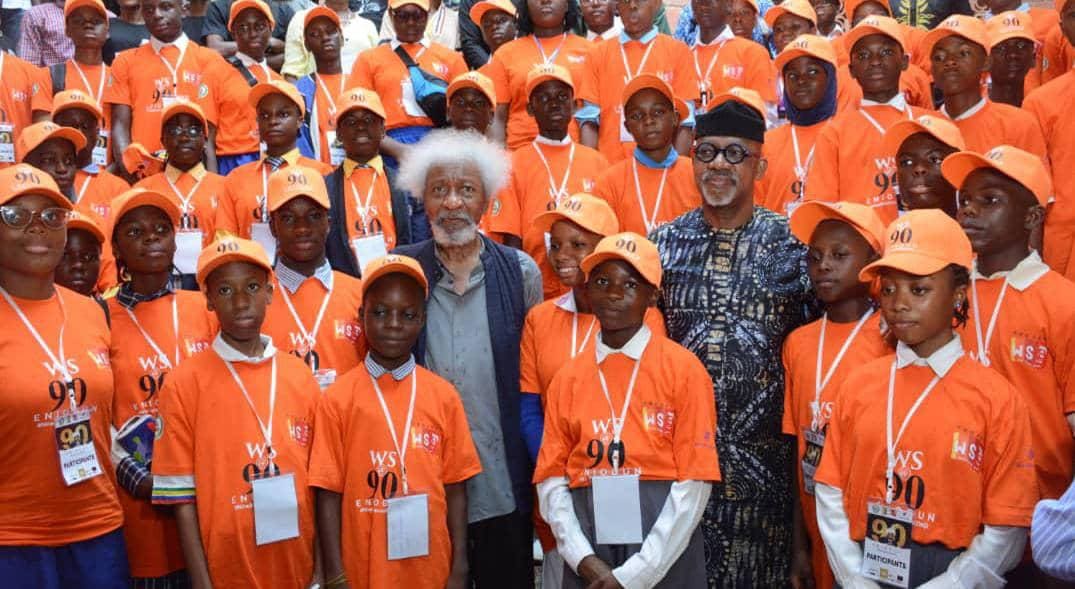
Next up was the screening Ebrohimie Road, a documentary that put the spotlight on the university flat where Soyinka lived while he was lecturing at the University of Ibadan. Then the celebration berth in the serene city of Abeokuta with its heavily wooded roads and environs. This time, the Nobel laureate was very much around to welcome secondary school students from who he fielded lots of questions. He also received the winners of the birthday essay competition contested by secondary school students across the country.
As dusk began to take its foothold at the Ijegba Forest home of the literary giant, all guests exited, only to meet again at the June 12 Cultural Centre where the stage play Eni Ogun enthralled the audience with its thematic preoccupation on justice, and the unending quest for public governance, free of corruption and greed.
- https://theexplainer.com.ng/ws90-inside-view-of-global-culture-splash-to-celebrate-renowned-literary-icon/

