
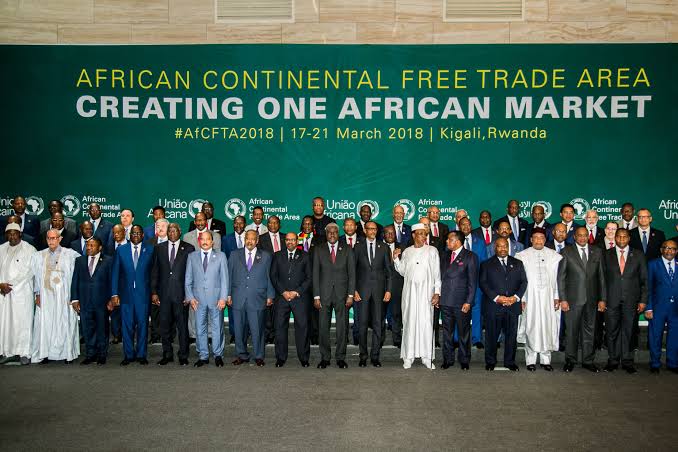

BARELY a month into the implementation of the age-long regional single market initiative launched under the African Continental Free Trade Area (AfCFTA) Agreement came into force, the process is stalled by the same obstacles that held it back for decades, findings have suggested.
The setbacks, sources have disclosed, range from the cold half-hearted commitment of member states, poor commitment from the host of the secretariat to dilly-dallying on the process of executing the tariff orders.
According to the protocol establishing the AfCFTA, its implementation route is anchored on four institutional frameworks – the Assembly, the Council of Ministers, the Committee of Senior Trade Officials and the Secretariat.
While the first three requisite institutions are existing structures within the African Union Commission (AUC) and member states, the Secretariat, which is expected to provide administrative support for the implementation of the agreement, was officially handed over to Ghana and the pioneer Secretary-General, Wamkele Mene, inaugurated since 2019. Until his appointment, Mene, who served as head of mission to the World Trade Organisation (WTO) for South Africa, was his country’s lead negotiator in AfCFTA.
A source knowledgeable in Africa’s trade and AfCFTA conceptualization, disclosed a few days ago that Mene is single-handedly, “with the support of probably one assistant,” responsible for charting the implementation route of the trade agreement. The source suggested that it was becoming worrisome to stakeholders that over a year after Ghana won the bid for the Secretariat, not much is happening at the office.
“We are almost entering February, yet there should be a tracker on what has been achieved month-by-month and quarter-by-quarter. It is typical of Africa. When there is a job to do, it is like a talk show. People come to make presentations and return home without following up with the discussion,” the source lamented.
While the trade and regional financial organisations have looked forward to the actualisation of the agreement, the political will required to move the deal into the next critical stage is said to be missing as the governments of state members are foot-dragging.
Back home, Nigeria’s implementation committee is also holding back the process. While Ghana has shipped its first consignment, Nigeria continues to await the release of the list of liberalised goods by the National Action Committee, one month after implementation commenced!
The implementation, which is dependent on customs procedures and infrastructure that will help nations ensure that the rules of origin and ratification instruments are adhered to, has been stalled over inability of the National Action Committee to unveil the list of liberalised items.
Under the deal, each state or regional trade bloc is expected to create its framework, which is hosted on the Africa Trade Observatory (ATO) portal. Searches on the site on Wednesday reveals the liberalised items are yet to be uploaded.
The logic of the AfCFTA is that if African countries did more business with each other, they would all benefit, creating more jobs and reducing poverty across the continent. Unfortunately, many African countries still do more trade with their former colonialists than they do with their neighbours. This trend may not likely change anytime soon, especially if tariff barriers are not removed as envisaged by AfCFTA.
This is because, the AfCFTA single market eliminates tariffs on 90 per cent of goods produced on the continent, offering investors potential economies of scale; enabling them to manufacture goods in one country and export tariff-free to the whole continent, if the goods are not on the exclusive list of the destination country.
At a virtual press conference held recently, Secretary-General of the African Continental Free Trade Area Secretariat, Wamkele Mene, said countries like Ghana, Egypt and South Africa were ready with the required customs infrastructure to ensure commercially-meaningful trading started. He added that Ghana had on January 4 officially recognised the first consignment of goods to be exported under the AfCFTA.
“The most important point that I want to emphasize is that Africa is now trading under new rules, new preferences because we want to build a single integrated market on the African continent. It may take some time before each of us sees the direct benefit. We are not going to be deterred by our critics who say they don’t see evidence that trading has started,” Mene said.
But the Secretary of the National Action Committee for the Implementation of the AfCTA, Francis Anatogu, said trading under the cover of AfCFTA had not commenced anywhere in Africa, arguing that Nigeria is not left behind. He, however, said the underlining challenges would be resolved soon.
He said trade would only take off after “we execute the tariff order, that is, the list of trades to be liberalised. Members of the Economic Community of West African States (ECOWAS) have the same list. The list has been finalised at the sub-regional level and submitted to the African Union (AU) for technical verification. When the technical verification is concluded at AU, it will be published and become public documentation,”
According to him, the tariff orders would be transmitted to customs for action after he gets AU’s approval.
A Ghanaian diplomat was quoted by a source to have recently regretted that the process appeared stalled by multiple challenges recently, suspecting that external forces could be undermining the long-awaited single Africa market.
IN Nigeria, stakeholders in the manufacturing sectors view the agreement with caution. The Lagos Chamber of Commerce and Industry (LCCI), in its 2021 outlook, said AfCFTA could make the local business even less competitive as rising cost of operation continues to weigh heavily on them. Other experts have similarly warned that the trade deal could turn Nigeria into a dumping ground for other African countries.
On January 4, Ghana organised an event to commemorate its first export under the framework, setting a tall order for other countries.
Nigeria, the regional bloc’s most populous country and the biggest economy is yet to secure the required infrastructure to leverage the agreement.
Mene remains confident that the start of the will lead to a flourishing of trade relationships among African countries “Africa is now ready under new rules and new preferences because we want to build a single integrated market on the continent,” the trade expert said.
The ratification of the protocol has thrilled manufacturing hubs where it is widely perceived as unrestrained access to a big market such as Nigeria hitherto dominated by China. The perception is also a cause for worry in the local market.
But Anatogu said Nigeria, being an import-dependent, would need to “work actively with other African countries to grow specific sectors” to benefit from the agreement.
He was confident Nigerian companies would benefit in terms of cheaper inputs and other ways as the deal takes root. Besides, he said, not all items would be liberalised.
Nigeria endorsed the agreement in 2019 and deposited instruments of ratification subsequently. Notwithstanding, according to Article 27 of the treaty, after five years from the date of entry into force, a state party may withdraw from the agreement, which shall be effective two years after receipt of notification.
Research and Markets described the agreement as “a game-changer in the continent’s ambition to boost intra-African trade and spur economic development”.
But while Nigerian businesses are worried the agreement could emerge as a blight on their operations, trade in goods is just one out of the five areas covered. Others, according to the legal document, trade in services, investment, intellectual property rights and competition policy. What Nigeria may lose to trade in goods, it could gain from trade in services, which is often considered as its competitive edge.
The execution of AfCFTA may have unearthed the historical nonchalance of African leaders towards regional economic and trade integration. The AfCFTA’s cardinal mission is to accelerate intra-African trade and boost Africa’s trading position in the global market by strengthening the continent’s common voice in global negotiations. It is considered a strategic move towards realizing Agenda 2063.
But it was not just two years ago when AfCFTA got the required ratification the ideas of Africa’s single market were conceived. Intra-African trade was central to the creation of AU’s legacy organisation in 1963. But political integration received more prominence as the Organisation of African Union (OAU) kicked off close to six decades ago.
By 1980, 41 years ago, the Lagos Action Plan aimed at minimising reliance upon the West by promoting intra-African trade was adopted. This gave birth to the creation of regional cooperation organisations to promote trade among member countries.
Rather than bring African countries together, the sub-regional economic blocs further drifted the countries apart. Eventually, a semblance of the much-needed trade facilitation body came in the African Economic Community that came on the wing of the Abuja Treaty 1991. The search for a continental free trade zone finally agreed at the 2012 African Union summit in Addis Ababa, Ethiopia. Free trade was to be created in 2017 while the negotiation processes and timelines were agreed upon in 2015 at the Johannesburg summit.
There were concerns by some countries led by Nigeria on whether protocol would sufficiently prevent anti-trade practices like dumping. The delay in ratification by Nigeria intensified the fear of colonial legacies across the continent, with anxiety over possible interference by external powers.
The delayed full commencement of trading under AfCFTA is reawakening the memory of the tortuous journey to its creation and ratification.


3 comments
… [Trackback]
[…] Read More here on that Topic: naijatimes.ng/africa-single-market-project-through-afcfta-suffers-teething-setback/ […]
… [Trackback]
[…] Find More to that Topic: naijatimes.ng/africa-single-market-project-through-afcfta-suffers-teething-setback/ […]
… [Trackback]
[…] Find More to that Topic: naijatimes.ng/africa-single-market-project-through-afcfta-suffers-teething-setback/ […]
Comments are closed.