
7

Ebrohimie Road is a most significant part of Soyinka’s life. It is where he lived before he went to prison. He lived in UI for five years, spent two of those years in prison. Post his imprisonment, he wrote The Man Died, which became one of the prominent books in his literary output. Viewers will get an insight into a part of Soyinka’s life that I believe had a major significance in the person he became. Leaving UI in anger, helped propel him more to the global limelight as a literary genius and human rights defender
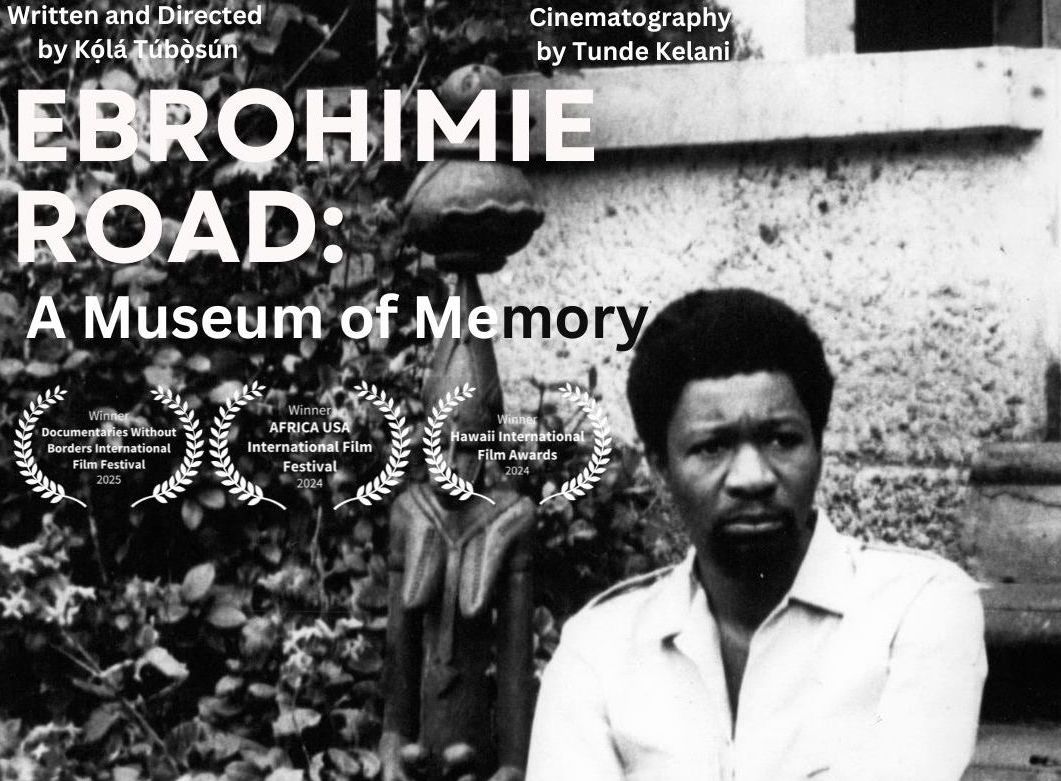
THURSDAY, May 15 is another date to see Ebrohimie Road: A Museum of Memory, the documentary film written, produced, and directed by Kola Tubosun, the Yoruba linguist, translator and culture activist.
Shot by Tunde Kelani, the film feature as part of the ongoing 32nd African Film Festival New York, AFFNY, and will be screened at the Maysles Documentary Centre, 343 Malcom X Boulevard, New York.
The documentary, launched in July 2024 to mark the 90th birthday anniversary of the Nobel Laureate, Wole Soyinka, who is the inspiration behind the project, and since then, has featured at over a dozen festivals around the world, and as well notched several awards, including “Best Documentary” at USA-Africa International Film Festival Los Angeles (2024); Hawaii International Film Awards (2024); Documentaries Without Borders International Film Festival (2024); Spotlight Documentary Film Awards (Silver award winner) – January 2025; Bare Bones Music-Doc-Script Festival (February 2025), and Travel Beyond Borders Film Festival (February 2025). It has also been nominated in several prizes, as well as being finalist in many other juried competitions.
Ebrohimie Road… centers on Soyinka, Africa’s most-laurelled writer, and “global humanist” lived in while he was a lecturer at the University of Ibadan (UI), before and after imprisonment. It explores events between 1967 to 1972 related to Soyinka, and events about those connected to the house, after he left UI.
“Ebrohimie Road is a most significant part of Soyinka’s life. It is where he lived before he went to prison. He lived in UI for five years, spent two of those years in prison. Post his imprisonment, he wrote The Man Died, which became one of the prominent books in his literary output. Viewers will get an insight into a part of Soyinka’s life that I believe had a major significance in the person he became. Leaving UI in anger, helped propel him more to the global limelight as a literary genius and human rights defender,” Stated Tubosun, in an interview.
And speaking about the inspiration behind the documentary, which has received rave reviews, since it premiered, the producer said it was inspired by a photo he came observed on the cover page of one of his favourite Soyinka books, Ibadan The Penkelemes Years, which showed the then 35-year-old lecturer, sitting on the steps leading to a simple bungalow, on Ebrohimie Road, on the University of Ibadan campus.
In a July 2024 article in Africa Literature Today under the title, “Soyinka on Ebrohimie Road”, (https://worldliteraturetoday.org/2024/july/rediscovering-soyinka-ebrohimie-road-kola-tubosun) , Tubosun, stated:
The photo of a young man of thirty-five, on the front page of Ibadan: The Penkelemes Years, had fascinated me for years. Wole Soyinka (b. 1934, Abeokuta, Nigeria), then an acclaimed playwright, sits with his hands crossed on the steps of a house. He wears leather sandals, one that wraps around his big toe. He is flanked by two gnomelike sculptures. The one to his left — and to the right of the photographer — spots a Yorùbá cap, likely put there before the photo was taken. The one to his right seems to be firmly rooted in the ground beside the steps but is tall enough to show up in the photo as if it’s placed right behind the man, to the right.
There are other details in the photo—the hedge that intrudes slightly into the shot from the photographer’s left hand, the position of the writer’s legs (one foot lower than the other on the steps), the slight view of the open door of the house behind him, and the crack in the concrete at the top of the step, placed in the photo approximately near the writer’s left shoulder.
Something about the way the writer appeared, his eyes cast slightly askance toward his left but gently avoiding staring at the camera, is striking. When it appeared on the cover of his 1994 memoirs, the writer had become world-famous not just for his Nobel Prize but also for his handsome gray Afro. Seeing the writer so young, so confident, so full of intensity and in such a casual look and environment invited my strong interest.
“So one day, when I found out that the photo had been taken at the University of Ibadan, my alma mater, my interest became more intense. This was about a decade ago. I had graduated from UI, come to the United States for a Fulbright program, and completed my master’s degree in linguistics and teaching English. It was during one of my visits to the university staff club when a colleague mentioned, during a conversation, that the house where that famous Soyinka photo was taken was at the university. Not just that, but it was still habitable, and accessible.
I also learned a few things about the circumstances behind the photo. It had been taken in 1969, shortly after the subject, Soyinka, was released from his prison detention for participating in activities that the Nigerian military government found unacceptable during its conduct of the civil war against a breakaway region then called Biafra. Soyinka had not only visited Biafra in the early days of the war, he collaborated with a few rebels who had distanced themselves from the breakaway region and were now intent on creating what was called a “third force” to neutralize both the Biafran rebellion and Nigerian state aggression. Returning from Biafra, Soyinka was arrested and locked away without trial for almost thirty months, much of which he spent in solitary confinement. Upon his return, he granted a few interviews to journalists, one of which was with the journalist who likely took that photo. In a few years, Soyinka resigned his job at the university and embarked on a voluntary exile, during which he wrote his seminal prison pamphlet/memoir, The Man Died (see Books Abroad, Summer 1974).
All this history converging on my presence in the University of Ibadan stimulated me. Soyinka had been employed here as the first indigenous director of the School of Drama. His appointment began in 1967 shortly before the war began and ended shortly after his release and resignation. So the details of his productive presence at the university were always a matter of conjecture. How long did he stay after his return from prison? What was it like when he was gone? Why did he resign, beyond the issue of the war? As a student of this university, I had heard stories, none of which were conclusive. Some said he was pushed out because of his involvement with politics. Some said it was his temperament. Others said it was his personal decision, which he himself had written about. But in each of these writings, there were different reasons. In one, his marriage had been strained and he wanted distance. In another, his collection of carvings, which beautified and decorated his house — and that famous photo — had been stolen one after the other while he was gone, so he no longer felt welcome. In another narrative, the political situation on campus after his return made it hard to remain there. And in yet another, corroborated by some of his colleagues, the decision of the university to not officially confirm him as a full professor upset him and led to his resignation.
Curious about the layers of stories behind the house on Ebrohimie Road, Tubosun, visited the house, and his encounter and discovery that the story of the house, especially that of its famous occupant, Soyinka, was closely linked to a crucial slice of Nigeria’s political history, deserved to be aired.
Essentially however, his later encounter with Wole Soyinka, who was now a prominent global citizen and activist, inspired him to write a proposal to a funding agency to produce a short film on the house.
Wrote Tubosun, author of Edwardsville by Heart, a collection of poems, among other titles:
“The many conversations I’ve had, on and off camera, with Soyinka, members of his family, his friends and colleagues, acquaintances, readers of his work, and others, his decision to never return to that spot is linked to a number of painful memories connected to those times, the people, the events, and other personal matters.
“My decision many years later, after being graciously funded by the Open Society Foundation and Sterling Bank in Nigeria, to produce and direct a short film about that house and its role in Nigeria, the writer and his family, and the University of Ibadan, was inspired both by his response and my own recurring fascination with that encounter and all the histories connected to it.
Ebrohimie Road features commentaries by Soyinka’s children who spent better part of their childhood in that house – his first son Olaokun, a medical doctor; his first and third daughters, Moremi, a lawyer and Peyibomi, a university teacher in the US, and Ilemakin, his second son, as well as brother-in-law, Kunle Idowu. Also featured are neighbours of the Soyinkas in those days, present occupant of the house, Professor Nelson Fasina; and some lecturers at, and alumni of the university, who knew when the Soyinkas lived there, including Dr Dan Esebaye, Professor Kolapo, Professor Femi Euba, and others..
In later interviews with journalists, Tubosun, also revealed:
“I was interested about what happened in UI, and the environment at the time. I spoke to those who had lived there, and in the house after his second wife left around 1989 about the role of the house overtime.”
“I didn’t plan to be a filmmaker or writer. I didn’t think anyone else had the passion I had for the story, or knew all the things I wanted to discover. I also wanted to have control of the creative process.”
He hopes the documentary will emphasize the importance of documentation, how history is documented and narrated in Nigeria, and challenge Nigeria to better tend to the documentation of its histories, and thus make history more presentable to present generation.
“History is not only documented in books. Film is a good way of documenting and teaching history to the younger generation.”
