

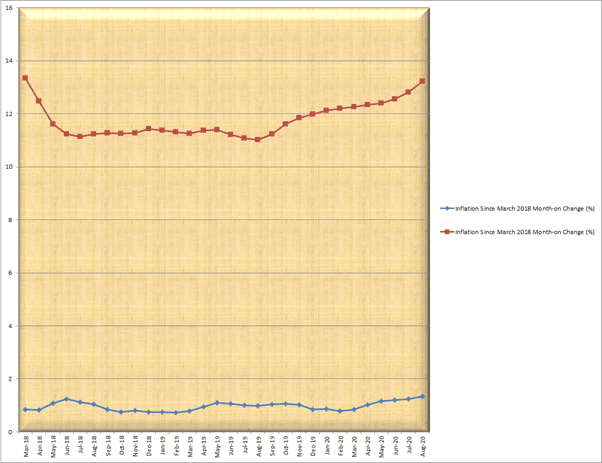
National Inflation Rate Since March 2018
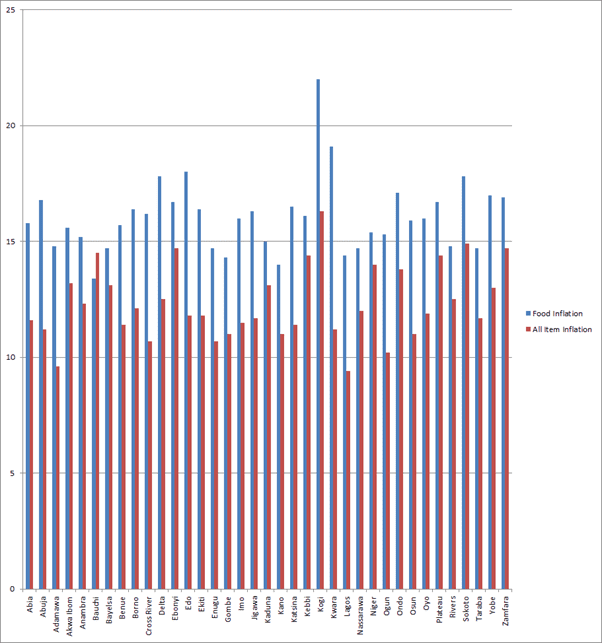
Inflation Rates By States In August
By Joseph ‘Afamhe
The borders were closed before anybody realised that the local farmers who claimed they were producing enough to go round underestimated the huge need of the country’s population, which has grown at an average of 2.6 percent in the past 10 years.
OVER a 29-month moving mean of inflation rates fell apart at the end of August as a jump in the figures from Kogi, Kwara, Sokoto, Zamfara and a few other states have raised new anxiety about food supply dynamics.
According to the Consumer Price Index (CPI), a measure of the general prices of goods and services, Kogi led in both food and general inflation rates in August.
From the figures released by the National Bureau of Statistics (NBS), the year-on-year (YOY) inflation rate in August was 13.22 percent, 0.44 percent points up from the July figure. It was the highest since April 2018 when the rate climbed down from 13.24 in March 2018.
The figures analysed by Naija Times show that the inflation rate jumped in August owing to a spark in the figures collated from Kogi, Zamfara, Sokoto and a few other states. The food inflation rate in the core north is as depressing as the rising inflation rate.
Food inflation of Kogi State was 22 percent, six percent clear-off above the national average. The overall inflation of the state is also 3.08 above that of the entire nation.
With 19.1 percent and 18 percent respectively, Kwara and Edo – Kogi’s neighbours – are second and third states with the sharpest increase in prices of food. Food inflation in Sokoto, Yobe, Jigawa, Katsina, Kebi, Borno, Plateau and Zamfara also pulled through the national ceiling, a situation that raises fear about the growing impact of insecurity on food production.
Though a few states in the south also experienced an unusual rise in food inflation, the figures from the north -– a zone hitherto regarded as the food basket of the nation – are particularly upsetting.
ECONOMISTS said there is no logical evidence for the rise of prices of food items in the northern states. Bode Ashogbon, an economist and investment consultant, said he could only attribute the rise “to flooding and insecurity” as no economic factor could be responsible for the unusual increase.
“Security challenges could be responsible for inflation. A lot of people are moving away from the farm because of insecurity. But if you look at Kogi, you also want to ask whether insecurity is a major concern. Why should food inflation be the highest in Kogi?” Ashogbon asked.
The economist also wondered why general inflation is not easing with the lifting of the lockdown and reduction of the supply hiccups.
On the flip side, Lagos with, 9.4 percent, recorded the least inflation. It was followed by Adamawa and Ogun states. Other states whose general inflation was much lower than the national average were Cross River, Enugu, Gombe, Kano and Osun. Inflation rates in the listed states were also far lower than the urban area figure, which NBS put at 13.83 percent.
Ayodeji Ebo, managing director of Afrinvest Securities Limited, was also shocked by the rising inflation rate in the north but had no explanation to offer for the spark. Of the Lagos State general inflation, Ebo said proximity to the seaports could be an explanation.
Apapa and Tincan seaports are the biggest in Nigeria, accounting for over 70 percent of the country’s total imports. Ebo said the cost of ferrying imported goods to other parts of the country from Lagos is a major component of the unit cost.
Ebo’s explanation fits into the context of general good inflation analysis as Nigeria depends largely on importation. But with the north which is perceived to be relatively food independent leading in the price increase, there are concerns about the country’s food sufficiency.
The weakening naira, Ebo added, is responsible for the rising cost of goods and services. He noted that the trend would continue for as long as Nigeria remains an importing country.
The marginal propensity to import (MPI), which explains the percent of every naira spent on consumption that goes into imported goods and services, is as high is 70 percent, economists have claimed. This reinforces the claim that Nigeria’s exploding population merely provides a market for Asia, Europe and America.
LAST year alone, the country spent $1.3 billion on the importation of cereals. The figure does not capture the undeclared smuggled tonnes of rice and other items that came into the country through the land borders weekly.
Rice has increased by over 100 percent since the borders were closed last year. Neighbouring countries, including the Republic of Benin whose economy survives on Nigerian’s patronage, have mounted pressure on the federal government to reopen the borders but the latter insists that would only happen after mutually-beneficial terms are signed.
The borders were shut on the government’s claims that the food sufficiency programme was being undermined by unrestrained smuggling and that the local farmers had grown adequate capacity. The borders were closed before anybody realised that the local farmers who claimed they were producing enough to go round underestimated the huge need of the country’s population, which has grown at an average of 2.6 percent in the past 10 years.
The border closure, which the Central Bank of Nigeria (CBN), admitted is partly responsible for the neck-breaking inflation, has only succeeded in increasing the prices of rice rather than boosting production.
Nigeria’s penchant for imported items is growing by the day. From foods, fashion to household, everything is consumed. There is a preferred foreign variant for every item Nigeria produces at a comparative advantage, including garri. The local content of a few items that are produced locally is less than 30 percent in most with a larger percentage of their raw materials imported from mostly Asian countries.
These, economists suggest, are responsible for the continual fall of the naira, collapse of local companies and rising unemployment.
Successive CBN governors have attributed their inability to stablise the naira to uncontrolled love for foreign items. The campaign for the consumption of indigenous products has been a sort of pet campaign of the current governor, Godwin Emefiele.
Other government officials, including the lawmakers, have also been part of the campaign. But analysts said such a campaign is more effective when it is backed by action and not when the legislators turn down Innoson cars for Toyota models and turn around to advise Nigerians to buy shoes made at Ariaria Market.


5 comments
… [Trackback]
[…] There you will find 33763 additional Information on that Topic: naijatimes.ng/exclusive-rising-food-prices-in-northern-states-raise-fresh-anxiety/ […]
… [Trackback]
[…] Here you will find 74441 more Information to that Topic: naijatimes.ng/exclusive-rising-food-prices-in-northern-states-raise-fresh-anxiety/ […]
… [Trackback]
[…] Find More to that Topic: naijatimes.ng/exclusive-rising-food-prices-in-northern-states-raise-fresh-anxiety/ […]
… [Trackback]
[…] Read More here to that Topic: naijatimes.ng/exclusive-rising-food-prices-in-northern-states-raise-fresh-anxiety/ […]
… [Trackback]
[…] Information on that Topic: naijatimes.ng/exclusive-rising-food-prices-in-northern-states-raise-fresh-anxiety/ […]
Comments are closed.