
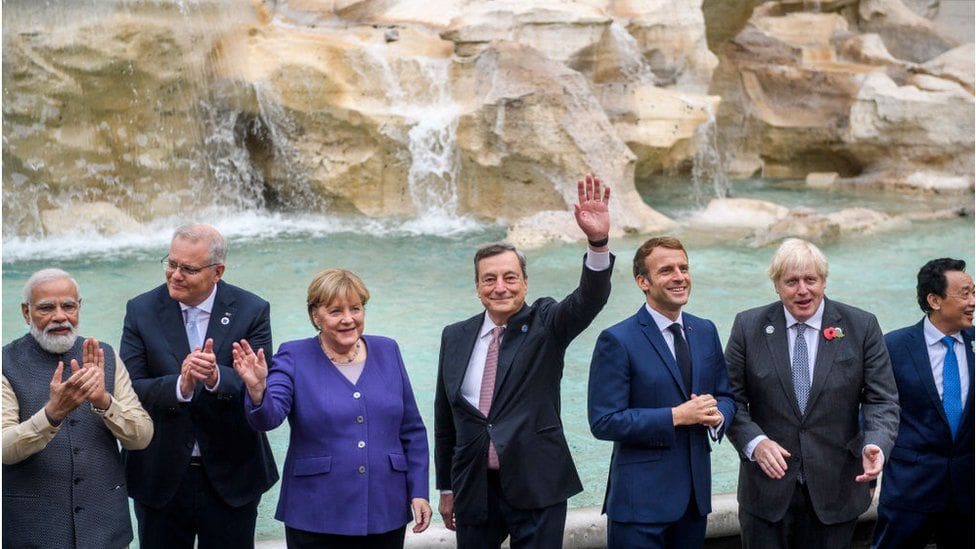

THE leaders of the world’s richest economies have agreed to pursue efforts to limit global warming with “meaningful and effective actions”.
But exactly how this will be achieved was not revealed in the leaders’ communiqué at the G20 summit in Rome.
Host nation Italy had hoped that firm targets would be set before the COP26 summit in Glasgow, which has now begun.
The G20 group, made up of 19 countries and the European Union, accounts for 80% of the world’s emissions.
The communiqué, or official statement released by the leaders, also makes no reference to achieving net zero by 2050, which many countries have already pledged to do and climate scientists say is critical to avoiding a climate catastrophe.
Net zero means reducing greenhouse gas emissions as much as possible, until a country is absorbing the same amount of emissions from the atmosphere that it is putting out.
The communiqué does pledge, however, to stop financing new, unabated coal plants internationally by the end of this year – a strong message to coal-reliant nations such as China, Russia and India. But the G20 leaders stopped short of agreeing to end coal power in their own nations.
Activists had expressed their disappointment over the initial drafts of the communiqué, feeling it was not tough enough. There had been concerns reaching a deal would not be easy, as among the leaders not appearing in person is China’s President Xi Jinping. China is the world’s biggest polluter – although, per person, its emissions are about half those of the US.
Oscar Soria, of the activist network Avaaz, told the agency there was “little sense of urgency” coming from the group, adding: “There is no more time for vague wish-lists, we need concrete commitments and action.”
However, others have been keen to paint the G20 as a stepping stone to COP26, which will see delegates from nearly 200 countries gather to discuss cutting carbon emissions.
A US official told reporters the G20 was about “helping build momentum” before the leaders headed to Glasgow later on Sunday, while France’s President Emmanuel Macron told newspaper Journal du Dimanche that “nothing is ever written before a COP”.
“Let’s not forget that in Paris, in 2015, nothing was decided in advance,” he told the weekly.
On Saturday, the first day of the two-day summit, focus was on Covid and the economy, with an agreement being reached on a global tax rate which will see the profits of large businesses taxed at least 15%.
It follows concern that multinational companies are re-routing their profits through low tax jurisdictions.
On Sunday, Britain’s Prince Charles – who often speaks out on environmental matters – addressed the group.
He urged the leaders to take action “for the sake of humanity”, but acknowledged with the costs for new infrastructure likely to spiral into “trillions of dollars” it needed both government and the private sector to work in tandem.
Going into Sunday’s final meetings, Italian Prime Minister Mario Draghi called on his colleagues to set long-term goals and make short-term changes to reach them.
“We must accelerate the phasing-out of coal and invest more in renewable energy,” he said. “We also need to make sure that we use available resources wisely, which means that we should become able to adapt our technologies and also our lifestyles to this new world.”
After years of talking, the planet is now at least 1.1C hotter than the pre-industrial level. Climate scientist want warming restricted to 1.5C to prevent climate catastrophe.
COP26 climate summit – The basics
- Climate change is one of the world’s most pressing problems. Governments must promise more ambitious cuts in warming gases if we are to prevent greater global temperature rises.
- The summit in Glasgow is where change could happen. You need to watch for the promises made by the world’s biggest polluters, like the US and China, and whether poorer countries are getting the support they need.
- All our lives will change. Decisions made here could impact our jobs, how we heat our homes, what we eat and how we travel.
https://www.bbc.com/news/world-59109186

