

By Uzoma Amuka
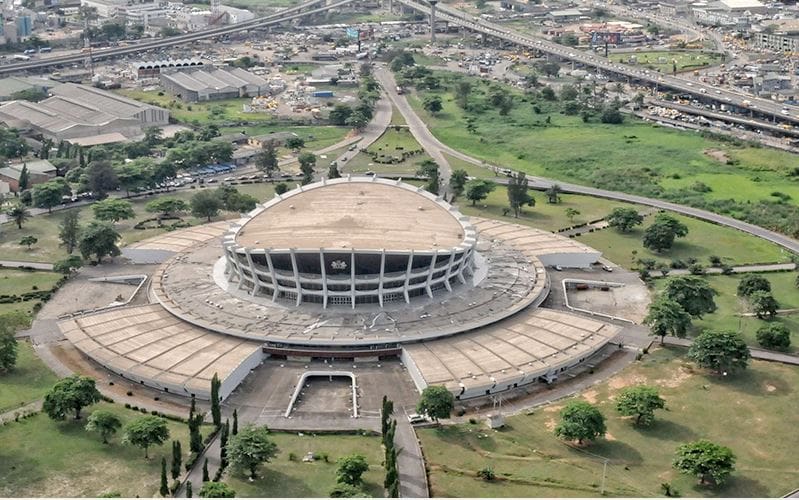
For decades, the complex was in the news for the wrong reasons, paramount of which are rot and dilapidation… The various occupants left the building to gradually deteriorate to the extent that the roof of the main auditorium cracked and rainwater began to drip into the hall. This began to destroy the stage, collapsible seats, the lighting and amplification system, the floor, and priceless art works.
FEW in the culture sector will envy Professor Sunday Enessi Ododo, the new General Manager of the National Theatre. His fate is like that of Adil in Tawfik al-Hakim’s play, Fate of a Cockroach. He is a general without his troops.
Ododo is going to a National Theatre, whose fate, in three years to come, will be determined by a coterie of businessmen in the guise of ‘Bankers’ Committee’.
Ododo, who attended the universities of Ilorin and Ibadan, where he gained his B.A, M.A and PhD, in Performing and Theatre Arts between 1986 and 2004, is a former president of the Society of Nigeria Theatre Artists (SONTA).
The Okenne, Kogi State-born scholar is also a member of bodies including the National Association of Nigerian Theatre Arts Practitioners (NANTAP), Reading Association of Nigeria (RAN) and Association of Nigerian Authors (ANA). He was ANA’s national vice president from 2009 to 2011.
He has left golden footprints at the University of Ilorin and University of Maiduguri where he was until President Muhammadu Buhari appointed him GM.
But the Professor of Performance Aesthetics and Theatre Technology in the Department of Visual and Performing Arts, University of Maiduguri, as a ‘scholar artist,’ has to find a way to lift morale of staff as well as see to it that the facility does not become another casino lounge and binge centre for the noveaux riche.
He has the mandate to turn the place around, but can he — in the face of policy inconsistency, financial starvation and low morale of the upper cadre staff, which also crave a move up based on the civil service regulations?
Prof Ododo believes he will change the narrative of the National Theatre.
In an interview with the News Agency of Nigeria, the General Manager said he would strive to elevate the nation’s centre for cultural and performing arts to the world map.
Ododo said he would collaborate with relevant directors and staffers to achieve the said mission.
“I am confident that with maximum cooperation, we will change the narrative of the National Theatre, I am an optimist and like to look beyond immediate challenges meant to be conquered.
“It’s a new beginning whereby we will begin to write our own stories of new achievements, success and development by fashioning out a roadmap that will take us out of the woods.”
He appealed to the directors and staffers to follow him with open mind as part of efforts to revamp the National Theatre to his dream.
He also disclosed that he would collaborate with the stakeholders in the culture and entertainment industry to make the centre a valuable setting for shows.
“Lagos, being an entertainment attraction, I will fashion out ways to involve the entertainers and cultural experts to see the theatre as an ideal centre for shows and performances.
“We shall ensure that it also generates fund for the government as a tourist site and commercial venue for all forms of entertainment and promotions,” he said.
Uncertain role of the General Manager

PROF. Ododo took over the mantle of leadership from Mr Sunday Baba, a Director from the Ministry of Information and Culture, who headed the National Theatre in acting capacity from 2019 to 2020.
According to Dr. Sola Adeyemi of The Goldsmith College, London, “The National Theatre General Manager is a ceremonial post.” He asked, “what does the incumbent ever do? At least, in recent times. They “manage” truly, but this is not with any incentive to innovate. And with the new deal concerning the premises, the GM will only be expected to liaise with the project managers and manage the normal theatre workforce. Do you think this can be different?”
Adeyemi said: “However, being candid about Ododo and National Theatre, if anybody can achieve anything, it’s Ododo. He is a Theatre technician/scenographer. He has the experience of working in the university and outside. He has vast network connections in Nigeria and outside. The main issue is the inherent corruption in the culture industry and the lack of government patronage and sponsorship. The place is always starved of money. That’s my reason for saying it’s a ‘ceremonial post’, because the government that appointed him may also be the one that undermines his efforts.”

A history of mixed fortune
CONSTRUCTED in 1976 for the preservation, presentation and promotion of arts and culture in the country, the facility, for some years now, has been a major concern for the art community and professionals that operate at the fringe of the art and culture sector.
The facility, which, in 1977, served as venue of the events of the second World Black and African Festival of Arts and Culture, otherwise known as the Festival of Arts and Culture (FESTAC’77), was the pride of the nation, having been designed after the Bulgarian Sports Centre in the Port City of Varna, Bulgaria, and sits on an expansive land that is about 23,000 square metres.
For decades, the complex was in the news for the wrong reasons, paramount of which are rot and dilapidation. There was no proper routine maintenance of the building by the Bulgarian architects that constructed it or any local agency.
The various occupants left the building to gradually deteriorate to the extent that the roof of the main auditorium cracked and rainwater began to drip into the hall. This began to destroy the stage, collapsible seats, the lighting and amplification system, the floor, and priceless art works.
The crack in no time spread to the other wings and it became dangerous for events to hold in the facility. And to prevent anyone from being electrocuted, electricity power supply was cut off, leaving the building to be unmanageable, hot to the extent that even staff that ought to be on their seats during work hours began to loiter, while some moved to the ‘abeg igi region’ — under the tree — and at the close of work go home.
The financial loss at the National Theatre is unquantifiable given the resurgence in the cinema-going tradition in the past few years in the country.
Earnings from cinemas are just one aspect of what can be done with the National Theatre. Alook at what is being done at Terra Kulture, FilmOne House, Silverbird Galleria, and Genesis Deluxe in terms of raising revenues, the National Theatre’s loss is just too much.
Landmark records at the facility
THE facility played host to leading theatre and performing artists like Duro Ladipo, Hubert Ogunde, Ola Balogun, Chief Eddie Ugbomah, Moses Adejumo Olaiya, Lere Paimo and others. These artists shaped the Nigerian Film industry tagged Nollywood.
While Ogunde, whose Yoruba language films made about N5 million most weekends, Ugbomah made about N3 million with his English films like The Death of a Black President, Oyenusi and Black Gold.
There is the exhibition hall, two cinema halls, the banquet hall, the VIP hall, and the 5,000-seater main bowl. No other venue in Nigeria has this capacity. The main bowl also has a revolving stage, which is rare to come by in most event centres, and this stage has not been used in the last 30 years. Imagine how much money government would be making if 5,000 people pay at least N500 to watch a film or play that would be shown thrice or four times a day?
The theatre has more halls than any event centre in the country and if well managed, revenues from them could be used to sustain it with reserves sent to government’s coffers.
There were some renovations done by various Ministers including Barr. Bromillow-Jack and Amb. Frank Ogbuewu. During the tenures of Professors Femi Osofisan and Ahmed Yerima, some renovation was carried out but because it was not funded and was not well-provided for, the impact was minimal. Over time, what was done was peripheral and akin to: repairing one cinema hall today and rehabilitating some toilets there. There was no holistic repair.

An uncertain future with the Bankers’ intervention
ON Sunday, July 12, 2020, the Federal Government and the Central Bank of Nigeria (CBN)/Bankers Committee began what is considered the most detailed commitment to the facility since 2007 when discussions on concession of the culture edifice was initiated by the Bureau for Public Enterprises (BPE).
The BPE had established the framework for concession and hosted an open bid for it, after a widely publicised call for expression of interest. It eventually announced Infrastructica as the preferred bidder with a bid of N35.8 billion for a 35-year concession of the National Theatre. It also declared Jadeas Trust, which offered N28.9 billion, as the reserved bidder.
Infrastructica was expected to rehabilitate, run, and upgrade existing facilities, including the cinema halls and; develop 12,000sqm of available re-developable space. The company was also expected to develop games arcade, amusement park, theme parks and arts galleries.
In 2013, officials of BPE and the Infrastructure Concession Regulatory Commission (ICRC), an agency of government, also supervised another process of concessioning initiated in 2013 by the former Minister of Culture and Tourism, High Chief Edem Duke.
The ICRC had already issued Full Business Case (FBC) Compliance Certificate to the Ministry of Information, the supervisory ministry but progress could not be made until the FBC certificate is tabled before the Federal Executive Council (FEC) for consideration to permit further actions on the concession process of the architectural masterpiece and a cultural landmark, which the Minister of Information and Culture, Alhaji Lai Mohammed, did not present the certificate to FEC until the emergence of CBN/Bankers Committee.
In this new arrangement, the National Theatre, Iganmu is to be turned around with N25 billion via a public-private partnership (PPP), in a two-phased effort.
The Lagos Creative and Entertainment Centre Project would upgrade the facility at a cost of N7 billion in the first phase, while the second that involves the development of the fallow land within the complex, is to gulp N18 billion.
The disclosure came to the fore when the Federal Government handed over the national asset to the Central Bank of Nigeria (CBN)/Bankers’ Committee to return it to its glorious years in Lagos.
The project is tagged: ‘The Nigeria Entertainment City, a Public-Private Partnership model being deployed to see the current theatre main bowl fully upgraded, and the adjoining land around developed into complimentary facilities.
Facilities expected amongst others in the entertainment city will include; a five-Star hotel, ultra-modern office buildings, a multi-level car park, shopping and retail facilities, as well as an amusement park.
There are more to this arrangement, which surely will task Ododo’s thinking as a ‘scholar artist’. CBN is not a commercial bank. The Federal Government owns it 100 per cent. As banks are set up as commercial enterprises, are they going to use shareholders’ funds? Is it a corporate social responsibility? Or, for them, is it an investment to which they expect returns? All of those things were not stated in the handing-over, and those are very valid questions that need to be asked.
According to Prof. Duro Oni, an expert in Design and Technology for the Theatre, who was at various times: Head of the Dept of Creative Arts, Dean of Arts and Deputy Vice-Chancellor at the University of Lagos and also a chief executive officer of Centre for Black and African Arts and Civilisation (CBAAC), “There is no problem with the CBN. If you look at the kind of money they are talking about, N25 billion, obviously, that is a lot of money. I’m not sure any private enterprise in Nigeria will be able to cough out that kind of money for a long-term investment that may not start yielding anything for some time, but I know that the CBN has that capacity. But when they bring in the Body of Bankers, what is their own interest in the matter? Is it corporate social responsibility? Do they want to assist the arts or culture in development? Or is this an investment opportunity which they expect to make returns? If they want to make such returns, what would be their involvement and what part of it will become their own investment?”
Oni added to the twist: “If you look at the figures that they gave in terms of the N25 billion, they said seven billion would be for the renovation of the theatre itself, and N18 billion for the other works. Obviously, you can already see the shift in terms of the resource allocation; the theatre is to be rehabilitated for seven billion while the other aspects, the surrounding environment for 18 billion. So, is it the surrounding environment that is more of the priority or the work that would be done at the theatre? What are the plans for that surrounding environment? People would want to know. They say its fallow land, I mean, there is no land in Lagos that is fallow. It just depends on when you want to develop it. So, if the interest of the Bankers Committee is in the surrounding environment, what do they want to put there?
“Where is the PPP now? Because PPP means Public-Private Partnership; who is partnering who? The CBN/Bankers Committee? The Federal Ministry of Information and Culture? To refurbish the National Theatre? Why don’t they do a corporate social responsibility? If they partner, that means they are expecting returns, and what are the returns? Is it from the theatre, or is it from the other things that they build on the grounds of the National Theatre? I mean, look at the big shopping malls in Lagos, if you give one of them a large portion of space there, of course, they will build a big shopping mall, they will get customers and they will make money. How does that advance the cause of the theatre itself? There is not much that is disclosed or understood. That is the kind of thing that breeds suspicion, which really should not be. The banks are not set up as charity organisations, banks are set up as commercial enterprises, to make money for their investors and those who have subscribed to the bank in terms of shareholding.
“If this is something to which they are investing their money to make returns, then let us know; let us get the information about how they intend to do this and what it is they intend to do. What is their projection? In which areas are the partnerships. We’ve heard information that people won’t lose their jobs. To me that is a tall order because most of the staff at the theatre have been there for a long time, and if there are now new operators, so to speak, under whatever range of partnership, then what they are going to do in the theatre may also require a new set of hands. Are they just going to keep the staff until they’re old enough to retire? Some of the staff who still have some skills would be happy to work in the rehabilitated theatre. There is so much that is not clear about this partnership.”


0 comments
… [Trackback]
[…] Read More on that Topic: naijatimes.ng/hazy-pictures-at-the-national-theatre-as-new-head-resumes/ […]
… [Trackback]
[…] Find More on to that Topic: naijatimes.ng/hazy-pictures-at-the-national-theatre-as-new-head-resumes/ […]