

By Maja Fawole
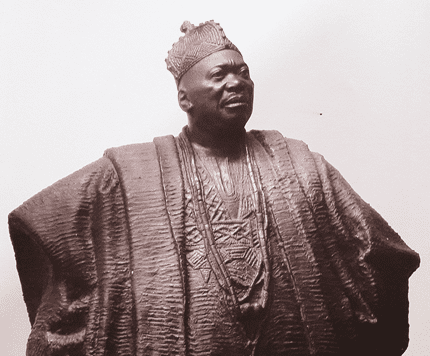
AS Nigeria prepares for her 60th independence anniversary, it’s time to celebrate her legends of Art who have never relented in igniting aesthetic sparkles that continue to enliven contemporary art in Nigeria and beyond. One of such giants is Abayomi Barber who will be 92 years in October.
Abayomi Adebayo Alade Barber is a force of cultural revolution and artistic evolution in contemporary Nigeria. With his return from England and immediate entry into art practice in Nigeria in 1971, a new standard was set as one of the bars to measure the quality of art in Nigeria.
Although Barber belongs to the pre-independence era of Nigeria based on his training and subsequent practice in the United Kingdom, he would soon align with Nigeria’s young masters of the post-independence era. He only returned to Nigeria about 10 years after Nigeria’s independence from colonial rule and quickly set up his thriving studio in the University of Lagos. The studio began to produce artists whose body of work, in tandem with consistent practice, metamorphosed into what Frank Aig-Imoukhuede, one of Nigeria’s culture experts, had described in 1984 as a school of thought.
Having an independence of mind was a determining factor in the development of Abayomi Barber’s art. That he enrolled at the Yaba Technical Institute (now Yaba College of Technology) in 1953 and willingly abandoned the programme because it “was not offering anything new” attests to such independence. Earlier before the admission saga, he was offered civil service employment by Ben Enwonwu who was then Government Adviser on Art, but he turned down the offer and chose instead to join the publisher of Aworerin, a Yoruba comic magazine, as a graphic artist. This afforded him a platform to illustrate many contents of the various editions of the magazine.
Invariably, Abayomi Barber emerged into the scene with the status of a pseudo-renaissance artist whose skill cut across virtually all specializations of the arts. With internship at the Saint James’ Palace Studio, London, from 1968 to 1971, he fertilized his formalist approach to art. He became a Realist in sculpture, painting and scenic design. His equal strength and skill in painting and sculpture is simply unquestionable. By extension, he is a songwriter, singer, and saxophonist. He met it all with amazing skill and mastery. Delightfully, he remained in active art practice in England until he returned to Nigeria in 1971.
Emergence of Abayomi Barber Studio
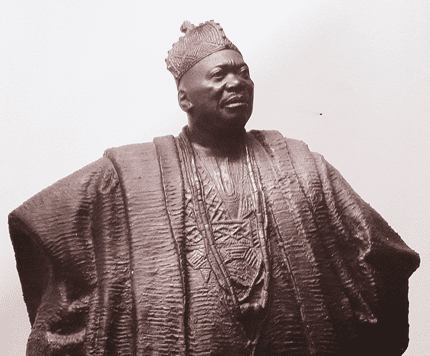
WHEN Abayomi Barber returned to Nigeria in 1971, his first port of call was the Ori Olokun domain at the University of Ife (now Obafemi Awolowo University), Ile-Ife, where he had planned to unleash his creative energy. Unfortunately, the slow response to his absolute interest became frustrating to the point of self-rejection from Ile-Ife. He had to return to Lagos as he would soon become a cornerstone at the University of Lagos where he was employed as a Senior Technician in 1971 and seconded to the School of African and Asian Studies. There, he produced monologues, illustrations, posters, and other graphic requirements. In fact, he would have been employed as a lecturer, but he was more at home with studio practice; hence, his acceptance of the post of Senior Technician.
Barber was subsumed in a stagnating impediment of the time as the School of African and Asian Studies had no studio for art practice whereas Barber, the only artist in the employment of the school, could not do without one. The first three-month contemplative period was an administrative and artistic stagnating era in the life of the artist who just resumed work, did nothing, but received his salary at the end of each month. There was a lull in artistic activities and he didn’t seem happy with the situation. Incidentally, and much to Barber’s satisfaction, the School of African and Asian Studies ran out of its usefulness and a replacement was established. It was called Centre for Cultural Studies. Unexpectedly, the school authority did not see Barber’s usefulness in a new Centre established to accommodate Research, Performing Arts and Music.
Unknown to the UNILAG authority, Barber was grounded in Music. He had been part of a professional musical band in his early days. This he revealed to the school and followed up with a tenable argument that no performing art could function well without visual art. He convinced the school authorities about the need for backdrops (large background scenic paintings executed on baft fabric) to create reality for drama presentations. The idea was wholesomely bought and Barber’s retention as a staffer of the Centre was sustained. He constantly produced paintings and scenic effects on backdrops for many of the drama and musical productions by the Centre – whether they were staged in or outside Nigeria.
Adventure into academic space
INDEED, Abayomi Barber had birthed the idea of a practical workshop space called art studio as soon as he joined the School of African and Asian Studies in 1971. For an artist who preferred studio practice to academic teaching, he refused to resume work until the school was able to build him an art studio where he produced many works for the Centre for Cultural Studies. He had complained to the then Vice Chancellor, Prof. Saburi Biobaku about lack of studio space to facilitate his productivity, thus serving as an impediment to art development in the school. Barber was instantly tasked to design a befitting studio for the Centre. His initial design, studded with facilities of his dream, was considered to be bogus, unrealistic and expensive to build. It was later modified to accommodate an artist and his assistants. Despite the fact that art and artists were despised at the time, Barber’s vision was clear. Art was his life and he would go out of his way to protect and preserve it. As philosophically envisioned in his sayings and deeds, “Art is like a cup of honey besieged by flies.” He was so sure that once artistic activities took off in the studio, people would be naturally attracted to the place; and that was exactly what happened.
Between 1971 when he took up Muri Adejimi as his first student and 1996 when he retired from the University of Lagos and relocated to his home studio at Ijoko-Otta in Ogun State, more than 100 students (now masters in their own right) had been trained while many others still seek him out for training and influence.
Abayomi Barber School of Thought
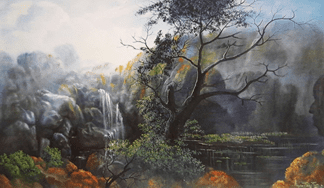
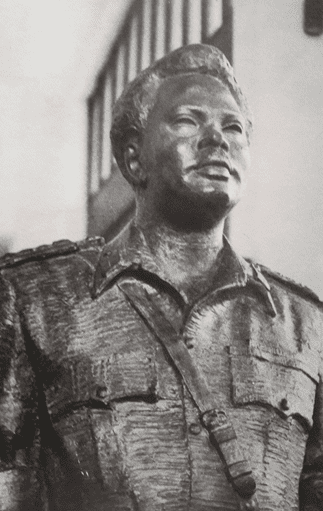
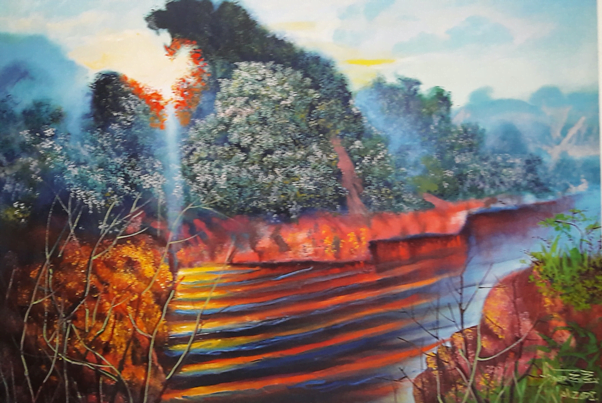
AS Barber intensified his art practice, producing paintings, sculptures, scenic backdrops and illustrations, he re-established himself as an artist who leapt from the realm of Realism to the climax of Surrealism. Many of his works tell realistic or surrealistic stories, employing the tenets of naturalism. Many factors are responsible for this.
First, he hails from Ile-Ife, the home of naturalistic Ife terracotta and bronze work of the traditional period between the 15th and 16th centuries. Also, his academic training coupled with exposure to art studios in London where naturalism was a non-negotiable phenomenon, also influenced his commitment to production of art forms that glorify realistic/naturalistic finesse. Even in its pursuit of Surrealism as a style, Abayomi Barber School, in its ideological advancement, embraces pertinent use of humanistic or figural elements as a vehicle of expression. The philosophy that emulates neo-classical perfection situates the School and its works on a pedestal of discipline, hard work, commitment and dedication. This is evident in the reasoning and creative impulsiveness of each member of the School.


4 comments
A legend indeed! 👏👏👏
… [Trackback]
[…] Find More Info here on that Topic: naijatimes.ng/abayomi-barber-living-legend-of-art-at-92/ […]
… [Trackback]
[…] Find More Info here to that Topic: naijatimes.ng/abayomi-barber-living-legend-of-art-at-92/ […]
… [Trackback]
[…] Info to that Topic: naijatimes.ng/abayomi-barber-living-legend-of-art-at-92/ […]
Comments are closed.