

THE just-concluded 22nd Lagos Book & Art Festival, LABAF 2020 promoted by the Committee for Relevant Arts, CORA staged a festival edition of its popular BookTrek programme on Saturday, November 14.
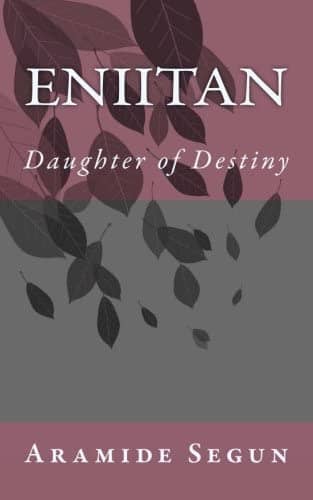
Aramide Segun’s 2016 Novel Eniitan, Daughter of Destiny was at the centre of the highly elevated discourse, which had Aramide (real name Mowunmi Segun) being engaged by Akin Adesokan, an Associate Professor of Comparative Literature and Cinema and Media Studies at the University of Indiana, Bloomington, USA.
The story in Eniitan... unfolds in very manageable locations. It is not one of those novels where the characters are spread all over the place. The geography of this writing is no doubt the city and its margins. Kinseko may be a metaphorical marginal city, it still has all the pathologies of any big city with a preponderance of broken people and their plethora of troubles. For instance, the ill-treatment of unfortunate members of the lower class is exemplified in the portrayal of the house-help – Taibatu.
The poor and the weak are always the losers in the story of life. They are the ones who live their lives in fear and are always consumed by fear. In the novel, the house-help walks away with a bundle of joy but leaves behind a bundle of Naira notes that would have helped her start a new life. If you are a lover of dark stories or stories of dysfunctional families, you will find this book a very fascinating read.
Apart from the themes above, Aramide Segun also talked about the sub-theme of herbal medicine since there is an Iya Adunni in the story. When she was asked if the plot in her story about the promotion of herbal medicine has influenced her personal life.
Ms. Segun responded that growing up in a middle class family meant traditional concepts such as herbal treatments were not a part of her life but as soon as she arrived in Ibadan, she discovered that the people are so traditional, especially during greetings compared with what she encountered in Lagos.
During her time at Ibadan, IFRA, where she operated from, she was based in and affiliated with the University of Ibadan’s Institute of African studies. This implies that there were papers produced on traditional medicine, which she read. Once or twice traditional diviners (àwọn Babalawo) were invited as guest presenters to the Institute and one actually tried to divine for her, which she refused.
Aramide admitted having contacts with those knowledgeable about the craft but that those encounters did not play any significant or direct role in the writing of the novel.
She ended her response with a suggestion to the government to take herbal medicine as serious as the Chinese have taken alternative medicine.
What Ms. Segun and Professor Adesokan did not discuss is the fundamental differences between Western Pharmacopeia and the traditional medicine she will like to see privileged. At what point will dosages and measures be discussed. Who will champion the issue of standardisation in diagnosis when it comes to prescription of herbal medicines? I guess issues like these should not come into a literary gathering where imagination is key.

IN any case, another subtheme in the book has to do with Death.
“Death, one of the few characters unnamed in the novel, stalks both the young and the old, leaving the reader in suspense as to whom its next victim will be. I must quickly point out that the story is not about death but about the vicissitudes of family life placed against the backdrop of local politics. The shenanigans of the decadent class of politicians are skillfully woven into the plot.”
If I had one more opportunity, I would have liked to ask her how she deals with real life issue of death and the dexterous way in which she introduced death into the plot. As readers will come to uncover, trauma is another recurring sub theme in the book; so, I would have wanted to know how she navigated this concept in the book.
According to an expert on the subject, “[t]he concept of trauma, itself a source of critique, is generally understood as a severely disruptive experience that profoundly impacts the self’s emotional organisation and perception of the external world. Trauma studies explores the impact of trauma in literature and society by analysing its psychological, rhetorical, and cultural significance.
“Scholarship analyses the complex psychological and social factors that influence the self’s comprehension of a traumatic experience and how such an experience shapes and is shaped by language. The formal innovations of texts, both print and media that display insights into the ways that identity, the unconscious, and remembering are influenced by extreme events thus remain a significant focus of the field.”
In Eniitan… the writer was able to navigate more of the psychological effect on the family than anything else. At each point, the reader will be shocked into reality and sent into a deep empathy with the characters.
The text and the context of its production soon took a back seat during the lively conversation between Adesokan, himself an award winning writer, and Aramide (aka Wunmi) Segun.
The discussion moved to why she used a digital platform for the publication of her novel instead of one of the local publishers. In a not too surprising tone, Ms. Segun said, “Publishers are stealing from writers.” The real problem we have in this country, she stated further, is that publishers are not being honest. They sell books and refuse to declare royalties and all the other sharp practices they engage in. Though the problem is not with publishers alone, the bookstore owners are culpable as well.”

As she was discussing this with passion, my mind went to an earlier presentation by former President of Association of Nigerian authors, ANA, and current Secretary General of Pan African Writers Association, PAWA, Dr. Wale Okediran, where he talked about empowering writers. My reaction then and today is should writers be made to promote their own books?
The event was designed more as a conversation between a writer and a professor of comparative literature with a vast amount of knowledge on current literary issues.
Ms. Segun was so engrossed that she did not at any time stop to take a sip of water.
It should be on the records that another CORA BookTrek has completed its cycle and we the virtual participants and those gathered in Kongi’s Harvest, at the Festival village Freedom Park are the wiser for this initiative of taking books and their writers on a trek.
Adapted from: https://www.theculturenewspaper.com/kinseko-it-is-not-lagos-aramide-segun-and-professor-akin-adesokan-in-conversation/


0 comments
… [Trackback]
[…] Here you can find 89407 more Information on that Topic: naijatimes.ng/kinseko-it-is-not-lagos-aramide-segun-and-professor-akin-adesokan-in-conversation/ […]
… [Trackback]
[…] There you can find 44436 more Information to that Topic: naijatimes.ng/kinseko-it-is-not-lagos-aramide-segun-and-professor-akin-adesokan-in-conversation/ […]
… [Trackback]
[…] Read More here to that Topic: naijatimes.ng/kinseko-it-is-not-lagos-aramide-segun-and-professor-akin-adesokan-in-conversation/ […]
… [Trackback]
[…] Here you can find 21385 additional Info to that Topic: naijatimes.ng/kinseko-it-is-not-lagos-aramide-segun-and-professor-akin-adesokan-in-conversation/ […]
… [Trackback]
[…] Read More on on that Topic: naijatimes.ng/kinseko-it-is-not-lagos-aramide-segun-and-professor-akin-adesokan-in-conversation/ […]
… [Trackback]
[…] Find More on that Topic: naijatimes.ng/kinseko-it-is-not-lagos-aramide-segun-and-professor-akin-adesokan-in-conversation/ […]
… [Trackback]
[…] Find More on that Topic: naijatimes.ng/kinseko-it-is-not-lagos-aramide-segun-and-professor-akin-adesokan-in-conversation/ […]