

…every economy is struggling with the threatening economic effects of Covid-19 with frugal and debt-shy countries, including Germany, seeking a sovereign facility to pull out their economies from the claws of Covid-19. But Nigeria was already neck-deep in crisis before the Covid-19 escalated towards the first quarter.
THE National Bureau of Statistics (NBS), at the weekend, made the call, declaring a second recession in four years. The Q3 2020 gross domestic product (GDP) released shows that the economy contracted back-to-back, which is technically required to call a recession.
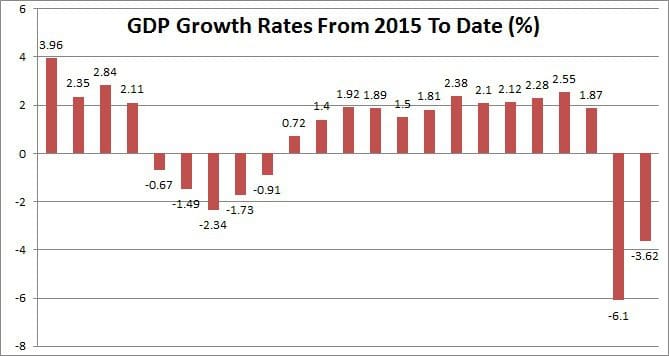
“Nigeria’s GDP recorded a growth rate of -3.62 per cent (year-on-year) in real terms during the third quarter of 2020. Cumulatively, the economy has contracted by -2.48 per cent.
“While this represents an improvement of 2.48 per cent points over the -6.1 per cent growth rate recorded in the preceding quarter (Q2 2020), it also indicates that two consecutive quarters of negative growth have been recorded in 2020,” the NBS says.
The NBS adds that 18 “economic activities” sectors recorded a positive real growth as against 13 activities that witnessed a contracted growth, suggesting that the downturn may not be as depressing after all.
Much as NBS’ evaluation may be true, it says nothing about the peculiar systemic risks which economists say might stifle growth for a long time to come.
No doubt, every economy is struggling with the threatening economic effects of Covid-19 with frugal and debt-shy countries, including Germany, seeking a sovereign facility to pull out their economies from the claws of Covid-19.
But Nigeria was already neck-deep in crisis before the Covid-19 escalated towards the first quarter.
“Before the pandemic, the economy was not doing well,” says Akpan Ekpo, a professor of economics and the founder of Foundation for Economic Research and Training. Ekpo, who listed insecurity and the mono-culture nature of the economy as some of the pre-pandemic challenges, says the recession has only driven the country deeper into the crisis.
Indeed, insecurity has decimated the economy of the entire northeast, which is also about one-sixth of the country’s population. A report by the United Nations Office for the Coordination of Humanitarian Affairs says 53 per cent of the entire population in Borno, Adamawa and Yobe require humanitarian assistance. About 13 per cent of the entire population of the three states are said to be internally displaced persons (IDPs).
While Boko Haram has taken northeast hostage, northwest has to bear with the activities of bandits, who evade communities and kill in dozens while taking young women hostage on the go. Over 21 million individuals in Zamfara, Kaduna, Niger, Sokoto, Kebbi and Katsina states are said to have been exposed to banditry, which started as a farmer/herder conflict about 10 years ago.
A report by ACAPS, a non-governmental research organisation, says the banditry which has degenerated into violence, sexual harassment, cattle hustling and killings, has affected activities in, at least, 35 local governments in four states of northwest alone.
Yet, ACAPS research said nothing about the crisis in Benue and Nasarawa states, where banditry originated in 2011 when farmers were attacked and killed by herders while their bodies were dismembered and littered on the roads.
President of the Yam Farmers Association of Nigeria, Prof. Simon Irtwange, said the farmer/herders crisis in Nasarawa and Benue is as troublesome today as it was 10 years ago. The professor, who is also the former President of the Institute of Chartered Economists of Nigeria (ICEN), says there is a positive correlation between rising insecurity in the north and escalating food inflation, which hit 17.38 per cent in October.
“It should not surprise anybody that the cost of food keeps rising. People do not go to the farm. On a daily basis, there is a story of a woman who was raped on the farm. There are reports of men who were killed brutally on the farms. So, people stay at home because of fear of being attacked,” Irtwange told our correspondent.
As the Federal Government continues to renege on its two-year-old pledge of N10 billion to rebuild states hit by herders’ attacks for seamless resettlement of displaced persons, Executive Secretary of Benue State Emergency Management Agency (SEMA), Dr. Emmanuel Shior, raised the alarm over impending humanitarian and food crises in Benue.
Shior, who discloses that there are stranded 500,000 IDPs in the state, draws attention to ranging “pockets of attacks”. Ironically, what Shior called “pockets of attacks” recently took the lives of 13 individuals in Obi local government alone.
Elsewhere in the Federal Capital Territory, Kogi, Edo, Delta, Enugu, herders and other bandits are killing in tens, scaring the locals away from farmlands.
There is also rising tension in Zamfara State over local as illegal gold miners seize swathes of lands, costing the government loss of revenue in addition to intensifying the insecurity.
ECONOMISTS and allied professionals have traced the rising food inflation to the tension in the north.
Indeed, northern states have witnessed faster food inflation than their southern counterparts since the beginning of the year.
Kogi, Kwara, Jigawa, Sokoto, Taraba and Zamfara, for instance, have remained drivers of the food inflation – showing the debt and scale of the food crisis.
The Structural Adjustment Programme (SAP), touted as the miracle pin that would bail out the economy from the budding Dutch Disease only launched the country deeper into a mess but its termination never stopped the hemorrhage.
The economic managers thought the falling naira was a little problem that would go away in a matter of time only to realise years later that it was, indeed, a falling knife.
The direction of the foreign exchange (forex) market has become the ultimate decider of many other economic indices – inflation, employment, standard of living and many others.
Whenever the naira crashes, inflation escalates, making prices unaffordable and the standard of living falling. Whenever the naira falls, industries, which depend largely on imported raw materials, experience major distortions and begin cost-cutting measures, including layoffs.
Dr. Ayo Teriba, CEO of Economics Associates, says “Nigerians would have to bear with high inflation rate” until the country is able to boost non-oil imports to address the oil crisis-triggered forex illiquidity that has become a perennial challenge in the economy.
The government has paid lip service to non-oil sector development for several decades. Strategies employed seem to be inefficient; at least, they are yet to produce substantial results.
Nigerians cannot still feed if foods are not imported. The textile plants have yet to roar to life despite several interventions made by the Central Bank of Nigeria. The country still depends on imports to make its transport functional.
Innoson Vehicle Manufacturing (IVM), the solo local car manufacturing, not talking about assembly, is treated with disdain by government, public officials and the elite who have the means to buy brand new cars.
The lawmakers who suggested the automobile should be patronised for their utility vehicles at the start of the current legislative session could not pull through their proposal.
Used cars have become a major drain of forex. According to the United States Department of Commerce, Nigeria imported 82,180 units of vehicles, the value of which was N161 billion, from the country in 2018. Information from the department said Nigeria was the third highest importer of used vehicles from the U.S, coming behind the United Arab Emirates (UAE) and China.
‘World’s Top Exports’ says Nigeria spent $5.6 billion on vehicle importation last year, and vehicles come behind machinery and mineral fuels on the list of top imported items. Machinery, which includes computers, and minerals fuels consumed $9 billion and $7.4 billion respectively.
Machinery, mineral fuels and vehicles only symbolise the country’s (rising) penchant for imported items. The list is endless – clothes, cereals, cosmetics, pharmaceuticals, steel and many others. The Lagos Chamber of Commerce (LCCI) has complained in vain about every policy on energy, interest rate, infrastructure, duty, taxes, security coupled with several other areas of governance that have made it uncompetitive for local industries.
There are also fiscal misdeeds, Bala Zakka, an energy economist, said have made the recession self-inflicted. With the public currently standing at over N13 trillion, the government does not have enough latitude to take more loans to drag out the economy from the downturn. The country’s debt to GDP is only 18.3 per cent, which means Nigeria is in a comfortable position and could still take more facility. After all, some country’s loans to GDP are over 200 per cent.
But Ken Ife, a professor of economics and financial analyst, says the cash flow, which is a major consideration by lenders, is a serious challenge. Close to one-fourth (24 per cent) of the 2021 proposed budget will go into loan servicing. This has consequences on the fiscal position of the country.
And the oil benchmarks are bogus and unrealistic. Zakka says it is unimaginable that a country that has gone through several oil market shocks would pick the current price as a budget benchmark. Nigeria’s quota is currently about 1.3 million barrels per day but the country hopes to sell 1.86 million barrels per day to meet its revenue target. Zakka describes the volume benchmark as absurd.
Also, the purchasing power of an average Nigerian has been at the lowest point, as shown by the purchasing manager index (PMI) of the CBN. Ekpo says the recent increase in pump prices of petroleum motor spirit (PMS) and electricity tariffs has even worsened this. Aggregate demand is a summation of the demand of individual households. A low aggregate demand means low production and higher unemployment. This nexus is critical for deciding whether to retain the hike in the two essential consumption items and reversing them as advised by Ekpo.
WITH back-to-back negative growth in GDP, Nigeria has entered a deep recession. It is deep when one considers steepness of the fall (-6.1 per cent in Q2 and -3.62 in Q3) compared to a decline of 0.4 per cent (Q1 2016) and 2.1 per cent (Q2 2016) that plunged the country into the previous recession. And when Nigeria came out of the recession in Q2 2017, it was the jump in crude prices that came to Nigeria’s rescue.
Today the immediate future of oil is more uncertain than any other time in the history of the industry. This is because as observed by the Director, Centre for Petroleum, Energy Economics and Law, the University of Ibadan, Prof. Adeola Adenikinju, COVID-19 (not man), a natural challenge, is the ultimate decider. How different countries will respond to the second wave and vaccination will tell how soon the market will rebound.
If oil prices rebound today, other underlying challenges are as debilitating. And as complex as the recession is, nothing says the extremely fragile growth has hit the trough yet.
Yes, it is a recession but no expert wants to bet a rebound is in sight. The uncertain Covid-19 trends are a pullback. Still, there are many more self-inflicted challenges that make Nigeria’s recession in the midst of a global lull a unique experience.


3 comments
… [Trackback]
[…] Here you will find 17333 additional Info on that Topic: naijatimes.ng/a-second-recession-in-five-years-why-a-rebound-is-uncertain/ […]
… [Trackback]
[…] Information to that Topic: naijatimes.ng/a-second-recession-in-five-years-why-a-rebound-is-uncertain/ […]
… [Trackback]
[…] Read More Info here on that Topic: naijatimes.ng/a-second-recession-in-five-years-why-a-rebound-is-uncertain/ […]
Comments are closed.