

•Praise youths’ resilience, organisational ability
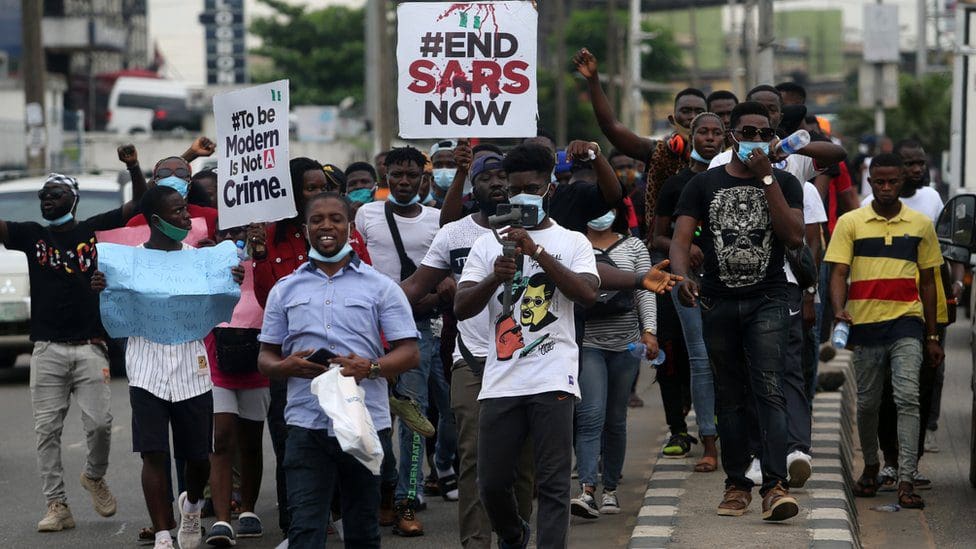
THE agitation against police brutality by Nigerian youths, tagged #EndSARS protests, which rocked the country for almost three weeks may have come and gone but its effects on the polity have continued to generate reactions.
As part of efforts to examine what has become a landmark in the history of agitation in Nigeria, an eminent scholar at the Institute of African Studies, Carleton University, Ottawa, Canada, Prof. Nduka Otiono, organised a virtual roundtable discussion with the theme: Democracy, Youth Agency and the Nigerian crisis.
The discussion, which brought together six brilliant minds in various fields from three continents, lasted for two hours.
According to the statement released by the organisers of the discussion, the purpose was “to do a spot-on analysis of the remote and immediate causes of the protests, its antecedents in the country since independence, the surprising resilience and organisational ability of the protesters.”
Also discussed was the significant roles of feminists (DJ Switch particularly) and social media, what the government needs to do, solutions from within and without and possible outcomes in the coming years.
The discussion was also part of the Umeme Flashpoint Series of the Institute of African Studies (IAS), Carleton University, Ottawa, Canada. Explaining the meaning of “Umeme”, the statement said, it is Kiswahili word for “lightning, the perilous bolt of electricity flashing across the sky which demands attention and reactions.”
Unveiling the identities of those who took part in the round table discussion, the statement read in part, “The participants were an eclectic mix of some of the best minds you could ever find. There was the moderator himself, Nduka Otiono, professor of graduate program at IAS, Carleton, anchoring the roundtable. Two professors, Obijiofor Aginam, Principal Visiting Fellow at UN University International Institute for Global Health, Kuala Lumpur, and Bonny Ibhawoh Senator William McMaster Chair in Global Human Rights at McMaster University, respectively, were panelists.
“Also in the panel were Ms. Yejide Kilanko, therapist in Childrens Mental Health, author of best-selling novel, Daughters Who Walk this Path, and Comrade Abdul Mahmud, Human Rights Activist, President of Public Interest Lawyers League (PILL) and poet who writes under the pen name Obemeta.
“Like Mahmud, Princess Hamman Obells is a rights activist and expert in Election and Governance. Hon Abdul Oroh was once Executive Director, Civil Liberties Organization (CLO) Nigeria, former member of the House of Representatives and now Principal Counsel of Abdul Oroh & Company Legal Practice.”
In his introductory remark, the moderator, Otiono, noted that “the panel was chosen very carefully to represent different tendencies and different interests”.
He disclosed that what prompted the decision was the need to have “a very frank and brutal discussion about the state-of-the-nation regarding the recent #EndSARS youth uprising against oppressive policing and the decadent leadership that has left Nigerian youths almost hopeless in an otherwise immensely blessed nation.”
Otiono stressed that though a long history of systemic sociopolitical decadence could be said to be responsible for the protest, the immediate cause was the celebration of the country’s diamond jubilee.
The moderator launched into a quick summary of the #EndSARS uprising from the beginning to when it was brutally quelled and the government’s intimidation of the promoters of the agitation through different means.
“Driven by a common cause, availing themselves with ample opportunities on social media, thousands of young Nigerians massed out at Lekki Toll Gate Lagos in a peaceful protest against endemic police brutality.
“Galvanised by the protest in Lagos, youths in more than a dozen state capitals followed suit almost immediately, staging their own peaceful demonstrations as well, effectively shutting down activities in much of the country for the period it lasted.
“Taken completely unawares, the federal government acquiesced to the protesters’ demand by swiftly announcing the dismantling of the Special Anti-Robbery Squad (SARS) fingered by the protesters as their main source of grievance. And even more quickly substituted the reviled SARS with a new outfit called the Special Weapon Tactical Team (SWAT).
“The protesting youths turned down the offer promptly, insisting it was just a change of name, and went one step further, this time to the government’s great discomfort.
“Now, young people all over the country were using the protest to express displeasure with those in leadership positions, their anger and frustrations at a failed democratic process, unpromising economic prospects and general apathy of an elite political class to the plight of the long-suffering masses.
“It was phenomenal and totally unexpected. Confronted with unforeseen situations like the October protest that has now entered into world lexicon as #EndSARS uprising, the federal and state governments reacted typically with panicky measures, what Professor Wole Soyinka once described as ‘herd panicking’ in the early stages of Covid-19 in Nigeria.”
Much of what happened since then is in the public domain: fatalities in an army-organised shooting at Lekki; looting and burning of government and private properties after hoodlums hijacked the protest; the curfews imposed in most state capitals and towns in Nigeria, including Abuja; the presidential panel and others set up by governors to look into all of that; the sudden interest in and announcement by the authorities of long-forgotten empowerment programs aimed at Nigerias youths.
“If the last was meant to pacify the protesters, it didnt help matters much as the government soon proceeded to seize the International Passports of key players and prevented them from travelling outside Nigeria (some passports have been returned); freezing of bank accounts used to provide logistic support to the protesters (none has been de-frozen); labelling some of the key participants terrorists (yet to be proven.)”
The statement traced the history of agitation in the chequered history of Nigeria from the early years after independence to the 70’s and 80’s and even the June 12 agitation to put the recent #EndSARS protest in perspective.
It said, “To be sure, it is not the first-time demonstrations spearheaded by young people would erupt in Africa’s most populous country. There was the students protest against the Anglo/ Nigeria Defence Pact of 1962, for instance.
“There was the Ali-must-go riot of 1978 when the same university students protested a fifty kobo increase in meal vouchers leading to confrontations with the police that ended in fatalities.
“The 1988 fuel subsidy and 1989 SAP riots which later spread nation-wide were instigated by students at federal universities in Jos and Benin, respectively. Demonstrations against the June 12 annulment began in the University of Benin, then spread across much of the country with fatalities.
“Since then, young people have always been in the vanguard of protests for a better Nigeria — through the Babangida and Abacha dictatorial regimes. But #EndSARS protest was different. Previous ones occurred during military dictatorships. This is the first time a civilian government would be confronted with one.”
Declaring the discussion open, Otiono explained further why the roundtable had come to be, born out of IAS’s Umeme African Flashpoint Series.
He reminded the audience that the Umeme series “evokes the perilous bolt of electricity flashing across the sky, which demands attention and reactions just as we are doing.”
First to speak after the moderator’s opening remarks was Aginam. He agreed with how the rest of the world felt about the alleged shooting at Lekki on October 20, declaring that any government that opens fire on peaceful protesters anywhere in the world has committed a serious crime. That’s condemnable.
“Identifying completely with the youths, Aginam tied the main cause of the uprising to failure of leadership which, in turn, spawned bad followershipsince independence. Why do we follow bad leaders?Aginam asked rhetorically.
“Allowing there are no easy answers, he however suggested a possible cause: politicians who induce voters only during elections. You see the same people who have oppressed the masses, these people once its six months or so to an election, all we see is distribution of all kinds of resources, material and financial to induce voters.”
Recommending how the youth can sanitise the polity, Aginam said, “What young people can do to counter that is to form political parties of their own, a third, fourth or even fifth force as witnessed in the last presidential election where two young, dynamic Nigerians, Omoyele Sowore and Kingsley Moghalu were candidates of different platforms other than the dominant two – APC and PDP.”
Ibhawoh, in his own case, compared the #EndSARS protests to the Arab Spring. He wondered how it can then metamorphose into real change, into changing political leadership.
The Arab Spring, he reemphasised, was an exciting opportunity meant to mark the democratisation of the Middle East. It was a still-born revolution… Egypt, Libya, nothing changed. Lives were lost, nothing changed.
Ibhawoh said, “The crucial challenge for us the Nigerian people invested in Nigeria is how do we make sure that this is just not one more decades-long student, youth uprising the likes of which weve seen before?”
Ibhawoh also commended the role of women – Feminist Coalition – social media in the uprising but commended more the spirit of the generation that started it all. Our generation were cowed by the repression of the military, the professor said, referencing the previous generations of Nigerians who were either too timid to confront their oppressors or were just plainly complacent.
Unlike their fathers generation and those before, Ibhawoh suggested that this generation grew up in democracy. They are unencumbered by the fears of the civil war.
They are un-cowed by military dictatorship, by the memories of military dictatorship and so for them it is an opportunity to see this uprising across the line in ways that our generation and the one before us could not.
“We are also seeing a generation that is less susceptible to the old tricks – manipulation and division along religious, ethnic and tribal lines whereas our generation and the ones before were steeped in that kind of political manipulation, that tried and tested divide-and-conquer strategy of the Nigerian political oligarchy.
For the protest to have begun at all is some kind of optimism for Ibhawoh: If it is well managed we might be seeing the beginning of gradual change in Nigeria, the leadership that the youths have taken advantage of: the power of social media.
In her contribution, writer and psychotherapist, Kilanko, declared her full support for #EndSARS youth uprising, and then praised their enduring spirit.
She said, “I am impressed with what is happening in Nigeria in terms of the youth uprising, also with the Feminist Coalition, they have done an amazing job in coordinating the protest with accountability.”
The therapist particularly praised the determination of the youths to seize their future in their hands by speaking up (s’oro soke in Yoruba) and the hope that it will spill to them becoming part of the democratic process.
“We need to use this opportunity to move forward. However, that cannot be achieved without proper education because if we are going to move forward, we need education, we need to have the people have an understanding of what it means to be part of the democratic process,” Kilanko added.
The next speaker was Comrade Mahmud, renowned for his record of being in the frontline of protests dating back to the late eighties as a student union leader, through June 12 to the pro-democracy movements during the military dictatorship of Abacha. Going by his reputation as an activist he appeared poised to hold listeners and viewers attention:
“The #EndSARS protest didnt just start last October,” he said. And added, “It began sometime in 2016 after a young Nigerian, Kolade Johnson, was killed by a stray bullet fired by a police officer at an English Premier Soccer League viewing centre where the 22-year-old was.”
If the veteran activist has no faith in a government uneager to prioritise issues on and about young people, no faith in the cosmetic concessions they dole out now and then to placate protesting youths, he is even less sure how far those youths can go with their actions.
Mahmud said,“What the #EndSARS uprising has achieved is to have humanised citizenship in our country, they have posed that agenda that their lost citizenship can be recovered, their future that was stolen yesterday can also be recovered. But to what extent all of these have been recovered is out there for us to provide answers to.”
Obells followed by providing at least one answer when called upon by the moderator.
She said, “The government – state or federal – has a lot to learn from the organisational ability and swift mobilization demonstrated by the youngsters. Within a day, they had a website running, Obells said. Within two days they had raised N25m. Within a week they had N75m.”
Obells praised the syndicated control of the protesters across the states, their accountability and transparency – the very things they were demanding of those ruling them.
In her words, “All donations were announced and made public down to what they were spent on. Shorn of the traditional vertical leadership style, Obells insisted, things worked perfectly horizontally for them. Thus, the medics were always handy, caterers, too, even street hawkers who came around handing out water or soft drinks at their own expense. Many more sympathisers came with food.
“One of the immediate results of the protest was on account of food. As it gained momentum, the masses hijacked it and raided warehouses brimming with foodstuffs meant to be shared to them as palliatives because of Covid-19 pandemic,” Obells noted
She added that “people were now taking what belongs to them, refusing to call them hoodlums. They are just hungry Nigerians. They are looking for food.
“What you can’t downplay in the protest is the role women played, women like DJ Switch and other ordinary female folk, making themselves felt and useful all through.”
She noted that it shows how much women can offer if there is gender parity.
One negative aspect of the protest to Obells was the lack of prompt response by regional bodies like ECOWAS, calling out the chairman and Ghanaian president who sent a belated message through Twitter. They probably want us to have total mayhem before they will react, Obells said, concluding that it was not good enough.
In many ways, the next speaker Hon. Oroh represents both sides of the divide: a well-regarded former rights activist who led campaigns against the excesses of government concerning human rights and former lawmaker in the Lower House of the National Assembly.
For him, the #EndSARS uprising has raised issues about governance, about our lives, everything.
Though not out at the barricades now as he used to in the past, Oroh gladly let on that his sons were actively involved in the recent youth protest. But what got him mostly were some of the placards the demonstrators held aloft. One of them, Oroh said, proclaimed what sums up the protest. “Our Mumu don do,” like the youths were saying enough of our timidity, enough of our passivity. This is the time to ‘s’oro soke’, to speak up. We can’t continue like this.
Before the youth uprising, the former lawmaker submitted, “Nigeria was becoming gradually diminished. Now, our youths are saying we see a big country with big potential. This is our country, and we are trying to take it back.”
Oroh’s presentation wrapped up the first segment that lasted for about an hour, but it seemed to have only just begun, considering the many questions posted to the moderator during the Q &A session, the eager hands up to make their contributions (some of whom/which he regrettably had to skip) due to time constraints.
Notwithstanding the skipped responders, the Q&A session proved extremely lively and informative. The surprise of the session was popular stand-up comic Okey Bakassi who spoke from his residence in Lagos.
The session was recorded and is now available on IAS’s website and YouTube:https://carleton.ca/africanstudies/


4 comments
… [Trackback]
[…] Find More here to that Topic: naijatimes.ng/diaspora-nigerian-scholars-in-canada-conduct-post-mortem-on-quashed-endsars-protest/ […]
… [Trackback]
[…] Info to that Topic: naijatimes.ng/diaspora-nigerian-scholars-in-canada-conduct-post-mortem-on-quashed-endsars-protest/ […]
… [Trackback]
[…] Here you can find 88922 additional Information on that Topic: naijatimes.ng/diaspora-nigerian-scholars-in-canada-conduct-post-mortem-on-quashed-endsars-protest/ […]
… [Trackback]
[…] Read More Information here to that Topic: naijatimes.ng/diaspora-nigerian-scholars-in-canada-conduct-post-mortem-on-quashed-endsars-protest/ […]
Comments are closed.