
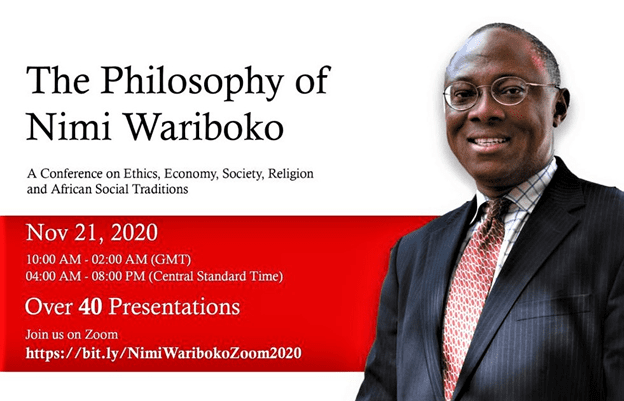

PROFESSOR Nimi Wariboko is not a man of war but on Saturday November 21, 2020, intellectuals with varied analytical tools and weapons of words came online to discuss and dissect his corpus of works. The conference on Ethics, Economy, Society Religion and African Social Traditions was organised by The University of Texas, Austin and Boston University (Institute on Culture, Religion and World Affairs, School of Theology, and African Studies Center).
The conference was planned to both celebrate the publication of the book, The Philosophy of Nimi Wariboko: Social Ethics, Economy, and Religion, edited by Toyin Falola and to advance the conversation on the scholarship of Dr. Nimi Wariboko. “The book offers transdisciplinary engagement and assessment of Wariboko’s work. The conference was to further advance the emerging conversations on one of the world’s most original thinkers. Participants offered fresh ideas on, and had lively engagements with Wariboko’s thoughts in addition to a wide range of scholarship in the areas of philosophy, ethics, theology, economic history, Pentecostal studies, and African studies.
The entire conference must have lasted a little over 15 hours according to a very lucid report by Professor Toyin Falola, the organ and organiser of the event. The kaleidoscope of papers and their presenters gave value to the long duration of the online gathering.
Since no one goes to a market to buy everything my choices from this market of ideas were made easy for me. The paper by Dr. Marcus Harvey on “What It Means to ‘Know’ in African Traditional Religion” was the first that resonated with me. His use of Akan proverbs as the basis of his exegesis drew my ears to his mouth. The first proverb had something to do with how power and stupidity co-exist. He said “[t]oo much power leads to stupidity” and then “[i]f you want to see everything you become blind.” The third part of the Akan proverb had to do with what a mute spirit deserves. According to the proverb, it is a spirit that does not talk we throw stones at. As if those were not enough for a mid-day food for thought (please excuse the cliché), Dr Marcus then added, “if something flourishes too much it begins to spoil.” The essence of these proverbs was to deploy them as part of an epistemological analysis of traditional oral religious discourse, primarily Akan proverbs with spiritual references or implications.” He went on to “argue that a contemporary sense of what it means to know within a traditional African religious environment can be established through attention to two themes: 1) knowing as an elusive yet adaptable relationship with spirit requiring constant interplay between the ancestral African past and the immediate present, and 2) knowing as a moral crucible.”
It was at the mention of the moral crucible that my ears overlaid as principle. Therefore, in the chat box I asked if he meant crucible or principle. In his response he agreed that it could be either crucible or principle. You can always know a grounded scholar by the choice of their ideas and the authenticity in their voices. Dr. Marcus knows the confusion that attends to Africa’s spirituality and he raised his voice to correct the misinformation. “African traditional religion, he said, “tends to be understood in Western circles as something other than a vast plurality of dynamic knowledge systems with related but distinct repertoires of ideas and attendant meaning structures. This tendency is given some historical context by late fteenifth century Portuguese sailors’ practice of bringing back to Europe feitiços, African religious implements believed to contain magical properties and often regarded by Europeans as primitive, exotic curiosities imbued with dubious significance. The dismissive Eurocentric sentiment toward Africa that so characterised Enlightenment-influenced thought of the eighteenth and nineteenth centuries provides further context for this tendency.”
As he rounded up his presentation and the word gnosis kept ringing in my ears, I was sure I had chanced on a new idea for the weekend. Unfortunately, I was getting too weak from too much sitting but as soon as Professor Gerald Ellis started his paper on the economics of student loan debt, I sat up again. He introduced himself as a student of Professor Nimi Wariboko who took nine courses from him and I fell for his modesty. The man in whom the event was in his honor soon corrected the humble introduction. He wrote in the chat box, “Dr. Ellis was a professor of economics at MIT who came to Boston University to study theology and religion.”
No, wonder his presentation was an interesting mix of religious principles and economic justice. He lamented that “[t]he continuous exploitation of students (debtors) borrowing money and financial institutions (creditors) have buttressed a division of the poor and wealthy. As a result, the students whom are being treated like the “least of these” have been held hostage to creditors with excessive student loans to fund their college education. The importance of Professor Wariboko’s book God and Money and Islup Ahn’s book Just Debt, illuminate the social relation of money and how its utility can alter the relationship between debtors and creditors.” He went on to talk about how the connection of social relations is relevant to his presentation “and lends traction to understanding this fractured relationship between the oppressed debtors and the wealthy financial institutions.”
Thus far, all appears to be going well until Dr Ellis, slipped in the innocuous notion that “Economics is elegant when it is acting fairly.” Just to be sure I heard him properly I asked in the chat side bar if economics can be fair in any sense when there is money to be made and an army of gullible consumers on queue? Like a seasoned scholar, he responded that “[g]reat observation sir! I would suggest it can act fairly and justly if and only if all have an equal and just opportunity to have good paying jobs, access to capital and loans etc. It is a slippery slope “equity is always in the eye of the beholder. Thanks so much for your important point sir!!” The way the intervention came I simply quietly ended the emerging discussion.
The next presentation that claimed my attention was its poetic use of roots and routes. Professor Devaka Premawardhana, of Emory University, spoke to the topic of “‘Roots that Work as Routes’: Beyond Pentecostal Triumphalism in the Study of Pentecostalism.” One of his objectives was to highlight the originality and importance of Nimi Wariboko’s scholarship on Pentecostalism for the study of African religions. In particular, it elaborates on the following insight Wariboko offers about the foundations of Pentecostalism in his Pentecostal Principle: “these are not roots that are static and reified; instead they are adaptive, dynamic, searching for other roots to establish connections and to be transformed. Pentecostals have roots that work as routes.”
To me I wanted to know if roots are a metaphor for life giving essence for mobility.”
Dr Oluwatoyin Vincent Adepoju added his words to a growing side talk “the roots/veins metaphor is really powerful,” he said. I was not done yet; you mean roots as immobility and veins as conduits for fluid life in motion? I submitted. As our chat was ongoing, the presenter reached a point in his presentation when he said “not roots that stabilize but roots that mobilize.” Unknown to us that Professor Wariboko was paying attention to our banter he slipped in an unexpected one-liner “[f]or the metaphor of root/route see pp. 185-186 of my Pentecostal Principle.” What more can be added?
As I look forward to reading, his book and what it has to say on root/route the next presenter was getting ready. I cannot now recall what led to my chat box contribution “the afterlife starts from dreams when you see what is life’s reality & narrative re-narrated, pay attention to your dreams and its effect on your mood when you wake.” These lines must have prompted Reverend Anna Droll to inform me that “I hope you will enjoy my focus on dreams and visions in the next presentation!” That presentation was about “Wariboko’s Pentecostal Principle and the Dreams and Visions of African Visioners.” She drew from her research conducted in 2017 in Ghana, Togo, Nigeria and Tanzania. Her presentation offered “microtheology” to complement certain concepts presented by Nimi Wariboko for Pentecostal epistemology.
For Wariboko, microtheology is necessary for the purpose of demonstrating ‘what people actually do in social situations with their faith… and what are the theological meanings of such interactions.” Here, Wariboko’s “piercing the veil,” “Pentecostal principle,” and the principle’s resultant “creative emergence.” As an emerging media scholar in the midst of theologians, historians and anthropologists, I suspected I was edging close to my pay grade. The cryptic thoughts only serve as fodder for me to recreate ideas about dreams I had nurtured for long. In my own, little understanding I insisted that time spent dreaming during our period of sleep must be added as part of life within life, just as scholars think about life after life.
Two other presentations served as hot coffee for a sagging spirit. One was Professor Segun Ogungbemi’s paper on “Death, Burial Rites and Afterlife.” His submission was in form of questions “why is it that human beings, as far as we know, pay a reasonable attention of their time to a natural phenomenon called death and the hereafter? The hereafter, After-life and heaven are interchangeably used here as they mean the same thing. What are the extant African cultural narratives of the ‘institution’ of death, burial rites and afterlife before the advent of foreign religions in the continent? In other words, how did the belief find its expression and practice in the indigenous religious epistemology? What are the spiritual, cultural and intellectual challenges of this belief to African modern civilization? Is it possible for the contemporary human cutting-edge knowledge to find an alternative solution to the existential threat of death as a final destiny of human beings?” I am sure I heard him well but by the time, I was going to share; his presentation with friends here is how I presented his ideas. I reported to my social media friends that a professor categorised death as Natural… oku agba; Untimely… oku pajawiri & self-induced death… suicide. In this category, I expected him to talk about kings that are forced to commit death. He also totally forgot those who are alive but are spiritually dead.
The last part of the walking dead is my own addition and I hope to develop it further someday. I was not done yet, I felt strongly that there is a need to redefine death in a way that will take care of Bolaji Ogunseye’s proposition that “life itself never ends – AND CAN NEVER END. Unless God (i.e.) the background force or trigger energy that forms and feeds the ETERNAL (or NO TIME) DYNAMICS (emphasis his) of life ends. Which is theoretically and logically impossible.” He added, “we are NOT our body. However, the ego/mind deceives us into so thinking. People who are in body, but live BEYOND EGO and choose HOW to use the body — can demonstrate that.” I must confess that these ideas, most times, fly beyond my comprehension. I am aware of those who are dead yet walk around this earth but I have no richness of words to articulate the concept just yet.
The last paper I was fully awake to partake of was by Andrew Court, Moore Theological Church and Life Anglican Church who serves on the pastoral staff team of Life Anglican Church in Western Sydney, Australia. He was already in Sunday while those of us in Florida were working the last hours of Saturday. He spoke to “Prosperity Theology and African Traditional Religions: Assessing their Resonance through a Case Study of Pastor Chris Oyakhilome.”
Andrew Court stated that in a chapter of The Split God: Pentecostalism and Critical Theory published in 2018, Wariboko describes the features of African Traditional Religions as “the common font of inheritance or the environmental air that African Pentecostals breathe.” Although studies of Prosperity Theology in Africa have grown in depth and number as research into Pentecostalism in the Global South has burgeoned, relatively few theological analyses have explored the significance of African Traditional Religions and their role in shaping and promoting Prosperity Theology in Africa. While some studies have explored the resonance of Prosperity Theology and African Traditional Religions, they tend to either do so in passing as part of a more generalised study or with a focus on urbanity and other sociological concerns rather than theological ones. Wariboko argues that the most profitable methodologies for approaching this topic examine representative works from Pentecostal pastors rather than denominational statements.”
The part of his presentation that gripped me was when he said Pastor Chris Oyakhilome in one of his books gave a prescription against kidnapping. Andrew Court said “if you are about to be kidnapped just start speaking in tongues, do not beg nor panic; your kidnappers will be the ones to beg you.” What will I not give to anyone who wants to try this?
In conclusion, Andrew Court, argued that “Oyakhilome’s emphasis on
- accessing blessings; 2) spiritual enemies; and; 3) activating power, draws heavily on the resources of African religious worldviews.”
MY take away from all the presentations is that “spirituality focuses upon the human experience of making meaning, tapping into the perception of connecting with something larger, grander, more profound, more meaningful to life than mere sense experience. Spirituality is ubiquitous, spanning all eras, chronological and physical ages, genders, social classes, religious systems, races, cultures, geographic locations, monotheism, polytheism, non-theism, agnosticism, and/or atheism.


0 comments
… [Trackback]
[…] Read More on on that Topic: naijatimes.ng/the-philosophy-of-nimi-wariboko/ […]
… [Trackback]
[…] Information on that Topic: naijatimes.ng/the-philosophy-of-nimi-wariboko/ […]