

The CBN through the Bankers’ Committee is willing to invest N21.8 billion to renovate the National Theatre, refurbish it, and run it profitably… Critics of the planned Public-Private partnership call for the publication of the contract, which for now remains out of the public domain. Clarity on the destiny of the current staff is required, while it should also be ensured that the FG supports the arts in a broader sense.
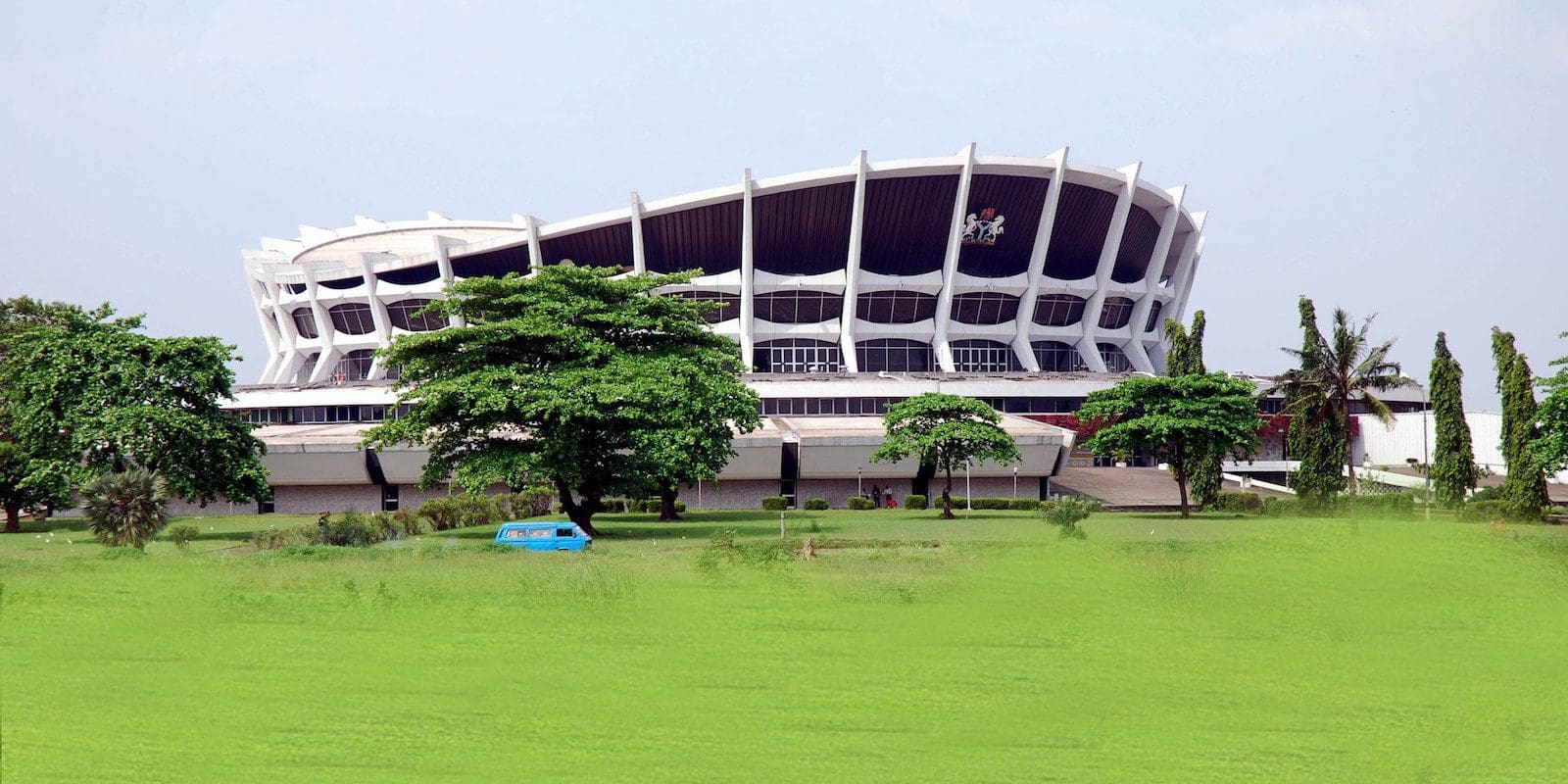
THE Lagos-sited National Theatre is an icon for everyone in my generation and a recognisable sight for those commuting between Lagos Mainland and the Island. The majestic structure, 19km away from the airport, sits in Iganmu like a quiet mountain for the last 45 years. It is an impressive edifice that most have only seen in passing, but somehow also one of the major attractions of Lagos. Many wonder what is really going on there. Now we know.
Eyes of a Lagos boy‘s visit to the National Theatre conducted by The Nigerian Field Society was an eye opener. One of the Directors of the complex showed us around the building; he also shared the history and activities that took place there. The theatre still holds such treasure and memories.
The beauty of that facility frozen in the 1970s is unmatched, even in its decaying state. The staff of the National Theatre have done a great job in keeping it clean, with two auditoriums still hosting conferences, dramas and events. The art works at the complex remain in an amazing shape that fills everyone with pride. The complex runs at a minimal fraction of its desired capacity that feels like an induced slumber.
The National Theatre is packed with the artworks of legendary contemporary Nigerian artists; stained glass walls by Yusuf Grillo, sculptures and murals by Lamidi Fakeye, Erhabor Emokpai and many others.
…Hosting the black family from all over the world
THE complex was put to full use for a month as one of the four venues of the Second World Black and African Festival of Arts and Culture, tagged FESTAC ’77, a major international festival held between 15 January and 12 February of 1977. It hosted 16,000 participants from 56 African countries and the diaspora in an unprecedented showcase of African music, fine art, literature, drama, dance and religion.
FESTAC 77 was hosted by Nigeria to set the tone of the cultural emancipation of Africa and creating a platform for its legion of talented artists. One of its aims was to promote black and African artists, performers and writers and facilitate their world acceptance and access to world outlets. World class superstars of the time flocked to Nigeria, Mariam Makeba, Stevie Wonder, Ipi Ntombi, Osibisa, Mighty Sparrow and a host of others. This also paved the way for many American artists of the 1980 who visited Nigeria to perform at the theatre such as Skyy, Shalamar, Musical Youth, Brothers Johnson, Dynasty, Kool and the gang and many more.


The birth of the dream…
THE commencement of the building was ordered in 1973 by the military government of Nigeria under General Gowon. It was designed and built by Technoexportstroy, a Bulgarian company, mirroring the (smaller) Palace of Culture and Sports in Varna, Bulgaria. The popular claim that the Theatre was designed to look like the late General Murtala Muhammed’s military cap is only a grapevine coincidence.
Completed in 1976, the complex is one of the largest and most beautiful of its kind on the African continent. It consists of a central hall with 5000 seats and a diameter of 52 meters, a collapsible stage that can be quickly rebuilt for concerts, meetings, film demonstrations and various types of indoor sports competitions. It also hosts a conference hall with 1600 seats, which can be used for various purposes and converted for banquets and cocktails; two large exhibition halls and two cinemas with 800 seats each. The theatre complex has dressing rooms for 600 artists at a time, a garage for 150 cars, 80 offices, 4 coffee bars and a buffet. There is central air conditioning, indoor TV and radio systems, as well as booths with facilities for simultaneous translation of eight languages; and, hectares of lush green lawn around.
A slip into disfavour…
THE complex became a shadow of itself in the last couple of decades as if the world of arts had left it in its tracks. The economic downturn and mismanagement in the cultural sector, coupled with lack of maintenance did the venue in. The facility became the example of a failed project as performers had to look elsewhere to host their shows. The Theatre complex was in a state of partial abandonment as it started failing. Power failure became a huge concern and there were stories of air-conditioning not working so that audiences had to use hand fans!
The early to mid 90s saw the resurgence of events at the National Theatre, when the Yoruba ‘home video’ movies were viewed at the venue. Bayo Adewusi, Alade Aromire, Ireti, Baba Suwe, Ogogo and several other stars of the Yoruba theatre circle showcased their arts in the complex. The influx of traffic of Nigerians to the theatre every weekend to watch movies at an affordable price became a thing, but it was accompanied by insecurity, muggings, car thefts and harassment by area boys. The area became a place one did not want to be around at night as it was simply dangerous. Piracy of ‘home videos’ finally killed the culture of theatre-going for many Nigerians.


A long journey to renewal….
FORMER president Olusegun Obasanjo, who opened the National Theatre as a military leader in 1976, proposed its privatisation in 2001, but was met with stiff resistance by Nigerian artists and citizens. There have been different solutions proffered over the years to rehabilitate the complex and to bring it up to date. One outstanding rumour was that the Theatre had been sold to a Dubai company in 2014, which led to an uproar by Nigerians who suggested that it should not be privatised but be left in care of the government, especially as it is a public property.
Last week, the federal government finally approved a Central Bank of Nigeria intervention. The Memorandum of Understanding (MOU), signed on 14 February, (between the Federal Government and the Bankers’ Committee led by the CBN) heralds a new life for the complex, and by extension the Nigerian arts and culture scene. The renovation of the complex, according to the CBN governor, Godwin Emefiele “would attract investment in the already booming cultural sector and can earn over 20 billion USD yearly from the creative industry and over one million jobs are expected to be created in five years.”
The CBN Governor projected that the upgrade of the theatre will create a minimum of 10,000 direct and indirect jobs during its construction phase. This is in addition to the 25,000 employees that will be engaged in different sections of the monument when the ‘Signature Cluster’ of the building is completed. The Signature Cluster will consist of a building each for music, film, fashion and information technology verticals. The CBN through the Bankers’ Committee is willing to invest N21.8 billion to renovate the National Theatre, refurbish it, and run it profitably.
Critics of the planned Public-Private partnership call for the publication of the contract, which for now remains out of the public domain. Clarity on the destiny of the current staff is required, while it should also be ensured that the FG supports the arts in a broader sense.
As these positive steps are being taken to inject life into the National Theatre, the world awaits an explosion of artistic and cultural production and expressions again, spurred by the singular rebirth of the complex.
- Originally titled “A look inside the National Theatre Lagos”, the article was sourced from: https://eyesofalagosboy.com/2021/02/28/a-look-inside-the-national-theater-lagos/


4 comments
… [Trackback]
[…] Find More Information here to that Topic: naijatimes.ng/a-look-inside-the-national-theater-lagos/ […]
… [Trackback]
[…] Here you will find 63400 more Information to that Topic: naijatimes.ng/a-look-inside-the-national-theater-lagos/ […]
… [Trackback]
[…] Read More Info here to that Topic: naijatimes.ng/a-look-inside-the-national-theater-lagos/ […]
… [Trackback]
[…] Information on that Topic: naijatimes.ng/a-look-inside-the-national-theater-lagos/ […]
Comments are closed.