

‘…over the years, more and more Nigerian music stars are making it a duty to release protest songs as their way of advocating against the ills and wrongs of the society. Through their lyrics, they have also called out the Nigerian government for its actions and inactions, asked for accountability and better governance at different times.’
MUSIC has a life all by itself. It is that life or presence that is able to abide with its listener long after the tune has faded. It carries a memory because it keeps unimaginable units of records. Memory is a potent weapon of recollection. Music is much more.
It is more soothing and energising than any other source of inspiration for thoughtful action. Among the religious, it is written in the Bible that in heaven, there is a steady chanting of Holy, Holy is the Lord God of Host…,” by the angels. These chants celebrate the majesty of God. In African traditional religions, music is an integral part of worship. It binds, it draws the worshipped closer. It purifies and pacifies not just the soul but also the physical body.
But as far as our subject today is concerned, I see music from the perspective of patriotism, nationalism and commitment to the betterment of one’s community, state and nation. I consider it to be a veritable medium for social mobilisation.
Nigeria has a strong musical tradition in this direction. Today, musical content produced in Nigeria is largely entertainment-driven; but even so, there is a strong thread of public interest, politically active voices.
Given the versatile nature of music and its ability to mirror just any aspect of society, there is hardly any part of life in Africa and Nigeria that has not been captured by music. From the ‘early days’ of lullabies and songs whose origins certainly predate Africa’s encounter with Western Education to the era of colonialism, music has always been a rallying point to inspire and mobilise the people for chosen causes.
In one sense, music was a tool for mobilizing tool in the struggle for independence from colonial rule.
Generally, musicians articulate their perceptions of the existential conditions in their societies, highlight the importance of relevant issues, promote and proffer ideas and solutions to their audiences in lyrics pregnant with meaning.
In this tradition we may consider a few musicians who saw in the craft a powerful tool for the reorientation and mobilisation of their people for critical causes at important moments in history. These cover both Nigeria and the black race:
- Fela Anikulapo-Kuti, Bob Marley & Lucky Dube: These legends responded to the prevailing socio-economic challenges of their day through music. For them, music was their gloves and guns in the battle for social emancipation. They gave a voice to the voiceless and put power in check. Their lyrics left no one in doubt as to the original conditions of the suffering masses and the failure of the political class on the African continent and the diaspora.
They may now be dead but it will be extremely difficult to erase their work and their worth in the minds of the common Africans who continue to find in their artistic production truths that, if the truth were to be told even today, still ring very, very true.
Fela, for instance, used his music as a weapon to fight corruption, injustice and the dysfunctional government in Nigeria and Africa. Though he died almost 30 years ago, much of what he decried is still very much around with us to this day.
Jamaica’s Bob Marley literally surrendered his talent to the cause of the poor, weeping, displaced African, home and abroad. His songs reminded the world about the plight of The Buffalo Soldier who has fought virtually every war around the world in defence of others and their wellbeing and has never once fought to free himself. Lucky Dube was yet another.
He stood still to fight apartheid in racially segregated South Africa and sang till the evil system sunk. Majek Fashek and Sonny Okosun are two other examples from an Africa and their sacrifices may be said to have yielded some fruit.
If there is one thing these foregoing examples did it was that they have now emboldened another generation of musicians bent on taking music for social consciousness to yet another level.
It is easy to see therefore how over the years, more and more Nigerian music stars are making it a duty to release protest songs as their way of advocating against the ills and wrongs of the society. Through their lyrics, they have also called out the Nigerian government for its actions and inactions, asked for accountability and better governance at different times.
Those who have become latter day converts to this creed include:
Eedris Abdulkareem
He is no doubt one of the most vocal critics of the Nigerian government. He will be easily remembered for the hit ‘Nigeria Jaga-Jaga’. It was a song that fetched him the anger of then president Olusegun Obasanjo. The song implied that the country was in disarray. His album highlighted corruption and suffering in Nigeria. Years down the line and his songs still resonate with the masses and the message has remained relevant.
Asa
‘There’s fire on the mountain’ was a hit that used persuasive vocal delivery to tell the Nigerian story in one blend of passion and protest.
Femi Kuti
His music is politically inclined as he sings about political corruption, poverty and primitive living conditions suffered by Nigerians. Femi continues to call out the Nigerian government and reminds the people of the need for social change. He’s been using music to inspire, change and motivate African people. Femi is following in the tradition of his father Fela.
Seun Kuti
The youngest son of Fela Kuti. Just like his father, he’s also a musician and activist.
Daddy Showkey
He has continued to be an activist for social reform and a loud voice in organising anti-government protests.
* Falz*
The socio-political consciousness that marks his songs is one that many Nigerians find welcoming in an industry where all music content appears to be heading in the same direction. His album “Moral Instruction” boasts songs criticising politicians, corruption, police brutality, prostitution, social injustice and internet fraud.
Burna Boy
Self-acclaimed ‘African Giant’, Burna samples heavily from Fela’s music. Songs like “Collateral Damage” and the recent “Monsters You Made” are protests about Nigeria’s problems. He mentions and complains about lack of water and the non-existent power supply in Nigeria.
Conclusion
Andrew Fletcher famously said, “Let me make the songs of a nation, and I care not who makes its laws.” Ladies and gentlemen, this alone should be telling and instructive enough.
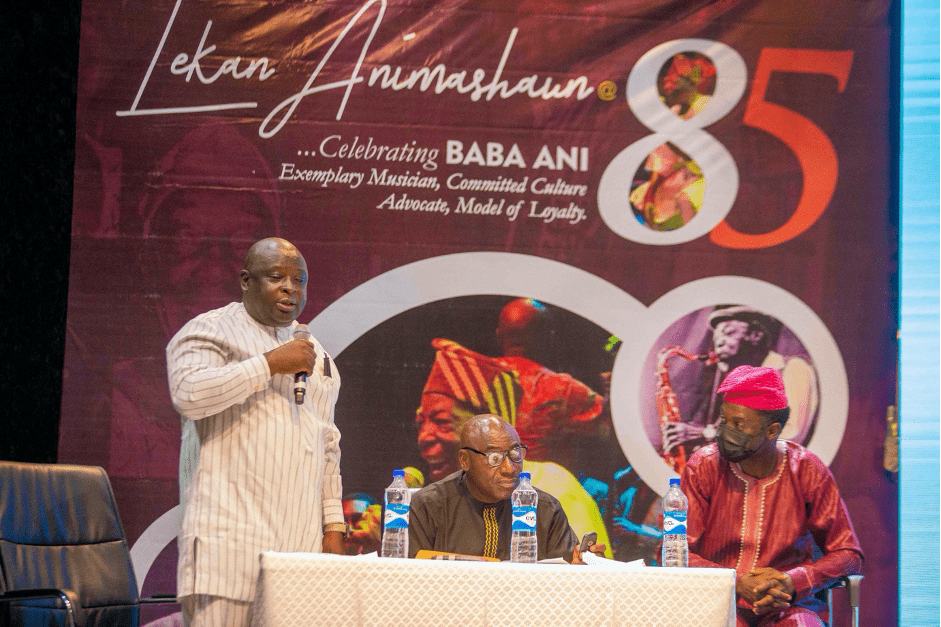
(Being text of a lead presentation by Babajide Kolade-Otitoju at the symposium marking the 85th birthday anniversary celebration of Lekan Animashaun, musician, bandleader, and ex-sideman of Afrobeat legend, Fela Anikulapo-Kuti, on Wednesday, August 18 at the Lagos Theatre Igando)



