
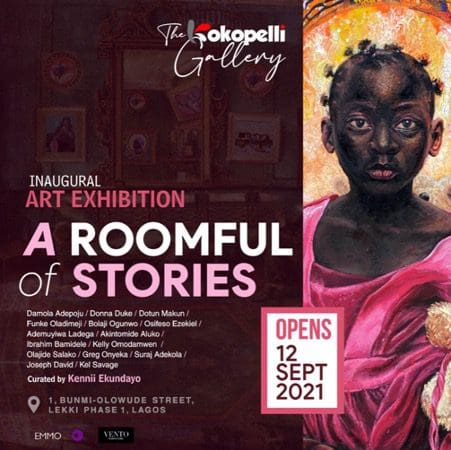


THE curator, Kennii Ekundayo will today formally presents her latest exhibition project, A Roomful of Stories, at the Kokopelli Gallery located on Bunmi Olowude street, in the Oniru segment of Lekki Phase 1 Lagos.

Featuring 15 contemporary artists, the opening is slated for 2pm, and the exhibition will run till October 16.
Artists featuring in the group show, which Ekundayo described as 15 of our finest contemporary artists are: Ademuyiwa Ladega, Akintomide Aluko, Bolaji Ogunwo, Damola Adepoju, David Joseph, Donna Duke, Dotun Makun, Funke Oladimeji, Greg Onyeka, Ibrahim Bamidele, Kelly Omodamwen, Kel Savage, Olajide Salako, Osifeso Ezekiel, Suraj Adekola.
Stated the curator: “A Roomful of Stories closely examines 15 artists whose exhibits, some appearing in singles and others, seried, yield to the artists’ anomalous positions as storytellers of their time. It sees a potpourri of various art forms — drawing, painting, sculpture and digital art — whose individual stylistic features and combined visual characteristics challenge the structure of regular art engagement whilst exploring at the same time, the materiality defining the methodical substance of each work.
“The world has not necessarily viewed the visual arts as an independent form of storytelling — as seen in the case of oral, written and digital mediums — only alluding to it within its illustrative capacity.
“It acknowledges and posits visual arts as an age-long and independent medium of storytelling seeing its use of elements and techniques commonly applied in the other forms.

“The assembled exhibits are recounts that revolve around evocative subjects such as the lot of child brides as seen in The Betrothal Series by Aluko and Oladimeji’s portrait of the forgotten seen in Ashabi, her sole memento of a deceased ally; Omodamwen’s Ovbialeke, Salako’s Dambe Series and Savage’s Hall of Masks chronicle the artists’ keen like-mindedness to valorize their native heritage while Adepoju in his piece, For How Long? satirizes the political gambits that have derided the education sector of the country through his reflection on the plight of the schoolgirl, Oreoluwa, Ekundayo explains.
“It goes to show that even when the artist is not actively sharing stories steeply associated with her/his person or experiences, s/he still serves as a conduit through which the story of another is shared.
“Visitors to the exhibition will find themselves mostly hypnotized by the rhythmic, colourful patterns of mask-like motifs represented in various colour schemes in the Faces and Phases series by Onyeka; or trying to decipher the third-person narrative form of Ogunwo whose works share a common identifier — thickly layered vibrant paint strokes”.
******

*******
CURATOR’S NOTE
‘…to make an artwork really great, there must be a story around it’
WORKS of art celebrated as some of the world’s greatest compositions each started off with a story. One could make reference to Vincent van Gogh who barely sold or was noticed during his lifetime but his works would go on to gain prominence later on when his sister-in-law, Joana van Gogh-Bonger published the letters exchanged between him and his brother, Theo, her deceased husband. These letters helped to spread the compelling mystique of Vincent van Gogh, the intense and dedicated painter who suffered for his art and died young, throughout Europe and the rest of the world.1 That is how the world came to know about an artist who had gone unknown all his life — people started reading these letters which were stories about both brother’s days, their respective environments, and in the case of Vincent Van Gogh, he would brief Theo on what he was working on at that instance as well as the rationale behind it.
The act of connecting an artwork to a story has resulted in the appreciation of the work as well as its value. It is more than a psychological dilemma since the human mind is wont to the activity of either creating mysteries or unraveling them through the sole channel of storytelling.
In the words of the renowned master, Bruce Onobrakpeya, “to make an artwork really great, there must be a story around it” and it is for this reason that he has actively documented his works, most of which are expansions of famous folklores and myths by publishing them in prose and poetic forms. This exercise of telling stories through/about his work has led to him enjoying wide engagement that has equally assured an enduring legacy for the artist.
Through the citation of these two globally celebrated artists from different eras, it is significant to note that the majority of people who have come to enjoy art in its veritable form have not done so because they ‘understand’ the process of creating the works or principles associated with their creation but simply because they can connect to them through the stories they have spun from the figment of their imagination or as a result of similitude to their experiences. In many cases, it has been a case of either or both of them.
A Roomful of Stories brings together 15 closely acquainted artists with parallel professional experiences whose works, some appearing in singles and others, seried, yield to the artists’ anomalous positions as storytellers of their time. It sees a potpourri of various art forms — drawing, painting, sculpture and digital art — with individual stylistic features and combined visual characteristics that challenge the structure of regular art engagement whilst exploring at the same time, the materiality defining the methodical substance of each work.
The assembled exhibits are recounts that revolve around evocative subjects such as the lot faced by children under harsh living conditions as seen in the Nomad’s Hustle by Ladega and Oladimeji’s portrait of the forgotten seen in Ashabi, her sole memento of a deceased ally; Omodamwen’s Ovbialeke, Salako’s Dambe series and Savage’s Hall of Masks chronicle the artists’ keen likemindedness to valorise their native heritage while Adepoju in his piece, For How Long? satirises the political gambits that have derided the education sector of the country through his reflection on the plight of the schoolgirl, Oreoluwa.
It is important to understand that the story apportioned to each exhibit merely serves as a secondary tool of narration while the exhibit is the principal. The artist, if not actively sharing stories steeply associated with her/his person or experiences serves as a conduit through which the story of another is shared, thus resulting to the adoption of factual and fictitious accounts as well as embellished conversations.
Visitors to the exhibition will find themselves mostly hypnotised by the rhythmic, colourful patterns of mask-like motifs represented in various colour schemes in the Faces and Phases series by Onyeka; or trying to decipher the third-person narrative form of Ogunwo whose works share a common identifier — thickly layered vibrant paint strokes.
The role of visual arts as a core medium of storytelling has been consistently watered down through the argument of its rather elective role as an illustrative tool instead of an independent form of storytelling as seen in the case of the oral, written and digital mediums. However, taking a peer at history and more recent times, this has proven to be a poorly informed ‘theory’ particularly as the first step to the production of a work of art is captured in the need to express; whether a thought, idea, feeling, experience — in short, tell a story.
This exhibition strongly acknowledges and posits visual arts as an age-long and independent medium of storytelling seeing its use of elements and techniques commonly applied in the other forms.
A Roomful of Stories is the vision of the gallery’s founder/director, artist Dare Herald, whose primary goal in the establishment of the gallery is to reflect the “intangible essence of storytelling” according to him, hence the rationale behind the thematic inclination of its inaugural show. In his words, “Every artwork mounted within The Kokopelli Gallery walls shall be imbued with narrative elements enough to encourage the creative imagination of the onlooker.”
About the Curator:

KEHINDE “Kennii” Ekundayo is an independent art curator based in Lagos, Nigeria. Specific about modern and contemporary African art, she has curated exhibitions around the country and internationally. Her professional practice began in March 2017 with a group exhibition of amateur photographers, and has grown to curating key projects involving the likes of revered legendary artist, Bruce Onobrakpeya and Nobel laureate, Wole Soyinka, in various media ranging from drawings and paintings, to film and photographs, to texts and installations amongst other art forms.
She is affiliated with the Committee for Relevant Art (CORA), a Nigerian not-for-profit platform for artists, art critics and aficionados, and culture advocates as the Communications Officer. She is also a part of the organising team of the Lagos Book & Art Festival, LABAF, a yearly prime literacy and youth empowerment project that recently concluded its 22nd edition.
Ekundayo is head curator at Galeri ODUMIJE, a research and curatorial outfit that operates out of Lagos, Nigeria.
******
DIRECTOR’S NOTE
‘Stories do things to my imagination, they make room for my extemporaneous nature’

WE are thrilled to present our inaugural Art exhibition ‘A Roomful Of Stories’ at The Kokopelli Gallery featuring 15 of the finest contemporary Artists in Nigeria. We acknowledge these Artists’ versatility and their dynamic influence through this exhibition, what a way to launch a space dedicated to reflecting the intangible essence of storytelling and to reemphasize its importance.
I have always been drawn to stories, I have always loved them, real life or fiction, both to listen and to tell them. They do things to my imagination, they make room for my extemporaneous nature. I love that storytelling suggests possible basic psychological similarities across various human cultures. Intertwined with the development of mythologies as we know, storytelling predates writing from the times of oral tradition, combined with gestures and expressions. Storytelling is responsible for cultural preservation – with strong memetic structures, storytelling replicates in most minds and informs the subconscious. Also for illustration – it enhances better understanding of a situation, for example how Jesus used them to drive home his points through parables — the relatability and clarity it provides.
Away from the popular oral tradition and writing, the Visual Arts form of Storytelling is capable of many things. It imposes a nature of imagination from the image of the artwork, you tend to continue the sequence of the event from the perspective and mood suggested by the artist through your imagination. In a case where you relate on a high level, it further gives the artwork a stronger memetic structure that can be easily passed on. This exhibition is aimed at enhancing a better understanding and meaning to human existence through the remembrance and enactment of these stories by different artists through different mediums.
At The Kokopelli Gallery, we are charting a course for Storytelling through creative process. The gallery will connect artists and audiences through experiences with contemporary art.
Once again, thank you for your reception and for coming on this journey with us. I hope you enjoy the exhibition.

