
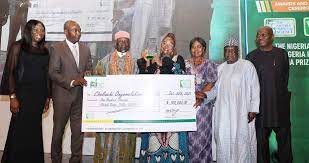

THE $100,000 Nigeria Prize for Literature, NPL, this year has been won by Cheluchi Onyemelukwe-Onuobia for her novel, ‘The Son of the House.’
The jury headed by Professor Olutoyin Jegede, a Professor of Literature in English at the University of Ibadan, described the book as “a profoundly unconventional novel that portrays the lives of two women in different worlds whose paths crossed during captivity. But they soon realised their path had earlier crossed at various points. The stories of Nwabulu, a one-time housemaid and now a successful fashion designer, and Julie, an educated woman who lived through tricks, deceits, and manipulations, are told through a mosaic plot structure against the backdrop of modernity and traditional patriarchy, poverty, and neglect.”
The announcement was made by Emeritus Professor Akachi Adimora-Ezeigbo at a grand award gala staged last night, October 30, by the promoters of the prize, the Nigeria Liqueified Natural Gas, NLNG at the Eko Hotel & Suites , Victoria Island, Lagos.
There were 201 entries at the end of call for submission earlier in the year out which 11 were longlisted in August, and three in September.
The three finalists are:


Cheluchi Onyemelukwe is a professor of Law at Babcock University, where she served formerly as an Assistant Professor.
The Son of the House released in 2019 is regarded her best book; and it won the Sharjah International Book Fair prize
Her first novel, Nervous Conditions (1988), was hailed as one of the most important novels of the 12th century and was included in the BBC’s 2018 list of the 100 books that shaped the world. Her novels, The Book of Not (2006) and This Mournable Body (2018) were longlisted for the Booker Prize 2020.
Her plays have been performed at the University of Zimbabwe, and her short musical Kare KareZvako, (Mother’s Day, 2005) was screened at Sundance. Her films have also received international recognition.
Other Jury panel members are: Professor Tanimu Abubakar, a Professor of Literature in the Faculty of Art, Ahmadu Bello University, and Dr. Solomon Azumurana, a Senior Lecturer in the Department of English at the University of Lagos.
The Advisory Board of the Prize also announced the appointment of the International Consultant for this year’s prize, TsitsiDangarembga, an acclaimed Zimbabwean author.
The Nigeria Prize For Literature was established in 2004 and sponsored by Nigeria Liquefied Natural Gas (NLNG) company.
The Nigeria Prize for Literature runs concurrently with the Nigeria Prize for Literary Criticism (also sponsored by NLNG), for which four entries were received in 2020. The literary criticism prize carries a monetary value of N1 million.
The Nigeria Prize for Literature rotates yearly amongst four literary categories – prose fiction, poetry, drama, and children’s literature.
Since 2004, it has been won by: Gabriel Okara (co-winner, 2005, poetry) for The Dreamer, His Vision; Professor Ezenwa Ohaeto, for his volume of poetry, Chants of a Minstrel (co-winner, 2005, poetry); Ahmed Yerima (2005, drama) for Hard Ground; Mabel Segun (co-winner, 2007, children’s literature) for her collection of short plays Reader’s Theatre; Professor Akachi Adimora-Ezeigbo (co-winner, 2007, children’s literature) with her book, My Cousin Sammy; Kaine Agary with her book, Yellow Yellow (2008, prose); Esiaba Irobi (2010, drama) who clinched the prize posthumously with his book Cemetery Road; Adeleke Adeyemi (2011, children’s literature) with his book The Missing Clock; Chika Unigwe (2012, prose), with her novel, On Black Sister’s Street; Tade Ipadeola (2013, poetry) with his collection of poems, The Sahara Testaments; Professor Sam Ukala (2014, drama) with his play, Iredi War; Abubakar Adam Ibrahim with his novel Season of Crimson Blossoms (2016, prose); Ikeogu Oke with his collection of poetry, The Heresiad; (2017, poetry); Soji Cole with his play, Embers (2018, drama); and Jude Idada with his book, Boom, Boom (2019, Children Literature).
STATEMENTS ON THE PRIZES
THE NIGERIA PRIZE FOR LITERATURE, 2020/21, by The Advisory Board
Good evening ladies and gentlemen,
LET me start by commending the Nigeria LNG for initiating and sustaining the three Prizes. It is noteworthy that while the company being a gas company should naturally gravitate towards science and engineering, they considered it important to establish the Prizes for Literature and Literary Criticism, thereby bringing perceptible growth to Nigerian Literature. The phenomenal success recorded on a yearly basis is an indication of the ever-increasing commitment of the organization to fairness, integrity and excellence.
The journey leading to this evening started several months ago with the receipt of 202 Novels for the Literature Prize since the genre in focus is Prose Fiction. Immediately the Panel of Judges was constituted, they swung into action and despite the challenges imposed by the pandemic, found creative ways to do their work meticulously, using a set of 11 clearly defined and approved Criteria. The Panel of judges also worked in close coordination with the Advisory Board, and the Secretariat of the Prize to produce, evaluate and prune the 202 entries to 50, then 25. From this point, they were able to produce a longlist of 11 and thereafter, a shortlist of 3. For the avoidance of doubt, the final three novels shortlisted are mentioned here in alphabetical order of author’s name:
Abi Dare’s The Girl with Louding Voice;
Cheluchi Onyemelukwe-Onuobia’s The Son of the House; and
Obinna Udenwe’s Colours of Hatred
In a sense, the shortlisted Novels are axioms of a profound ‘paradigm shift’ from the preoccupation of the Nigerian Novel with collective, nationalist issues to an interrogation of the permeation of the notion of ‘the end justifies the means’ and the autonomy of the self or primacy of individuality in defining and pursuing what best serves its immediate interests. This portrait erases the efficacy of the moral distinction between the urban (loose and corrupting) and the rural (serene and authentic) in designation of the postcolonial space or setting by first and second generation of Nigerian writers. In aesthetic terms, the entries have, in divergent ways, been influenced by or constituted out of an interface between creative writing, film, home video and romance.
Abi Dare’s The Girl with the Louding Voice was published in 2020 by Sceptre. It is a narrative that tells the story of the plight of a girl-child, a valuable commodity who is sold into marriage at an early age. The heroine, Adunni, is forced by poverty and the death of her mother to drop out of school. She is married off to an elderly polygamous man with a view to raising funds for her father’s survival. The novel also tackles the issue of early marriage, child sexual abuse, childlessness in marriage, and domestic violence on one hand; and on the other, the urgent need of female bonding or sisterhood in transcending the constraints that have been placed in the life of women by men.
Cheluchi Onyemelukwe-Onuobia’s The Son of the House was published in 2019 by Parresia Publishers. The novel presents the predicaments of two women, Nwabulu a one-time housemaid and a successful fashion designer; and Julie, an educated woman who lived through tricks, deceits and manipulations, as they meet in captivity. Both women decide to tell each other their stories. They soon discover that their lives had crossed at different points. The subject matter of the novel is developed through the rupture of traditional plot and the mediation of a single narrative voice. It is made up of a prologue and a three- part story moments, each dominated by multiple points of narration, The Son of the House is an experimental novel with a complex plot structure made up of a main plot and several subordinate plots that are interwoven.
Obinna Udenwe’s Colours of Hatred is a plot-driven detective story and published by Parresia in 2020. The novel is a confessional that centres on the story of Leona of the Dinka tribe and her involvement in the killing of her father-in-law. It is a whodunit, which through introspection and re-telling explores issues of love, hatred, war, revenge, oppression, extra-judicial killings, military rule, displacement and exile with their attendant tensions that leave scars on people and homes. In this context, the novel draws substantially from the tradition of modernism and deploys investigative techniques of detective narratives and flashbacks to account for what has happened.
After a careful scrutiny of the three Novels, the Panel of Judges and the Advisory Board have, in consideration of its profundity of technique and subject matter as a Nigerian family saga, its thematic depth and social relevance as a commentary on the diversity of collective experiences that shape, hold and mar families in postcolonial Nigeria, and its feminist undertones, found Cheluchi Onyemelukwe-Onuobia’s The Son of the House outstanding, and declare it the Winner of the 2021 Nigeria Prize for Literature.
May the ink continue to flow!
Thank you, ladies and gentlemen, and do enjoy the rest of the evening.
Prof Akachi Adimora-Ezeigbo
Chairman, Advisory Board – The Nigeria Prize for Literature & Literary Criticism
Saturday 30th October, 2021
*******
THE NIGERIA PRIZE FOR LITERARY CRITICISM, 2020/21, by The Advisory Board
IN February 2020, the Advisory Board announced the call for entries for the annual prize. By the deadline set for submission, we received entries from four contestants made up of 3 essays from each of them and giving a total of 12 articles. I must first say that for a country like ours blessed with so many renowned writers and critics,this number of entries was not good enough. I and my colleagues on the Advisory Board would like to see more entries in future as we have a rich and thriving literary community.
The entries received were thereafter handed over to the judges for adjudication. On closer examination, the Judges observed that some of the submissions were marred with errors of omission and collation, others lacked rigour and yet others did not fall within the approved years of publication. In spite of this, guided by the 6 approved assessment criteria, the Judges were able to find a winner amongst the four contestants.
This particular contestant submitted three Essays all of which were published within the 2017 and 2020 specified date of publication. In addition, the Journals in which the essays were published are reputable with rigorous peer-review process. The three entries are bound by their focus on how underdevelopment and poor leadership have created not only absurd conditions but also made the development of coping/survival strategies vital to how individuals and groups survive in Nigeria since the introduction of Structural Adjustment (SAP).
Remarkable is the depth of analysis that characterized the 3 essays. The author not only laid the background for the conversation into which he enters with his essays, he also shows the point of departure he charts. For instance, in his “Self-Publishing in the era of military rule in Nigeria, 1985 – 1999,” while acknowledging that studies have been carried out on the Nigerian book industry, he was able to demonstrate that none has interrogated how the self-publishing culture emerged. Noteworthy also is the historiography of publishing in Nigeria prior to the incursion of the military into the sociopolitical climate that the author was able to enact in the said essay, and his ability to establish a confluence between the Structural Adjustment Programme (SAP) introduced by the military and the inauguration of the regime of self-publishing in Nigeria. As demonstrated by the author, among other things, it is the folding-up of established publishing houses in the 1980s and 1990s as a result of the economic realities of the time-period that inaugurated the regime of self-publishing.
The depth of analysis of the 3 essays is, perhaps, also owing to the applicability of the theory/concept utilized by the author. For instance, in his “Postcolonial Ogres in Ngugi Wa Thiong’o’s Wizard of the Crow, the writer deploys as well as establishes an intersection between Mbembe’s, Pageaux’s, and Bakhtin’s postulations of the grotesque in his analysis. Drawing on the features of the grotesque such as parody, exaggeration, degradation, and scatological images, he criticizes the state and its carnivorous power as depicted in Ngugi’s novel.
Above all is the relevance of this author’s papers to literary studies in Africa, especially Nigeria. The publications contribute to scholarship in postcolonial studies and publishing as the works highlight and explicate postcolonial realities of disenchantment, alienation, exploitation, oppression, neocolonialism, deprivation, power relations, political leadership, loss of freedom, failure of leadership, abuse of power, and the gap between the rulers and the ruled. These issues, though peculiar to the African continent and the Nigerian nation-state, are universal. In this way, the writer rescues African/Nigerian imaginative works from their putative appellation in the West as anthropological materials.
Ladies and gentlemen, the Judges have therefore recommended, and the Advisory board has ratified, that The Nigeria Prize for Literary Criticism 2020/2021 be awarded to Uchechukwu Peter Umezurike for his critical essays – “Self-Publishing in the era of military rule in Nigeria, 1985 – 1999”, “Postcolonial Ogres in Ngugi Wa Thiong’o’s Wizard of the Crow”, and “Land of cemetery: funereal images in the poetry of Musa Idris Okpanachi”.
Thank you and do enjoy the rest of the evening.
Prof Akachi Adimora-Ezeigbo
Chairman, Advisory Board – The Nigeria Prize for Literature & Literary Criticism
Saturday 30th October, 2021

