
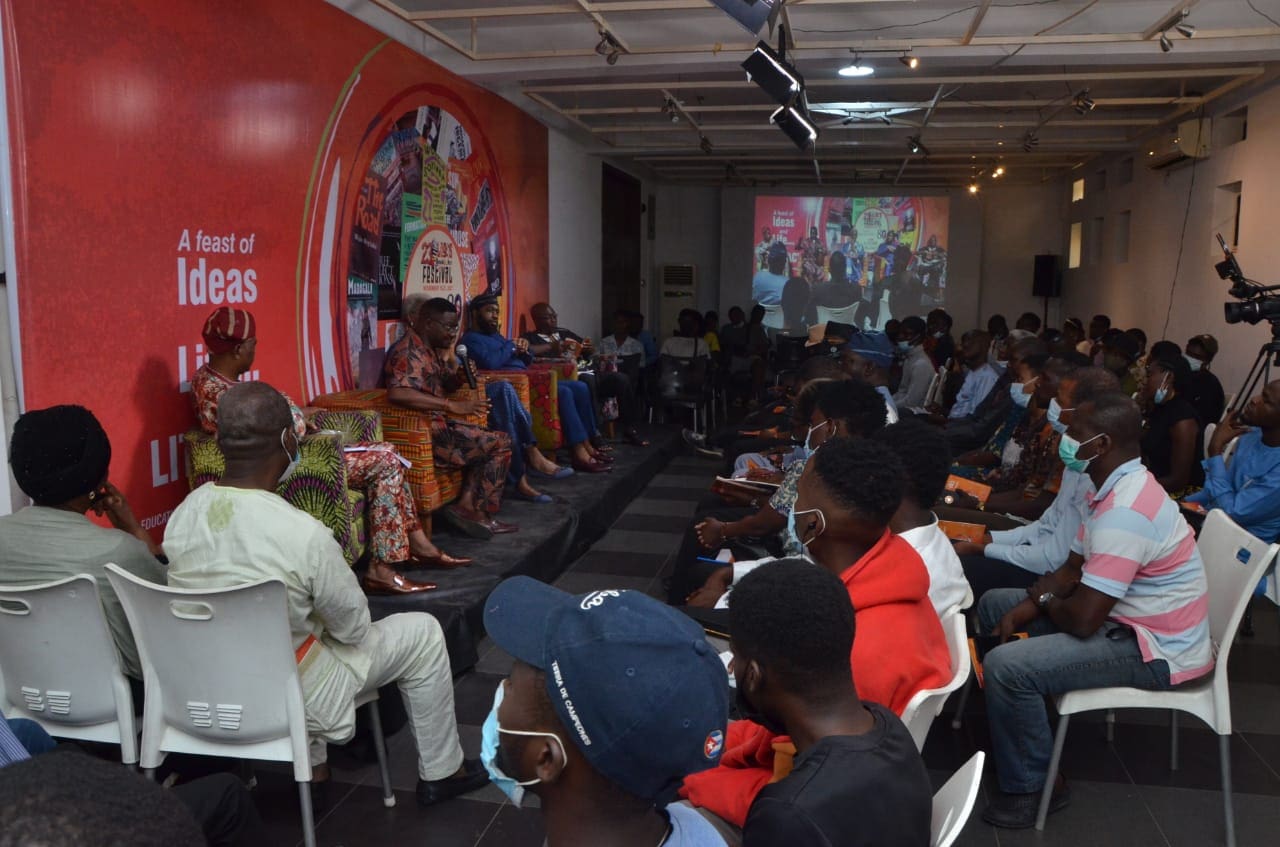

THIS year’s Lagos Book and Art Festival (LABAF) held two celebratory Arthouse Forum in honour of six eminent members of the art community who recently joined the ancestry pantheon and have created a huge vacuum that will be hard to fill in the years to come. Indeed, the forum brought together the spirits of both artists and collectors in a sort of communal ritual cleansing where they were both mourned and celebrated for living worthy lives and leaving behind inestimable cultural and historical legacies through the invaluable works they did that will continue to have resonance among the living.
It had double themes that created narratives of continuum where the works of the artist and art collector converge in ‘Homage to the Recent Arthouse Ancestors’ and ‘State of the the Collectors’ Vault’. With the two forums holding back-to-back, it turned out feasts of great ideas as the speakers on both sessions gave the audience value for their times’ worth. Students among culture aficionados made up the audience members.
While ‘Homage to the Recent Ancestors’ was devoted to celebrating art historian and teacher, Prof. Ola Oloidi, painter and teacher, Dr. Mike Omoighe and painter and teacher, Prof. Yusuf Grillo, it had painter and gallerist, Oliver Enwonwu, artist and academic, Dr. Ademola Azeez, artist and academic, Dr. Akin Onipede, and artist and teacher, Prof. Peju Layiwola who joined the discussion via Zoom as panel members. However, both sessions had painter and ‘Araism’ exponent, Mufu Onifade moderating while artist and art administrator, Mrs. Chinwe Uwatse, as chairperson. Notable art collector, Omo Oba Yemisi Shyllon was guest of honour for both sessions. Although no family member of the late artists was present, the case was different with the late art collectors whose wives and children and grand children were present to lend their voices to fears in some quarters that the art vaults of their late husbands and fathers were not only intact but would see a continuum and resurgence of activities in memory the works the collectors left behind.
Chairperson Uwatse expressed delight at the celebratory event in honour of the great artists who have left the artistic spaces they dominated with their work and presence, saying, ”These were men saw the value in having our own self-exoression, our own philosophies, our own aesthetics, our own cosmologies put into the background of our art. And so it is a special honour to give these men who have just recently passed the honour that is due to them that we somehow did not do in their lifetime, but we are here to do it now.”
Guest of honour, Shyllon, said he was close to all of the artists and fondly recalled that he had 20 works by Omoighe who said it sounded ironic that Omoighe was being called an ancestor when he was barely in his 60s when he passed earlier in the year. Shyllon also recalled how he got two of Omoighe’s works, one on Wole Soyinka and the other titled ‘Dugbe market’, describing it as ”very interesting piece.”
Perhaps the biggest living collector in the Nigerian art space, Shyllon waxed philosophical on the role of an art collector and why he or she must orient his or her art collection passion to the service of society and not just based on some fanciful whims.
”What role are we playing?” he asked his audience and fellow art collectors and would later narrate why he chose to establish his museum at Pan-Atlantic University (PAU), Ajah, Lagos, rather than the University of Ibadan or Obafemi Awolowo University (OAU), Ile-Ife where he attained his degrees. ”What impact are we making in society? Did we come here to add to society or take and aggrandise ourselves? What are we leaving behind for our children, for the earth?”
Moderator Onifade then introduced the three late artists, describing Oloidi as ”an art historian who was vast in his field”; Omoighe ”was a friendly man, hard working” and as Grillo ”a rennaissance man, a man of many parts”. In his tribute to all three, Onipede, who started out as a cartoonist at The Punch newspaper before veering into academics, lamented the exit of the artists, saying, ”It is painful to describe them as ancestors. If we can accept the fact that Grillo and Oloidi lived to respectable old age at over 70, Omoighe was only 60. Well, it’s final and the nature of life is that we don’t want to accept ours to depart.
”Oloidi was a veteran; we met at conferences. News of Omoighe’s death came like thunderbolt. A lot of questions popped up, but answers to them hung in the air. Happily, they lived fulfilled lives, artistically. Grillo was described as the most conversative of the Zaria Rebels, a giant of a man. He was the oldest and most formidable of the group in Zaria, a year ahead of the rest. They argued for the inclusion of local content in the art curriculum being taught them by the English teachers in Zaria. They advocated that enough of London Bridge is falling.”
Onipede recalled the establishment of Yusuf Grillo Pavillon by Rasheed Gbadamosi at his place in Ikorodu where they held art activities, adding, ”Grillo was great and he attracted greatness unlike now when people don’t want merit; they want mediocrity. Grillo was different. His work at Yaba College of Technology stands out; it’s on record he made it great.’
The art teacher also eulogised Oloidi’s ”zeal and commitment to art history and scholarship was sterling among his generation of art scholars”, also also praised Omoighe for being ”a peace lover, a blend of Auchi and Yaba school of art.”
On how he views Oloidi alongside his contemporary art historians, Onipede described him as a ”talent hunter with the likes of Uche Okeke, Obiora Udechukwu, El-Anatsui. If you look at the trajectory of University of Nigeria, Nsukka (UNN) art school, nationally and internationally, you will see how outsanding it is. Oloidi was first among equals; he’s first among modern Nigerian artists. A talent hunter; he’s written so much. No matter how you stretch it, he has a noble place in the art history of Nigeria.”
Layiwola who was close to Omoighe wondered how he could be classicified an an ancestor considering his relatively yong age when he passed away. ”Memory just keeps flooding in. I had the closest contact with Omoighe. On one memorable ocassion, he came with Prof. Bruce Onobrakpeya to ask if I could help facilitate at his Harmattan Workshop at Agbarho-Otor, Delta State; it was a very important period in my life. Omoighe had zeal to learn, to know more; he opted for Language and Communications and he went to Abraka to get his PhD. Omoighe made a lot of sacrifices for his students. He had projects he didn’t execute before he died. He was a family man who was devoted to his family.”
Layiwola also spoke about Oloidi whose scholarship she said she has great respect for, adding that though ”I did not have such close contact with Grillo, they were wonderful people and they played a vital role in our lives. This is a wonderful opportunity to celebrate them.”
For Enwonwu, Omoighe was ”a mentor to many other artists, contributing to organising events, an artist artist; he was a great administrator. Omoighe was able to fuse western and African art techniques. He was also political; he mastered the use of geometric forms in his work. The younger generation is able to take up art because of how these three men taught art. Their contributions weren’t just in practice but also as teachers who mde impact, and not only through their practice but through their remarkable personalities as well.”
Onifade compared Kolade Oshinowo and Omoighe’s art practice as shinning examples of how admirable it is to combine teaching of art and its practice.
Also, Azeez mourned the death of Omoighe, saying how close they had been since 1996. ”Omoighe is very mobile and restless scholar too, very daring, very controversial, too, like me; we shared many things in common,” Azeez said of his departed friend. ”For you to change things, you must step on toes. Coconut is very sweet, but you must look for something hard to break it. Omoighe belonged to many organisations. Omoighe liked to make impact in any assignment he was given. He mixed with everyone without difficulty. As a teacher, he did a lot; he was also a critic and writer as well. We were both in pains for the cause of the art. He made a lot of impact in writing, painting and scholarship.”
Azeez made some profound statement about the state of art pedagogy in Nigeria, arguing that for a vibrant art teaching practice to happen in art schools, whether at colleges or universities, the best brains must be recruited. ”For visual arts to flourish, you must have dedicated and intelligent art teachers. Let’s attract the best brains to art teaching.”
He lamented the inability of the University of Lagos to have its own ful Department of Fine Arts, as the disciplne is still under what he called ”shadow of Creative Arts”, arguing that the programme was too academic and lacking in practice. ”University of Lagos should be running MFA programmes; we run to the University of Benin, Benin City, to get things done.”
But Layiwola was quick to counter Azeez on the failings of UNILAG’s art practice curriculum, saying his opinion was unfounded as art practice was as vibrant as it can be in the department in spite of it being lumped in Creative Arts.
UWATSE also excorted the audience down memory lane in her encounter with Oloidi at UNN when she was a teenager. ”I’m one of the privileged artists to have had a relationship with all three artists,” she said. ”I met Oloidi aged 17 when I went to take entrance into UNN. I walked into a panel sitting behind a big table with my rather childish sketches compared to what others had; we met the stern faces of our inrerviewers. The only one who smiled was a younger Oloidi who led us out and said, ‘see you in September’. Oloidi knew what he talking about.
”Even as teenagers, they made us feel at home. El-Anatsui, Obiora, they asked us to call them by their names; we did with much trepidation though. They allowed us to express ourselves and we had arguments and quarrelled. Right through university, Oloidi treated us like siblings.”
Uwatse also also recalled when as an art administrator with the National Gallery of Arts (NGA), she invited Oloidi for the celebration of Prof. Ben Enwonwu in the 1990s and he refused to take part, saying the man was too aloof. She said she flew into a rage. But when she asked him to humour her with his presence, he obliged. And when Oloidi eventually met the legendary Enwonwu in his Ikoyi home, they had a 4-hour conversation. And when he came out, Uwatse said Oloidi ”was so enraptured; if he made mistake or wrong impression, he was quick to admit it. Oloidi was an amazing man.”
Uwatse also spared a thought for the guest of honour, Shyllon, saying, ”He’s done so much; he’s a lone star,” and brought the first Arthouse Forum session to a close.
********


Fond memories of ancestor-artists at LABAF Arthouse Forum
By Anote Ajeluorou
THE second Arthouse Forum session dedicated to visual arts has theme ‘State of the Collectors’ Vault’, with a special focus on the four art collectors who died recently and the fate of the huge collections they left behind. The session provided a moment for art collectors and artists alike to re-examine the role of art collection in society and how it could be made more beneficial as a cultural and historical legacy in the life of a nation. Prince Omo Oba Yemisi Shyllon again was the guest of honour, Chinwe Uwatse still chaired the session while Mufu Onifade also moderating it.
Shyllon continued in the same vein he started the session devoted to the late artists, ‘Homage to the Recent Arthouse Artists’ when he said he was also close to the late collector, Mr. Sam Olagbaju, and recalled how the late collector flew to UAE and South Africa just to honour him when he had presentations to make on art collection in those two countries. Shyllon also recalled how they first met at an exhibition when Olagbaju asked him, ”They say you’re an engineer; so what are you doing here?” to which he said he responded by saying he was a man of many parts.
”I was also close to Rasheed Gbadamosi,” Shyllon recalled, with whom he founded a billion naira cement company, and served as secretary. He said cement was much cheaper back then until Dangote’s strangulating monopoly entered the market and literally drove off competitors,with the result that Nigeria’s cement is the most expensive in the world today, largely because government’s policy pronouncements in day time are different from what is implemented at night. We sold off the cement company; I don’t know what they are doing with it now.
”Uncle Rasheed was a fantastic man, a dramatist, a writer, a collector and an industrialist, name it,” he continued. ”Rasheed Gbadamosi was my friend, mentor, uncle; I still mourn his exit after five years.”
Shyllon recalled how he came into collecting art, as a 21 years’ old student at the University of Ibadan where he studied Engineering and has since developed the passion to an ‘obssession’ as Moses Ohiomokhare of Quintessence Gallery would later reveal, as the conversation progressed. By the time he had fully come into art collection and had amassed a substantial treasure trove, Shyllon said he thought of giving back to society but wanted such art philanthropy attached to a university, an institution that would value his gift. Fortuitiously, the late poet and dramatist, Prof. JP Clark, came visiting and he took him into confidence about his intention of building a museum for the University of Ibadan, their alma mater.
But Clark screamed his objection at his choice of institution to cite an art musuem largely made up of works from his own collection, and then narrated how he gifted the University of Ibadan, also his alma mater, his memoir and how the librarian called to tell him that his memoir were dumped in damp place and were rotting away. Shyllon then cancelled out University of Ibadan and settled for Obafermi Awolowo University (OAU) instead, where he also had a degree and had been fascinated by the art works he’d seen there, especially at the vice chancellor’s livingroom, where Prof. Ben Enwonwu’s magnificent ‘Anyanwu’, Bisi Fakeye’s and other imposing works were had majestic pride of place. He’d been instrumental to refurbishing of the university alongside other generous old students and felt OAU would appreciate the value of the art gifts he would bring. But Prof. Wale Omole was now in charge as vice chancellor and had an aggressive relationship with the arts, describing them as fetish; he’d thrown out the Enwonwu, Fakeye and other works in the vice chancellor’s livingroom. Shyllon said he then cancelled his intention of gifting OAU such rare treasure that would be abandoned and outrightly thrashed. Instead, he settled for Pan-Atlantic University (PAU), Ajah, for his museum philanthropy.
”I personally built the Yemisi Shyllon Museum at PAU and put 1,000 pieces there,” he said.
”Don’t just be a colletcor of art,” he advised. ”What are you doing with such works? You may be a young collector, but ask yourself as a collector why you’re in it. If your purpose is not investment, glamour, contribution to society, if not selfless, a place where generations yet unborn will remember you for, then no need. What has happened to the collections of Gbadamosi, Olagbaju, Frank Okonta, and Abdulaziz Ude? We must have a purpose for art collection. It allows you to see what had gone before, as it documents the history and culture of the time. A museum is the only place you see the history of the past.
”Olagbaju was a great man; he was a great collector, collecting far and wide. The problem I have is, what has happened to his collection? We are now trustees.”
THE panel session had the gallerist, Mr. Moses Ohiomokhare, artist and academic, Dr. Sola Ogunfunwa, painter and administrator, Mr. Olu Ajayi, and artist and academic, Dr. Kunle Adeyemi. Prof. Jerry Buhari could not make it to the event. For session chairperson, Uwatse, the names of the four collectors invoke in her the passion they had for art collection. She, however, advised, ”If you want to have a collection, you must have a world view, a philosophy, and having a thread run through it that should have some sort of meaning. You should be able to leave a story that lives after you. Most people who collect don’t view art through their intellect. Imagine a collector saying ‘your work does not fit into their decor and that it should be modified with certain colours!’ It means this person is not a collector. It means your art will not be valued. It means the person is collecting because it’s a fad.
”Most collectors I know jealously guide their works, their collections and will always call you the artist from time to time to engage with his treasures, their passion. Art collection is not about ‘I can I can afford it,’ to show off. Why exactly are you collecting? Each piece of art is a sentence, a phrase, a paragraph in a book. So while there are collectors, there are collectors.”
ONIFADE described the relationship between artists and art collections as an eccentric one and related how such relationship played out between the artist Abiodun Olaku and the late Chief John Sunday Edokpolo, saying th two couldn’t see eye-to-eye until death took away the collector just when he, Onifade, had brokered a truce between them through a commissioned work that eventually didn’t see the light of the day.
Olu Ajayi related his experience with collectors as one between cat and mouse, ”My experience with art collectors is very personal, but is always a cat-and-mouse game. I’m thinking of writing a play about it. It’s like two spies trying to outsmart each other. That’s the game between artists and collectors. It’s such a drama; sometimes you like it, sometimes you hate it. The collectors are equally as crazy as the artists; they are not normal. But if you manage it well, the relationship goes a long way.”
Ajayi opined that ”art collecting may not be hereditary; they collect out of passion, interest, even addictive. Collectors can be secretive about collection.”
Ajayi lamented the passing of the four iconic art patrons, saying, ”It’s so painful their passing. When collectors pass on, the works become lonely and could get into the black market or be abandoned altogether. Art works are cultural objects and their fate should interest society how they are faring.”
ADEYEMI rated art collection in Nigeria high, but canvassed that an art collector must have ”a major objective and focus” for doing so, and must ”make conscious efforts to plan retainership and must document such collection and partner with institutions and donate to museums and institutions. Art collection is capable of immortalising the collector and collectors must encourage researchers to be involved in their collections.”
Adeyemi raised a critical issue regarding the process of art collection and strongly advised collectors on the need to involve family members, so they see the value in the collection. This is imprtant, he said, because when family is not made to be part of art collection process, a sad fate could befall the works, as they may either not know what to do with the works or dispose of them after the collector has left the scene.
”A collector must consciously involve the family if you want longevity for your collections,” he said. ”Collectors must have multi-generational engagement with the works. Establish a family club and get everyone in the family into art travel and holiday plans. He or she must have family members articulate views about artists whose works they like and so interest them in art.”
Olagbaju’s son, Oladele, was also in agreement with Adeyemi on the need to involve family in art collection. He recalled how his father met Twin 77 in Lagos Island while he was into stockbrokering and bought works from them. That was to signal a lifelong passion till he passed, noting that his father always sought their views about his collection and sometimes postponed their personal needs to a later date most likely because his father had invested in some art works and needed a little time to come up with resources for their needs.
For gallerist Ohiomokhare, art collectors cannot do without a gallery, as it is ”a place of variety where you can make decisions with many artists’ works that energise a collector’s interest. In some cases, it’s the size, the colour that initates the collection decision. A gallery helps in decision-making for the art collector. We shouldn’t discourage those who buy for their homes as decor. The collector is doing it out of passion.”
Ohiomokhare is in agreement with Adeyemi on involving the family when collecting art, and related a curious cat-and-mouse game that often happens between collectors and gallerists and their wives. And the wife of Edokpolor corroborated the intrigues husbands play with gallerists at the expense of their wives. He said some collectors are fearful of a backlash at home when they bring in an art work, as the wife would have rather spent such money on fripperies. So often gallerists package such works as gifts and hand them over to the wives to deliver to their husbands who would not know that their husbands had actually paid for the works. That way peace is ensured on the homefront, he said. It’s such a hilarious scenarios.
‘It’s quite interesting working with collectors,” he said. ”It’s an art on its own. Sometimes, it’s an obssession and you can’t blame them,” and related to the audience how collecctors also played games with each other. He said whenever Gbadamosi visted an exhibition, he often asked if Olagbaju or Shyllon had also visited, believing that if they had, then they would have acquired the best works, and he wouldn’t buy. Ohiomokhare said he would lie to him that they hadn’t visited yet to prolong the game.
Ogunfunwa looked at the relevance of documentating art collections, saying documentation is important in all spheres of life. ”Documentation is important particularly about art. Nowadays, we can monitor the movement of art, how many times it has travelled, who owns it and where it was last. Some collectors base their interest on what’s in vogue, particularly the artist and their own philosophy. Documentation projects a particular work, the cost of the work. So it’s necessary on the part of artists and collectors. Artists should track those who hold their works. Documenting works tie it to time and history.”
Wife of late poet and dramatist, Prof. JP Clark, Prof. Ebun Clark, said she started collecting art way back in 1964 at a time when the departing colonialists were carting away truckloads of arts, because Nigerians were not interested and saw them as festish they couldn’t accommodate with their newfound Christian religion. She stressed how Mbari Club in Ibadan at the time helped to stimulate creativity that has lasted till the present. He charged artists not to discourage those who want art for home decor, saying they too have their own value. He countered Ogunfunwa who canvassed that artists should track their works, saying it was not possible to track art, saying she buys from galleries and hardly directly from artists. The retired professor of English also charged collectors not to demean artsists, saying, ”Artsists are not beggars and collectors must not make them feel so.”
OLAGBAJU’S grandson Olalore, who joined the conversation via Zoom from the U.S., said, ”Art collection is history itself; art is a window to people, to culture, and to posterity. It’s a great opportunity to come from a family that values art and I encourage young people to take interest in arts.”
Mrs. Olagbaju said her husband was an avid collector and ”he really changed art. We will carry on the legacy and preserve his works. We want to set up a foundation and gallery in his honour.” Alao, Mrs. Gbadamosi said her husband’s collection is ”enormous and we’re thinking where to hang them, but a visit to Nike Ekundaye’s Gallery showed us that we can hang art even in ceilings, because his gallery is small. We will enlist artists to document the works; the person who did last did a bad job. If we don’t document the works we, cannot move foreward.” Mrs. Okonta, an architect, also lent her voice, saying she usually frowned at her husband’s passion for art collection and he always said they were gifts to deflect her annoyance. ”But there’s so much serenity, such peace just being at the gallery after we rehabilitated it,” she said.
Stage matriarch for whom LABAF 2021 is dedicated, Mrs. Taiwo Ajai-Lycett, charged the arts and culture community not to relent in their work, saying, ”Art, culture is the mainstay of any society even when politicians run societies. I thank you, the community of artists, for keeping us alive. Artists are guardian of society.”
Two performance art pieces enlivened the event of Day 2 at LABAF 2021. Yusuf Durodola performed ‘Atupa’ on the main stage at Freedom Park, with his lantern and an assemblage of candles. He would explain later that each member of society should attempt to be the ‘Atupa’ or lantern that should light up society so as to bannish darkness. Also, seasoned performance artist, Jelili Atiku, also screened a 4-minute docu-performance on Atiku in Holland titled ‘Mokoo Moro’ by Juul and also had a live conversation with her that also involved the audience.
Capping activities for the evening was a film screening ‘Tribute to a Pioneer Artist’ based on Nigeria’s first man to star in Hollywood films back in the 1950s and 1960s titled ‘Allelu? Alleluiah! The Legend of Mazi Ukonu’, directed by Ezennia Ed Emeka Keazor.

