
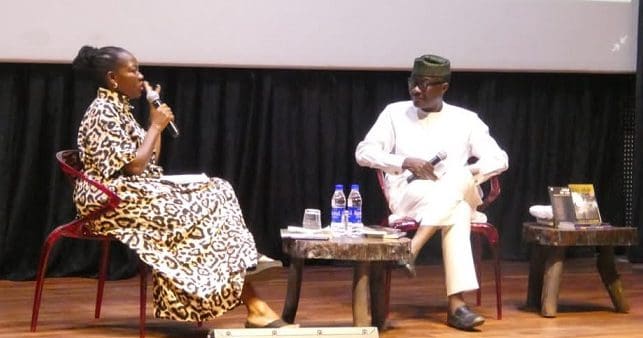

Photo: Molara Wood and Kunle Ajibade
By Nehru Odeh
WHEN Nigerien filmmaker Amina Mamani lost her father Mamani Abdoulaye, novelist, writer, poet, activist and politician in a rather extenuating circumstance at 10, she never knew who he really was. She never had the complete picture of him, she never had an inkling of what it means to have a father, she never knew what made him tick, save from patches of glimpses and selective limiting portraits vouchsafed her by the Nigerien authorities and the powers that be. But growing up, she was determined not just to know her father, to have his complete picture, but also to tell the world her story.
Amina indeed got to know her father by storytelling through film. And she is telling her father’s story via an award-winning biopic, a documentary, In The Footsteps Of Mamani Abdoulaye, which she spent 10 years putting together as she searched for her father by talking with people and digging into her father’s past.
Amina traced her father’s footsteps and ended up bonding with him. Still, the search for her father is actually a metaphor for Niger’s search for self, for nationhood. While the filmmaker may have seen her father and uncover some truths, Niger, sadly like other African countries, is still searching for self, groping in the dark and groveling in poverty, squalor and disease more than 50 years after independence.
That documentary, which Molara Wood, journalist, writer and author of Indigo, described as riveting was screened at Alliance Francaise, Adenuga Centre in Ikoyi on Sunday 12 June, 2022 to commemorate the 29th anniversary of the annulment of the June 12 Presidential election in Nigeria.
A striking feature of the documentary is that it uncovers the rotten underbelly of a country, its political actors and draw an uncanny parallel with Nigeria’s history and her search for democracy, what with both countries gaining independence almost at the same time and sharing a common boundary that is indeed without borders socio-culturally.
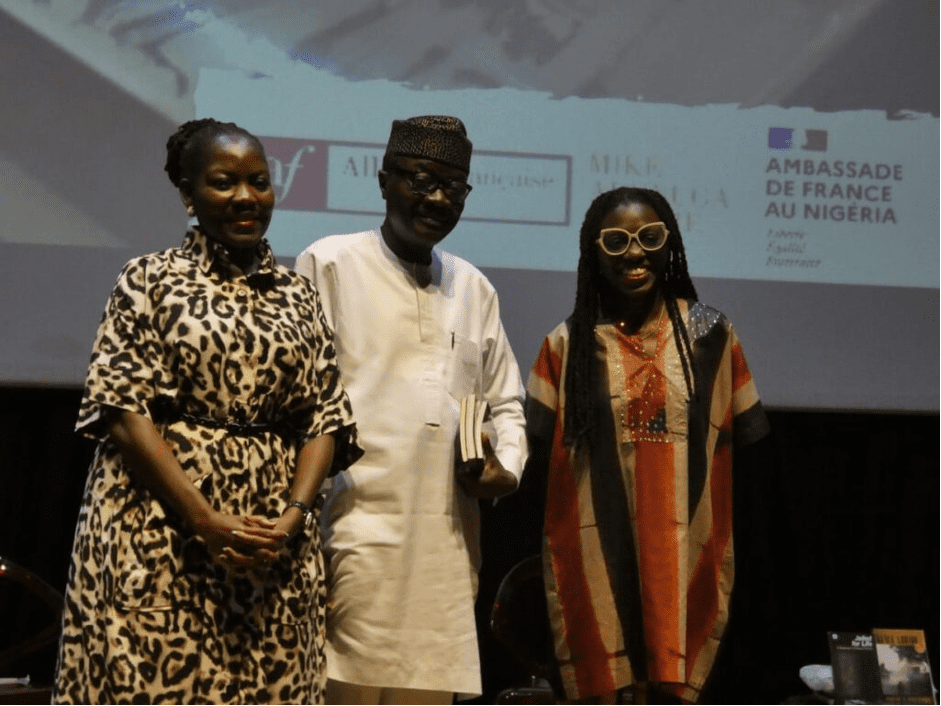
On hand to do justice to the documentary were Ms Molara Wood and Mr Kunle Ajibade, journalist, writer and Executive Editor TheNEWS/PMNEWS who was not just jailed for life by the then Nigerian military dictator Gen Sani Abacha, but almost died in his gulag. And contrasting tropes such as memory and forgetting, history and selective amnesia, dictatorship and democracy, identity and erasure dominated the discourse that evening.
Wood set the ball rolling when she asked Ajibade why he thought the documentary had so much grip on the audience and brought a figure that was almost forgotten back to life. Ajibade on his part hinged it on the fact that the documentary was a labour of love and that Amina’s pulsating love for her father, her filial ties to her father, runs through the entire film.
“You will agree with me that nothing is difficult to really percolate when something is infused with love. D.H Lawrence once said love is an inspirational creative force. And you can see the meticulous film that you just watched had a lot to do with that. She set out not only to dig all those necessary materials that would give a necessary composite of the father but also to let even the father speak in his own voice. And I think you can’t cut it to the bone better than that,” Ajibade, author of Jailed For Life and What A Country, noted.
Ajibade also said Amina made the film meticulously, moving from one point to the other with the passion of a lover, one who loves her country and the youths of that country. “Look at the way the documentary ends. It’s like someone driven by a higher purpose. That ‘I am doing this not just because I love my father, not just because I love my country, but because I love the youths of my country.’ So to that extent, she is interested in making sure that there is a kind of replacement, the replacement of the spirit of her father. And I think that that higher purpose for me was the driving force. And what makes the documentary has that large dose of integrity,” Ajibade maintained.
Wood, aligning her thoughts with Ajibade’s said the filmmaker actually spoke in the voices of all the people who knew her father and was happy to just be in the background and let her father speak. Wood also spoke about the presentness of the past and how the young Nigeriens have inherited a history book of which many pages are missing, noting that the will of the powerful people have erased many areas of the past.
When Wood asked the distinguished journalist’s for his thought on the screening of the documentary on June 12, a day declared Democracy Day and a national holiday in Nigeria, Ajibade spoke about hidden history and erasure, how a country deliberately distorts history and erases some truths and facts. “First of all, let me respond to the question of hidden history that you raised in the course of asking that question. When she showed this documentary at the University of Niamey, some historians after the show went to her to say ‘We knew of your father as a poet, we knew of your father as a novelist, but we did not know so much of your father as an activist and politician.’
“How could anyone know so much of Mamani Abdoulaye as a novelist and not know him as a politician, as a poet, as a novelist, as an activist? The truth of the matter, as you can see, is that that history of Mamani as an activist? The truth of the matter, as you can see, is that that history of Mamani as an activist and a politician was the kind of history that the authority in Niger would not want people to know, the kind of history they would like to forget. And deliberately so, they push that history out of the dominant national history of Niger. Of course, you kmow of that kind of trend in this country. So what the film has done is to dwell extensively on that hidden history of Niger and Mamani Abdoulaye. Because that is the history that would inspire people, would inspire others,” Ajibade said.
Drawing parallels between Niger and Nigeria, he said similar cases of erasure and strategic remembrance and forgetting happened in both countries. “The second thing is that you notice that all those who fought for democracy, for liberty, egalitarianism and all that shortly before independence, who fought for independence in Niger were not the one who benefited from that independence.
“Again we have parallels of that in Nigeria. When you check out the history of Nigeria, the likes of Enahoro who moved the motion for independence as a young man, 25 years old, who fought for independence, the likes of Obafemi Awolowo and the rest never tasted power. Indeed , when that independence was granted at the Tafawa Balewa Square, the likes of Obafemi Awolowo were pushed aside. And the rest of course as you can see, is history, just like it is history in Niger. Those who took over power were incapable of appreciating what independence was all about.”
Ajibade posited that independence was never the solution as many African countries had erroneously thought but the beginning of making governance work for the benefit of the people. But that sadly is not the case in many African countries.
“In fact, the documentary tells us that the coming of independence coincided with the rise of dictatorship. And talking about Democracy Day, Just like independence was proclaimed, It is good to proclaim independence, as you could see in the film people were happy. But what happens to the spirit of that proclamation? When you proclaim independence, the responsibility is on you to work towards achieving that goal, Have we been working towards achieving that goal, the goal of democracy? Can we really say, in the true sense of the word, that we have democracy? Democracy in the real sense of the word in Nigeria at the moment. My answer as you know is no.”
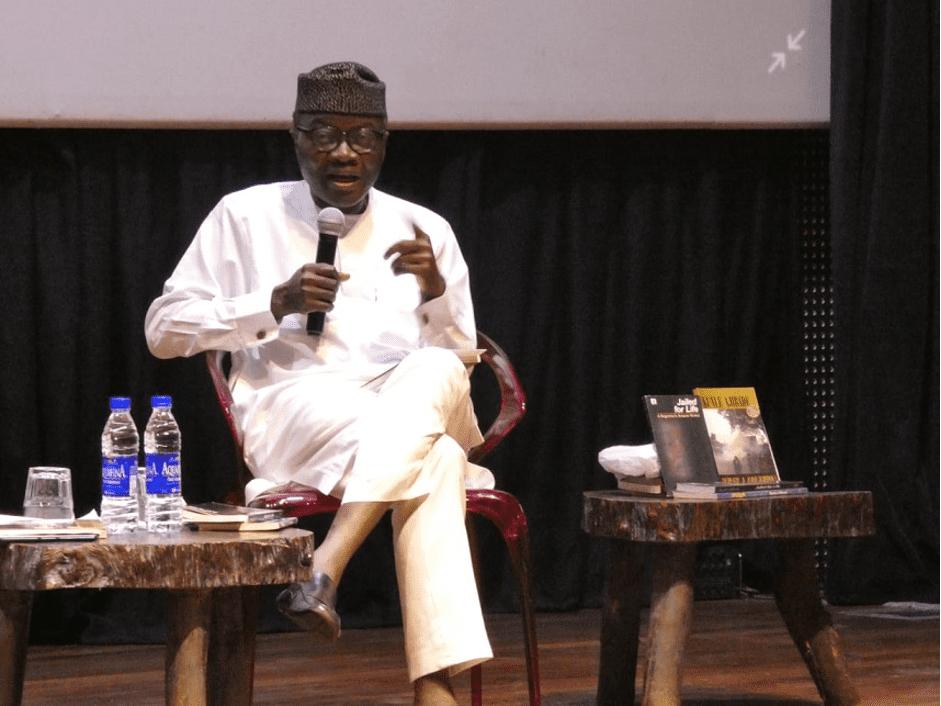
Ajibade, while marshaling out his points, also spoke not just about the Nigerian government deliberate policy to abolish the teaching of history in schools but how history is being taught wrongly. “when you have a country that deliberately, stupidly wiped out history from its curriculum then you must lay the blame where it belongs. What were they smoking when they did that? I agree that the way history was being taught was problematic,” referencing for example how an historical figure like Mansa Musa of old Mali Empire is being portrayed in history books as an extravagant king who distributed gold on the streets when he visited Mecca.
“Mansa Musa was a fantastic African? Why ? Because he travelled to Mecca and was distributing his gold and all that and I say wait a minute. And later on I could ask my myself, as a business man he was distributing those gold to people? And he devalued their own currencies? Was he investing those wealth? Was that the kind of investment we want to these young people to do? I thought that is a problematic way of writing history.History matters but the teaching of it, the way it is also presented, matters
“Amina does not preach in this documentary. That is history. It is not propaganda. It is a work of art. One is not saying that you shouldn’t engage in propaganda, but you should interrogate history and do it for a higher purpose.
Still talking about erasure, Wood wondered how little she knew about the West African landlocked country, Niger. “It’s a country just right up there, at the top of the map and when we were talking about the proliferation of small arms and desertification in West Africa, Niger gets mentioned. Now we are talking about insecurity. But I didn’t know about this great African revolutionary figure?”
The author of Indigo then asked Ajibade why is it that we know so little of this country next door and Mamani Abdoulaye is just being reveled to a lot of people through the film.
Ajibade hinged it on language difference. “Part of I think has to do with language. Nigeria is surrounded by Francophone counties/. But how many of our secondary schools teach French, even for economic reason? So we need to get serious about that. It is not just about the politics of these African countries. As you can see, it is even strategically important now to know he language,. So we got to do something about that,” he noted.
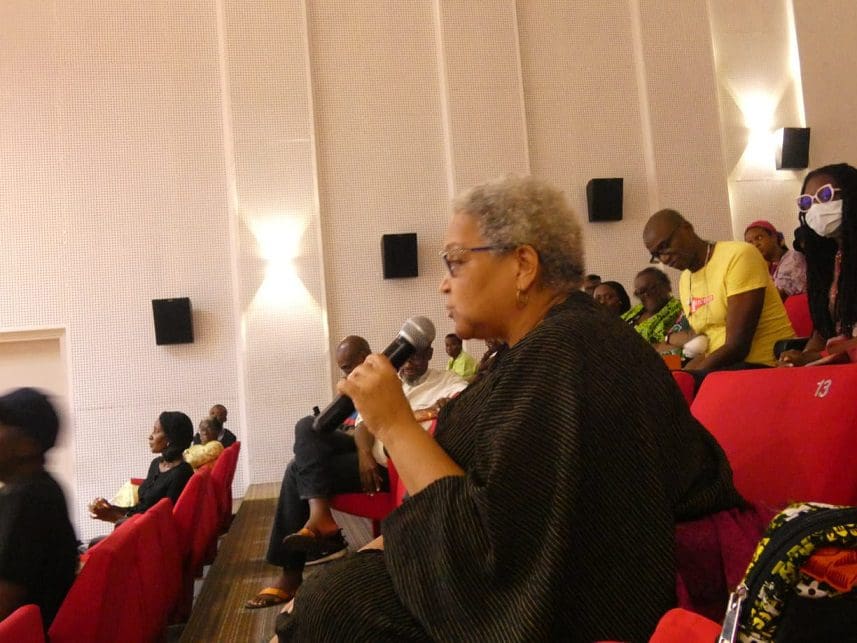
During the Q & A session, Obinna asked Ajibade from the audience what his thoughts were on Nigeria erasing Biafran history. Ajibade’s response was that the issue was not just about Biafran history per se but our general attitude, adding that we needed to do something about it. Ajibade said he was more interested in how history is also written and told, adding that virtually much of the history of Biafra is written as propaganda either from the federal or Biafran side and one hardly gets the truth. Backing up his point, he narrated how during the war, his father kept many of his friends who were Igbo on his cocoa farm. Ajibade then asked where is that story told in books.
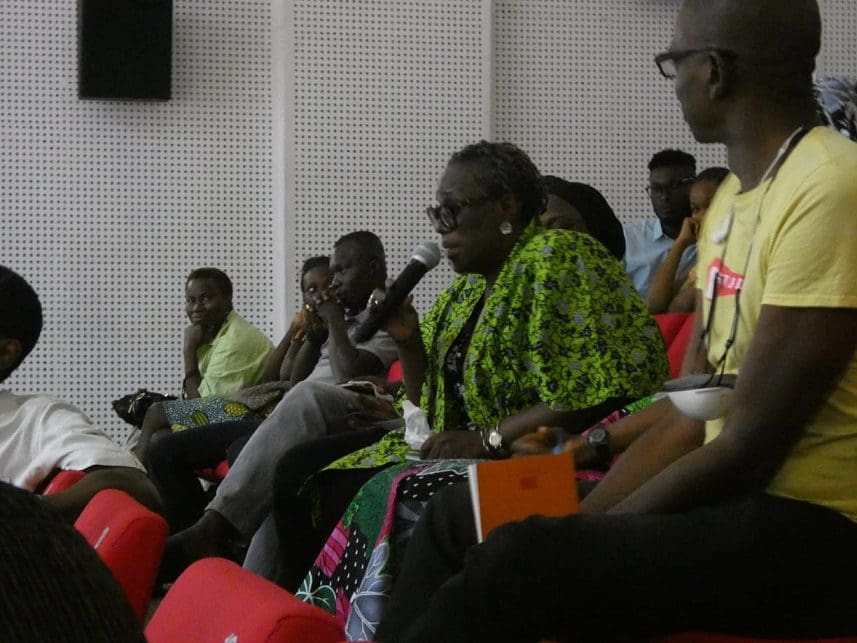
“Similar stories like that you have from people in Lagos here and other parts, particularly the West, of people helping their friends to keep their property. In fact, helping them to collect rent which they returned when our compatriots from the East returned to Lagos. Where is that story told in books, not necessarily in history books, but in novels, novels after novels? How I wish this young author can just buck this style of presentation, save the rest of us from telling a one-sided story, a single story.
“Let us have a compassionate story, stories that would help the rest of us and generation unborn to understand that our humanity matters. For me that is important. That is about style. It is not just about telling this story, the way that story is told is very important. We must tell that story in such a way that we humanize ourselves.”
Asked what his thought on democracy in Africa were and whether it was suitable for the African continent, Ajibade said, with a word of caution, that we must commit ourselves to make it work and that military takeover is not an option. We must do more of organizing rather than agonizing, he said.
“It is difficult to be hopeful about democracy in Africa, starting with our own country. But what I always say to people is that we just have to keep trying at it. We must commit ourselves to it to make it work Because the alternative is not the way out. And what is that alternative? The military boys are waiting in the wings, you know.
“But the point I’m making is this, there is nothing in my view really extraordinary about the people you are pinning your hope on. They are human beings like us who are probably worse than any human being that you can think of. And what we saw with Abacha, what we saw with Babangida, the experience we had under them, is a teachable lesson that we should not begin to think that that is the way to go.
“I do not think that military government is preferable to the putative democracy that we have right now, no matter how problematic it is. Let us work hard at making sure that we make it work by participating.
“It is human to agonize. The way we keep agonizing here is human. But we must do more of organizing than agonizing. We agonize a lot in this country. People don’t want to organize.
Aduke Gomez, lawyer, writer and poet, on her part, opined that she hoped the stories that are being written can be converted into films, into things that are accessible to people because not everybody has the stamina to sit down and be going through piles and piles of books.
“Heroes are great and we love heroes. But we wouldn’t know about Achilles if Homer hadn’t done his work. So the stories need to be written, they need to be told and they need to be retold over and over again,” she noted.
Popular Nigerian actress Joke Silva said the documentary was so moving that she was controlling herself not to cry. “There was what you said about the fact that what we know in Nigeria about Niger are these people who are driving our okadas, who we think have become a menace. That’s what we know of Niger. And we are seeing that Niger had these incredible political people. We are learning things about Niger. Maybe it is something that needs to be shared more,” she advised.
She also said the struggle for June 12 was not only made a bit fresher, but was also brought to the fore and likened M.K. O Abiola to the presidential candidate of the All Progressives Congress Asiwaju Ahmed Bola Tinubu, both of whom she said shares an uncanny similarity.
“The struggle for June 12 is made a bit fresher. It is brought again to the fore. The symbol of June 12 was Abiola, whom at the time he was contesting, a lot of people detested. He was such a controversial figure until the election was annulled. And then he become a symbol for whom everybody gathered around to born the democracy that we have now. I wonder if that is what we have in Tinubu that is so controversial also? Because of some of the things that Abiola was also accused of.
“And then finally, on this issue of producing films. Somebody had just mentioned it. And my response to him was that we want to make the films. We’re looking for the people who will fund them. If we find the funders, we will make them,” Silva explained.
And a vote of thanks by Aderinsola Alao on behalf of Screen Out Loud, who made the screening of the documentary possible with the support of Alliance Francaise and the Embassy of France signaled the end of that unforgettable evening.

