
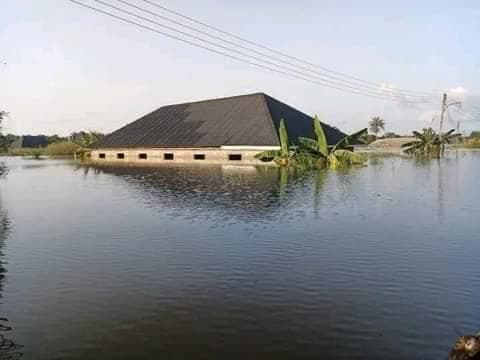

A group of international civil society organizations under the auspices of ActionAid Nigeria, has urged the federal and affected state governments to declare a state of emergency in light of the country’s flood disaster.
The organisations stated in a joint statement made available to the media yesterday that it was time for government at all levels to find long-term solutions to stop the country’s recurring floods and their effects in the afflicted areas.
The organization continued, expressing concern that 19.4 million Nigerians living in 21 states and the Federal Capital Territory (FCT) may experience a food crisis as early as August 2022, while the World Bank had also forecast that 95.1 million people will fall below the poverty line by year’s end.
The statement read in part, “With thirty-one States and the FCT affected by the flood, it is time for Government at all levels (federal, state and LGA) to explore sustainable ways to curb the perennial flooding that some states are increasingly experiencing during the rainy season. A repeat of this in 2023 when households, farmers and States would still be in recovery process could be catastrophic as this would heighten pre-existing food insecurity, poverty and increase the number of out of school children, especially girls who in such circumstances suffer early and forced marriage and other forms of gender based violence.
“The floods are coming amidst concerns that 19.4 million Nigerians across 21 States and FCT could face food insecurity starting from August 2022 as revealed by the United Nations Food and Agriculture Organisation. In addition, the World Bank’s forecasts 95.1 million Nigerians hitting the poverty line by the end of 2022.
“Whilst, we commend the current response by the federal and subnational governments, National and State Emergency Management Agencies, and the Ministry of Humanitarian Affairs & Disaster Management and Social Development, to the situation, particularly with the immediate provision of survival kits, food, and non-food items, we believe more can be done for the affected communities and the states in the longer term.”
As such, the NGOs demanded that states affected by the crisis declare a state of emergency, that efforts be launched to save lives and rescue people from trapped communities, and that awareness, sanitation, and preventative measures be promoted to stop the spread of diseases like cholera that are water-borne.
In order to be ready for potentially dangerous climate-related events, they also recommended the introduction or adaptation of community surveillance and early warning systems for flood prevention and mitigation, as well as the establishment of appropriate water channels to prevent waterways from becoming blocked and, ultimately, promote river dredging in the relevant states.
The joint statement was signed by Ene Obi, Country Director, ActionAid Nigeria; Hussaini Abdu, Country Director CARE International; Usie Emmamuzou, Country Director, Plan International Nigeria; and Tope Fashola, Country Director Christian Aid Nigeria.

