
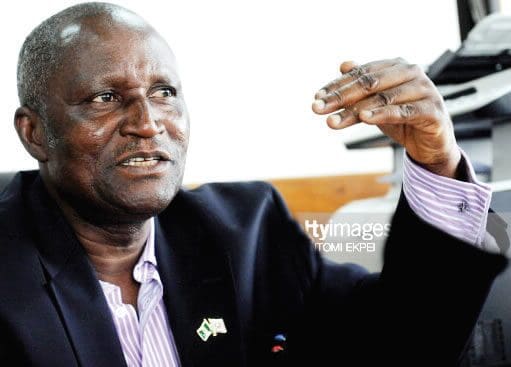

‘
‘…given his continued contribution to the advancement and promotion of culture, it is pertinent to note that though Professor Duro Oni is retiring from the University services, we can only be assured of his more visible role in promoting our culture in future. Thus, we continue to celebrate him and his achievements’
THE Professor Duro Oni I have been asked to speak about this evening is a familiar elephant to all of us. Many of us know and delight in the several components of humanity that make up the man.
Like the fabled elephant, we all can only claim to know a part of him. However, whichever part of Duro Oni that you know, I’m certain you all have an endearing story to tell. Whichever part he reveals to you is sure to be of enormous benefit to you.
I have titled my talk Duro Oni: Design, Aesthetics and Culture because I want to speak to his professional life. Afterall, it is from the most visible of professional life that he is retiring, after 46 years in the employment space of the University of Lagos. He officially joined the university on the 1st of October 1976, and after reaching the mandatory retirement age of seventy, he is retiring from university teaching.
That must be emphasised because the Duro Oni that I know is still going to be active, if not more active, in the several other spaces where he is equally visible. In the design world, in the culture sphere, in the social areas of community cohesion, and in the management of academic development, least of all at the Nigerian Academy of Letters, where he is the current president.
But before I talk about Duro Oni: Design, Aesthetics and Culture, I want to briefly mention what Duro Oni, or Uncle D as I call him, mean to me. Before our collaboration – in which he admirably led – on the production of a florilegium to the memory of the late lamented Arts Director Professor Dapo Adelugba, which came out in 2012, and the subsequent invitation to assist with some of his other publications, the work of Duro Oni always fascinated me.
I recall having to travel down to Lagos to watch productions involving his lighting design, sometimes in the guise of providing support for Theatre 15, a budding students theatre group at the University of Lagos. My association at Ibadan, Association of Theatre Arts Students, was mentoring this collection of talents. My fascination for Duro Oni’s work started after watching the lighting plot for the Dora Ifudu show in 1983, an extravaganza produced by Steve Rhodes, at the National Theatre Main Hall, Iganmu.
At one point, Duro Oni escorted me through his collections of lighting equipment and controls at Durolights, Sound and Vision, further engendering my interests in scenography, and in his work.
One of Duro Oni’s work, which set the standard for the practice and scholarship of design and technology of Nigerian theatre is Lighting Design and the Development of Modern Stage Lighting Practice in Nigeria. In that publication he set out his philosophy and the science of his design practice. Some other essays where he has expounded on that practice, emphasising the importance of innovation, inventiveness and cultural relevance in design include:
Tradition, Innovation and Change in Contemporary Nigerian Theatre;
Development of Design and Technology in the Nigerian Theatre: From Ibadan to Nassarawa;
Design and Technology Considerations in Contemporary Nigerian Theatre Performances: A Critical Assessment;
Scenography and Dramatic Atmosphere in Ukala’s The Placenta of Death;
Theatre Training in the Nigerian University System: A Critical Assessment of Selected Design and Technology Courses at Ibadan and Lagos, where he evaluated such courses as Basic Technical Theatre Practice, Theatre Design and Technology, Advanced Technical Design, and Design Styles at Lagos; and Introduction to Theatre Design and Organization, Basic Computer Skills, and Design and Technical Theatre at Ibadan. He also offered an Afrocentric perspective of computer aided design programmes such as AutoBLOCK and Stardraw apps; and
Producing Osofisan’s Midnight Hotel and Tegonni: Challenges for the Design Team – I must confess that I agree with his expositions in this essay, in comparing it with my design of Midnight Hotel at Ibadan. I placed the staircase up stage centre for Bicycle, one of the characters, to tumble down, and created a lighting design to increase in intensity, with deepened hues to mark the progress of Bicycle as he tumbled down. And we both agree on one thing: lighting Osofisan’s plays can be a ‘nightmare’ in a challengingly good way! For Osofisan writes to enthral, to delight, to reveal our cultural essence.
Perhaps Duro Oni’s most remarkable contribution is ‘Lighting: Beyond Illumination’, a lecture he delivered for his professorial inauguration on the 15th of December 2010.
In that lecture, he revealed the attraction for him of Lighting Design, from the complex structure of scenography, additionally consisting of Set Design, Costume Design, Sound Design, and Make Up. One fascinating aspect of that lecture was his historical appraisal of lighting in Nigeria since 1880 to the current contributions of companies such as Z-Mirage, Total Consult and Doxa Digital. I recommend that lecture as compulsory, nay mandatory, study for any student of Design in Nigeria. His is a contribution that is unequalled.
In conclusion, I must mention Duro Oni’s invaluable contribution to culture in Nigeria. His interest syncretically merges design to the promotion of arts and cultures in official directorates such as Centre for Black and African Arts and Civilization (CBAAC), for which he was CEO from 2000-2006. He was also the Director of the Confucius Institute at the University of Lagos from 2008 to 2009 as well as at the Centre for Cultural Studies at the University of Lagos, where he served from 1992 to 1997. During this time, he initiated and developed the bachelor’s degree programmes in Creative Arts, and in Chinese Studies in 1997 and 2013 respectively, at the University.
Indeed, given his continued contribution to the advancement and promotion of culture, it is pertinent to note that though Professor Duro Oni is retiring from the University services, we can only be assured of his more visible role in promoting our culture in future.
Thus, we continue to celebrate him and his achievements.
Sola Adeyemi
Director of Drama
University of East Anglia, Norwich, England.

