
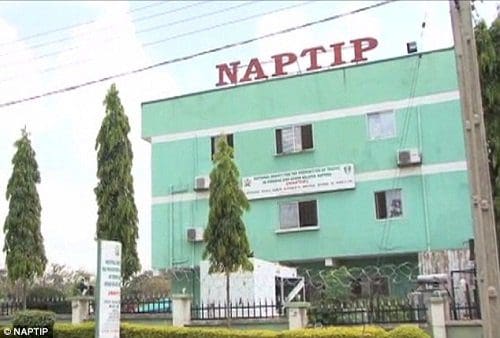

NAPTIP Director of Intelligence and Public Enlightenment, Josiah Emeriole has stated that as authorities continue to express concern about illegal migration, the National Agency for the Prohibition of Trafficking in Persons has rescued over 19,000 trafficked people since its inception in 2003.
The bureau also stated that between January and May 2023, about 32 persons were convicted of different human trafficking-related crimes.
Emeriole revealed this in Abuja during a one-day national learning, experience sharing, and policy brief distribution on countering human trafficking and dangerous migration.
The event was organized by Women Aid Collective with the help of the Swiss Government, managed by the Federal Department of Foreign Affairs, was held under the project titled “Scaling up prevention of human trafficking and unsafe migration through traditional and new approaches.”
According to him, all hands must be on deck to combat both illegal migration and human trafficking, and he said that criminal forces were taking advantage of Nigerians’ desperate need to leave the nation.
He said, “When you talk about the volume of illegal migration in Nigeria if anybody tells you that there is genuine data, the person will be lying to you because irregular migration and trafficking are all clandestine crimes. What this means is that when they are happening, you may not know.
“But over the years, NAPTIP, for instance, on human trafficking, has rescued over 19,000 Nigerians. We have also intercepted many people from making this dangerous journey, and several people have been prosecuted. This year alone, between January and now, about 32 people have been convicted.”
Emeriole stated that the prosecution of offenders frequently faces setbacks because victims are unwilling to speak out.
Muhammad Babandede, the keynote speaker and former Controller-General of the Nigerian Immigration Service, highlighted inadequate governance as a major factor driving illicit migration and trafficking.
While emphasizing the need of the media, civil society, and law enforcement agencies to be working together to combat this crime, he stated that Nigeria does not have any laws that prevent someone from leaving the nation.
Babandede said, “Trafficking is not only a matter of crime, good governance is a major issue. I could remember when we started NAPTIP, my young daughter, who is also now a mother used to ask me, do they try to pick people from London to Nigeria? And that was a big question for me because it doesn’t happen. I believe if we continue to have leaders who are committed to do good for the people, I am sure trafficking will reduce in Nigeria.
“Nigeria does not have laws to stop people from leaving. Some strict countries in the world have what we called exit visas, which means before you leave the country, you need to get a visa to leave. But Nigeria does not have an exit visa, which means that any immigration officer or law enforcement officer at the border must allow anyone who has a visa to leave the country otherwise you get a court case.”
He added that migration should be normal and safer for everyone, and that the globe should negotiate a peaceful transfer of labor.
Prof. Joy Ngozi Ezeilo, Executive Director of WACOL, raised concern that one in every four Africans trafficked is a Nigerian and noted that the country is not doing enough to prevent trafficking.
According to her, Nigeria suffers greatly as a source, transit, and destination country for human trafficking.
She said, “I believe we’re not doing enough prevention because prevention is key to curbing human trafficking and also addressing the root causes because if you look at the push and pull factors, you will find that poverty, youth unemployment, security issues, inequalities, exclusion, conflict, even corruption, all fuel and exacerbate human trafficking.
“One out of every four Africans trafficked is Nigerian, and in my role as UN United Nations Special Rapporteur on human trafficking for six years, I can’t imagine that in all the countries I have travelled to you must find a Nigerian in a trafficked situation.
“I feel that yes, we have NAPTIP and they are doing an excellent job within the little money available to it. But I think we need to scale up and we need to realize that this is one thing that gives Nigeria a bad name around the world.”
Also speaking,Christian Brugger, Migration Adviser, Swiss Federal Department of Foreign Affairs Peace and Human Rights Division, stated that the importance of community-level engagement cannot be overstated.
He added that the fight against human trafficking can only be won by a “Whole-of-Society” approach, adding that traditional and religious leaders must lead the way in protecting those in their communities who look up to them.

