
20

The play has lots of political undertones to it, and we believe that it’s a show that a lot of Nigerians, young and old would appreciate, and we are hoping for a really good turnout… The reason why we are staging the play on the theatre stage this year is, that we are doubling down on the importance of theatre. We are showing people that theatre is the cutting edge of entertainment, and why it is essential for people to embrace theatre
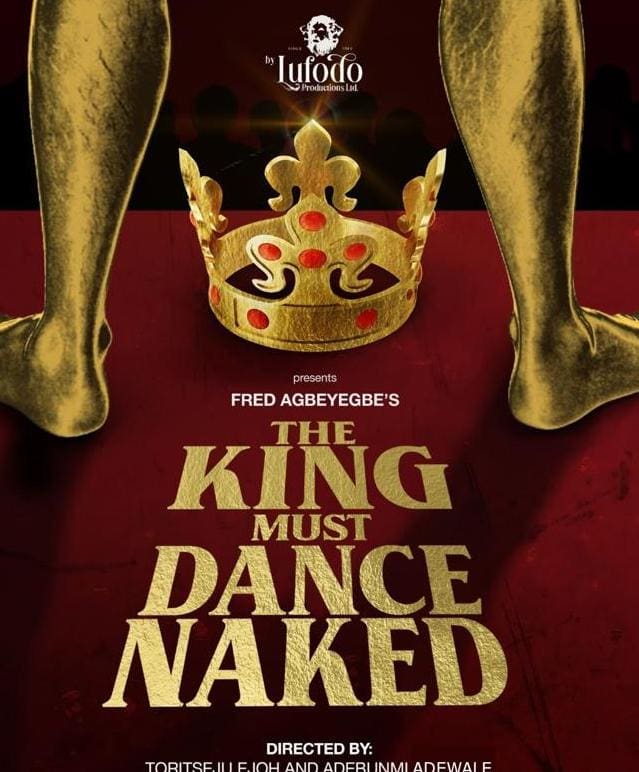
THE King Must Dance Naked, the popular play of the lawyer-dramatist, Fred Agbeyegbe, which ruled the theatre circuit in the early to middle 80s, is making a grand return this yuletide, courtesy of Lufodo Productions chaperoned by the theatre couple, Olu and Joke Jacobs.
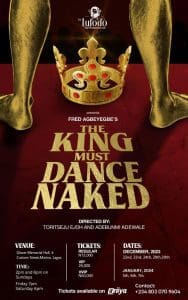
Reflecting on a radical quest for change through the confrontation of unbalanced laws of human existence, the play, which was the opener for the legendary Ajo Productions theatre project of the 80s, will be staged December 22- 24; 29-30, and January 5-7 at Glover Memorial Hall, Customs Street, Lagos.
Co-directed by Toritseju Akiya Ejoh and Adebunmi Adewale, and produced by Adesoji Jacobs, according to the co-director, Ejoh, touches on the “rich Itsekiri history and culture, which the writer, Pa Fred Agbeyegbe, who is 88 years this year, has used as his backdrop. The play first made its mark in the early 80s in Nigeria. It was a hit for theatre in Nigeria, and it’s still very relevant. One in celebration of the man’s birthday, and secondly, introspect into leadership in present-day Nigeria.”
Ejoh, himself an accomplished stage and screen actor and theatre manager, continues: “In ritual cleansing of the society, we come into the world naked and we would live naked. Nakedness in this context is not seen in a derogatory form, but it’s seen in a plain and truthful form. Naked we came and naked we will go.
“As a king, you will not bathe yourself when you transition; some other people will bathe you. So what have you to hide? The play, therefore, is introspect to leadership, to the test on the quality of a leader if you are willing to be accountable. That’s what the play is asking. Is leadership willing to be accountable?
“The king being the almighty, will he succumb to the directives of the ones that we do not see? Who is at play here? These are the questions that arise from the text The King Must Dance Naked, and its interpretation in movement, dance, and music is what the audience here will see on December 22, when we open.”
“Are willing to be naked? What do we have in the closet to hide? If we have nothing to hide, then we will be willing to let the spotlight shine on us. So what we want to do as artists is to allow the spotlight to shine on us as performers; we want to tell the story of leadership and its tussle with the gods and the society,” he explained.
On the infusion of other culture’s dances such as Swange, Ejoh said, “It is a deliberate act. As the prologue states, the play is usually associated with the Itsekiri tribe. Now in Itsekiri culture, for Oyeikoro, which is the celebration of the coronation of the king, we have people from other tribes come to felicitate with us. As you, the Itsekiri people are a collection of different ethnic nationalities.”
“We have people who are descendants of people from Igala Kogi State; we are all the way to Nupe in Niger State. We have people from Ijebu, and the last being the Benin tribe. So it is customary and culturally correct that people from other cultures will come to celebrate; it shows the inter-tribal friendliness of the Itsekiri people,” he added.
The producer, Adesoji Jacobs stated: “The King Must Dance Naked is a very culturally rich piece, celebrating the Itsekiri culture specifically. The play has lots of political undertones to it, and we believe that it’s a show that a lot of Nigerians, young and old would appreciate, and we are hoping for a really good turnout.”
“The reason why we are staging the play on the theatre stage this year is one, that we are doubling down on the importance of theatre. We are showing people that theatre is the cutting edge of entertainment, and why it is essential for people to embrace theatre.
“The humanization of society is necessary, and that is what theatre does for the Nigerian community. Also as a way of providing an opportunity for them to be in the theatre space, a cultural site, as well,” he added.
Lead actor in the play, Gloria Young, the play celebrates womanhood, as it reflects the strength of the main character, Queen Odosun, who has to take control of her life in a particular societal circumstance.
She said, “It doesn’t have anything to do with the present day or those days, it has a lot more to do with who is a woman. Every woman has an inner strength, it just takes some people to turn it around. Of course, there are certain women because of their present situation they back down because they are oppressed but they still fight. They have different ways of fighting. Every human has a different way of fighting. For instance, my grandmother was a fighter but she was not a let’s carry ‘bulldozer’.
“Our mothers, our grandmothers in those days used to fight at the minute. What they do is to push the men in front and their fight is being done. It is these women of nowadays that say no, no, if the man is fighting for me he will get the glory; I want to fight myself and get the glory. Are you seeing the difference? So that’s basically for the feminism talk,” she added.
Young continued: “We need to get the Gen Z away from their phones. Everybody you see is stuck with their phone, father, mother, and children. Even babies are stuck with iPads, tabs these days; they are watching Shark doo doo doo doo, all of that. Everybody is watching one thing or the other even at home. You know before, everybody is in front of the TV but that is not common anymore. So how do we now get them involved?
“History is a very important subject. If you don’t know your history and you don’t know where you’re coming from, how do you know where you’re going? With history, every child in school (secondary school) should be made to pass through the history class. Literature class helps you get involved in speech.”
