

…at CORA, we see an opportunity for the creation of an entire economy around the book trade. The NPL cannot alone wipe out all the entrenched dysfunctions of the Nigerian publishing sector, but it goes far. And those who are comparing it with book prizes in countries with structured book industries are grossly unfair
THE Nigerian writer is grudgingly a children’s story writer.
Children literature is not the first thing that comes to mind of the average author: It is poetry, then short story (in prose) and the novel, which is now gaining increasing popularity.
Drama is far-fetched, so are indigenous Nigerian stories, written specifically for children.
Writing for children is also not that straightforward, because you are usually an adult, who has to see things in the eyes of children.
But if literature must grow in our society, it has to catch the attention of young people when they are not even yet teenagers.
So, Distinguished Ladies and Gentlemen, please let us clap for ourselves for attending this party. It is the most important of all the four genres that the Nigerian Prize for Literature.
A warm welcome to our guests of honour; the distinguished shortlisted authors for the prestigious Nigeria Literature Prize and their families
I crave the indulgence of the Chairman Board of Trustees CORA, Chief Kayode Aderinokun, and members of the CORA Board of Trusteees, the CORA Governing Board as well as the leadership of the Nigeria Liquefied Natural Gas Limited.
Welcome our friends, book lovers, book readers, literary enthusiasts, plain well-wishers, and everyone here present, to the 15th edition of the Book Party organized by the partnership of CORA-The Nigeria Prize for Literature
The calendar has been slower this year because of the End Bad Governance protests, which has forced a postponement from August 4, 2024.
We are here because a profitable Nigerian gas company decided that a way to spend some share of its profit is to enable the Nigerian reading space.
The last time we got together was August 6, 2023 at this same venue; which has found a way to take over from the National Theatre as the primary site for cultural engagement.
I want to congratulate NLNG Ltd who are currently expanding their factory by 35% for the opportunity that the global market for gas continues to provide them, so that they have the incentive to continue to sponsor the Prize.
The NLNG runs the largest midstream hydrocarbon plant in Subsaharan Africa and it is a dutiful payee of taxes into the Nigerian treasury.
This year the Nigerian Prize for Literature is 20 years old, and this is the 20th award. It would have been the 21st, but in 2020, the owner of the Universe called for a reset in the affairs of humankind, so the world went into a state of languor. As you all know, we haven’t completely emerged from that reset.
This afternoon presents an opportunity to get a sense of what’s happening around Children literature.
The best writers of that genre are included among this 11 star writers we are honouring here:
Ndidi Chiazor-Enenmor, who wrote A Father’s Pride; Akanni Festus Olaniyi, who penned Bode’s Birthday Party; Jumoke Verissimo, who conjured up Grandma and the Moon’s Hidden Secret; Henry Akubuiro, who spurn the yarn entitled Mighty Mite and Golden Jewel; and Temiloluwa Adeshina who created Risi Recycle –The Dustbin Girl.
There is Olatunbosun Taofeek, who found The Children at the IDP Camp; Ayo Oyeku, who imagined The Magic Jalabiya; Familoni Oluranti Olubunmi, who argues that The Road does not End; Hyginus Ekwuazi, who crafted The Third Side of a Coin; Anietie Usen, who found Village Boy and Uchechukwu Peter Umezurike who sculpted Wish Maker.
Some of these writers are returning to the long list. Five years ago, when we assembled at this same hall, Shell Hall at Muson Centre, for the last Nigeria Prize Literature award for Children writing, Ndidi Chiazor Enenmor was there with A Hero’s Welcome. Last year, when we came here for Drama, Henry Akubuiro was one of them, with the text Yamtarawala, the warrior king
Jude Idada, whose book, Boom Boom won the last Nigeria Prize for Literature for Children story writing in 2019, had been in several rounds of this same competition before he won. So was the 2023 winner of the NPL, the poet and dramatist Obari Gomba. Before Gomba won the prize in 2023, with the political drama, GRIT, his works were longlisted four times.
Uchechukwu Peter Umezurike, who is on this year’s longlist was also part of the long list in 2011. In 2021, he won the Nigerian Prize for Criticism, which is a newer prize in the Nigerian Prize for Literature system.
The current chairperson of the prize advisory board, Akachi Adimora-Ezeigbo, and a member of the board, Ahmed Yerima, both professors, have been winners of the award. Ahmed Yerima competed for the prize more than once. He won at the first time he competed and then he tried again.
I have gone to this bit of historical excursion to highlight the fact that the NPL has become an enabler in the Nigerian literary ecosystem.
Part of it is the cash money; in 2019, the $100,000 was 36 million Naira. Today, it is 160 million Naira. That’s quite a significant amount of money in anyone’s account.
But at CORA, we see an opportunity for the creation of an entire economy around the book trade. The NPL cannot alone wipe out all the entrenched dysfunctions of the Nigerian publishing sector, but it goes far. And those who are comparing it with book prizes in countries with structured book industries are grossly unfair.
The first Book Party, which took place in the scenic seaside premises of the Goethe Institut on Victoria Island in 2010, was organized after a review of the first five years of the Prize (2004-2009), in response to calls that the prize should do more than a glamourous Gala night in which one author got rich, but the Nigerian book trade and literary scene as a whole didn’t seem elevated.
CORA decided to help out. We asked the question: Why don’t we organize book readings, in which the top laureates come out to engage with audiences?
For what is the worth of the riches when you don’t have an audience?
Nothing beats a Book Reading; an event at which an author sits and discusses his work with readers in the room.
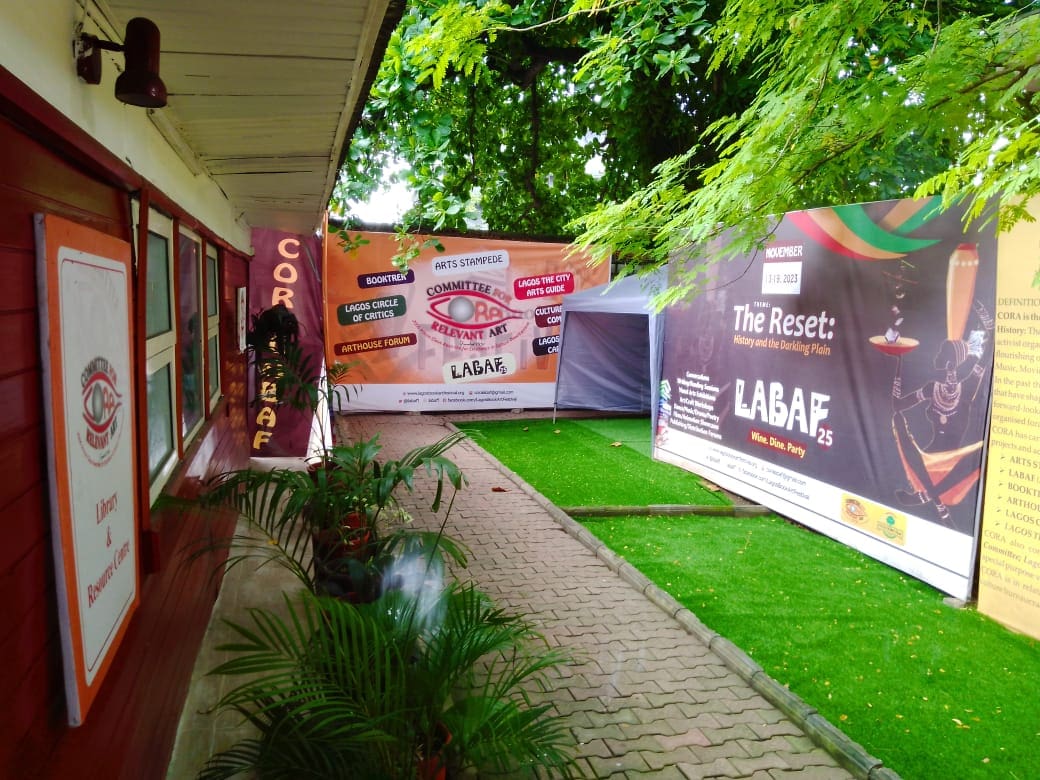
The Book Party is one of the series of events in our Calendar that preface our Annual Lagos Book and Art Festival (LABAF). The theme, this year, is Breakout: Hope is a Stubborn Thing
This year, CORA has determined three initiatives that extend this book reading to more than today
CORA has returned to regularly featuring the BOOKTrek, a periodic Book Reading programme at bookstores and culture spaces. It’s a periodic author-audience interface, featuring readings, reviews, and discussions of select books of searching historical and contemporary insight. We have had six Book Treks this year and, trust me; the texts are all significant. The BookTrek is part of CORA’s extension services, aimed at deepening Literary Appreciation and Audience Engagement with the published text
Regardless of who wins the NPL this year, this afternoon’s laureates are invited to the BOOK TREK segment of this year’s LABAF, to share their work with Festival attendees. They will also be hosted to readings in the week after LABAF.
Permit me to repeat our invitation to you all to participate in the Lagos Book and Art Festival, from November 11-17, 2024, at the Freedom Park in Lagos Island. The theme again: Breakout: Hope is a Stubborn Thing
We are going to have an exciting time this afternoon, engaging with this star-studded cast of writers. Let us enjoy the moment.
Again, let me crave the indulgence of the CORA Board of Trustees to invite all the laureates here, regardless of whoever wins the prize, to the 26th Lagos Book and Art Festival in November.
For: Committee for Relevant Art
Toyin Akinosho
Secretary-General

