
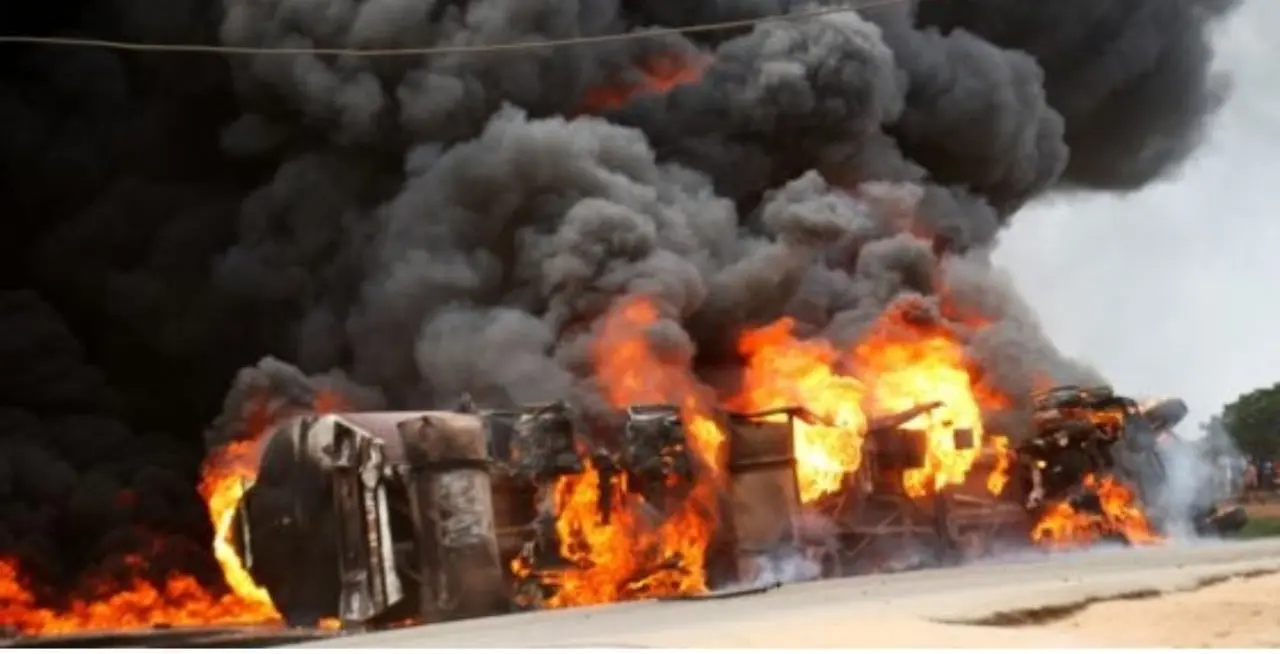

THE repeated explosion of inflammable fuel-laden tankers has become a recurring source of sorrow and pain on Nigerian roads. Sadly, after these mind-rending accidents, the quantum of losses in lives and property is way too monumental to count. Scores of families lose loved ones in a most traumatising manner and property worth millions of Naira is lost to the incidents.
The frequency of these explosions speaks to the unbecoming complacency of the relevant authorities and how cheap life has become in Nigeria. Public safety and the citizen’s well-being do not seem to feature much on the priority lists of those charged with the task of governance. After each episode, the nation moves on, only to await another round of massive losses in lives and property.
These explosions are reminiscent of how easily lives have been taken by avoidable mishaps in Nigeria’s public spaces. One minute, a road user can be behind the wheels of a vehicle, only to be consumed by an explosion from a fuel-laden tanker the next minute. Despite the many lives being wasted in these accidents, life continues until the next tragedy reminds us of the litany of lessons unlearned.
The state and society seem to pay no urgent heed to the consequences. In October 2024, a tanker explosion in Majjiya, Jigawa State, Northwest Nigeria, claimed 209 lives. 124 persons were left with various degrees of injuries. Similarly, this year, the country has so far witnessed several mishaps involving fuel-laden tankers. These articulated vehicles regularly tumble and spill their inflammable content, which gets ignited. The result has always been a long trail of sorrows, tears and charred remains of the dead and disfigured physiques of the survivors.
In January, Niger State, in the North Central geo-political zone, witnessed a devastating tanker explosion. More than 100 persons lost their lives at the scene while attempting to scoop fuel spilled by a fallen tanker. A few days later, 11 members of one family from the Abofia-Agbaja community, in the Ebonyi Local Government Area of Ebonyi State, were reported to be among the scores of victims of another tanker fire. This one occurred at Ugwu Onyeama, along the Enugu-Onitsha Expressway. By the time the body count was completed, 18 persons had lost their lives, their bodies burnt beyond recognition. Those who managed to survive were left with various degrees of burns and psychological trauma.
Also, on March 14, a tanker conveying gas exploded around the Otedola Bridge area of Lagos. This area has become notorious for such incidents, with no fewer than seven consequential occurrences between 2018 and 2025. Twelve persons were burnt beyond recognition and 54 severely injured in the 2018 incident, while four persons were reported burnt and several buildings and vehicles razed in the latest incident.
The Federal Capital Territory, Abuja, took its turn on March 19, when a truck transporting Compressed Natural Gas (CNG) exploded near the Karu Bridge, resulting in the death of several motorists and the destruction of vehicles. The Federal Road Safety Commission (FRSC) put the number of deaths from 80 tanker-related incidents at 555 in the last five years.
Apart from the horrible nature of roads across the country, which has been fingered as a major cause of accidents, the mishaps caused by fuel-laden tankers and other articulated vehicles have also been blamed on reckless driving and the ill-maintained state of the trucks. Articulated vehicles driven by barely literate and mostly unlicensed drivers, including teenagers, are also responsible for these mishaps, which continue to compromise public safety. Some of the vehicles used in conveying these inflammable liquids are either off-spec or poorly maintained, with some plying the roads with a lesser number of specified tyres. The slightest tilt gets the vehicles tumbling over.
Experts have repeatedly raised concerns about the overreliance on roads for transporting both regular and inflammable materials. The unfortunate situation of mishaps might continue unless this fundamental issue is decisively addressed.
It is common knowledge that in countries where the safety and security of infrastructure and citizens are prioritised, flammable materials like gasoline and CNG are not transported by road, particularly in busy areas with high traffic. Typically, such materials are conveyed through an extensive network of pipelines. Railways are also used to transport such hazardous cargoes. In spite of some progress in the rail sector, bulk goods continue to be transported by road in Nigeria. Conveying these flammable liquids in trucks through long road distances across the country poses significant risks.
Although the Federal Government has announced the setting up of a committee to unravel the causes of tanker explosions across the country and recommend ways of stemming the menace, the concern of close watchers remains that if the implementation of the committee’s recommendations is not rigorously implemented, as often with extant traffic regulations, lasting solution will remain elusive. The inaction over the years has been glaring, given available data.
According to the road transport data provided by the National Bureau of Statistics (NBS), the total number of road traffic crashes in the second quarter of 2023 was 2,967, indicating an increase of 8.56% from the previous quarter which recorded 2,733 and a 9.60% fall from 3,282 in the second quarter of 2022. Similarly, data shows that of all crashes, severe cases topped in the second quarter of 2023 with 1919, compared to fatal and minor cases of 756 and 292, respectively.
Disaggregating the data, the NBS showed that a total of 1,120 males were killed in the third quarter of 2023, accounting for 79.48% of 1,409 persons killed, compared to 289 (20.51%) females killed. Also, 6,430 males were injured during the period, indicating 76.76% of 8,377 injured persons compared to 1,947 (23.24%) females. The NBS data for 2023 similarly revealed that the North-Central recorded the highest number of crashes in the second quarter of 2023 with 980, followed by the South-West with 795, while the South-East had the least with 158. Similarly, the North-Central recorded the highest number of casualties with 3,036, followed by the South-West with 2,104, while the South-East recorded the least with 451.
While these figures of deaths and destruction would always be mind-boggling, the reality is that for each tragedy, there is scarcely any attempt for a thorough inquiry into the immediate and remote causes. No visible efforts were made to hold to account entities whose activities, actions, or inactions contributed to the decimation of lives and property on the roads. After officially lamenting the deaths and destruction, only families, friends and relatives of the victims are left to mourn and count their losses. The government and the rest of society move on. Those whose actions or inactions led to the incidents are left to continue with their rascality. No consequences! It is one of the reasons why this recklessness continues unabated.
At the heart of interrogation is the commitment or otherwise of the Nigerian state to the proper functioning of the society and the well-being of the people. Although successive governments have talked ceaselessly of the need to reshape the nation’s transportation system, which is predominantly road-driven, the efforts have been at snail speed. As such, by the government’s assessment, the heavy dependence on the road for human and cargo transport, coupled with several other factors, namely structural, human and mechanical, is responsible for the recurring incidence of road accidents and recurring threat to public safety. Data from official sources indicate for example, that in 2012 alone, over 4,000 lives and an estimated US$8b were lost through road traffic accidents in Nigeria.
It does not speak well that Nigeria, often touted as the giant of Africa and leader of the black race, will continue to look on while avoidable tragedies snuff out the lives of citizens. The authorities therefore need to activate the whole of government, whole of society approach to address the situation. Preventive steps, through robust enforcement of traffic laws and regulations, should be the name of the game. It should no longer be acceptable for ruffians driving articulated vehicles to cause such monumental tragedies without being visited with commensurate harsh consequences. The authorities at the federal, state and local governments must be ready to take preventive measures to bring a stop to the gory cycle of tanker explosions across the country.
Law enforcement agencies must take their responsibilities seriously to ensure that only legally certified and mature individuals operate heavy-duty vehicles, particularly those conveying potentially hazardous and flammable materials. For now, their response to this is, at best, very disappointing. For questionable motives, they often turn a blind eye to irresponsible practices on the roads, only reacting when disasters occur. The public also has a responsibility to stop justifying the actions of greedy individuals who rush to siphon fuel in accident scenes despite the history of tragic consequences associated with such actions. No justification exists for such reckless behaviour, which only increases the number of casualties and leaves families with unnecessary grief.
Critically, public enlightenment campaigns should be mounted at a societal level to raise awareness among citizens about their roles and responsibilities in preventing these avoidable road disasters. The current strategy, which focuses on zero preventive scenario planning, has relegated these agencies to the role of undertakers, who only respond after explosions must have occurred, to remove the dead and clear the debris. This approach must now be replaced with a focus on prevention and emergency management, prioritising citizen safety as the core outcome. Enforcement of traffic rules is key in resolving this matter. In the interim, the government might have to restrict the movement of such vehicles to periods of the day when their nuisance would not result in monumental disasters.

