
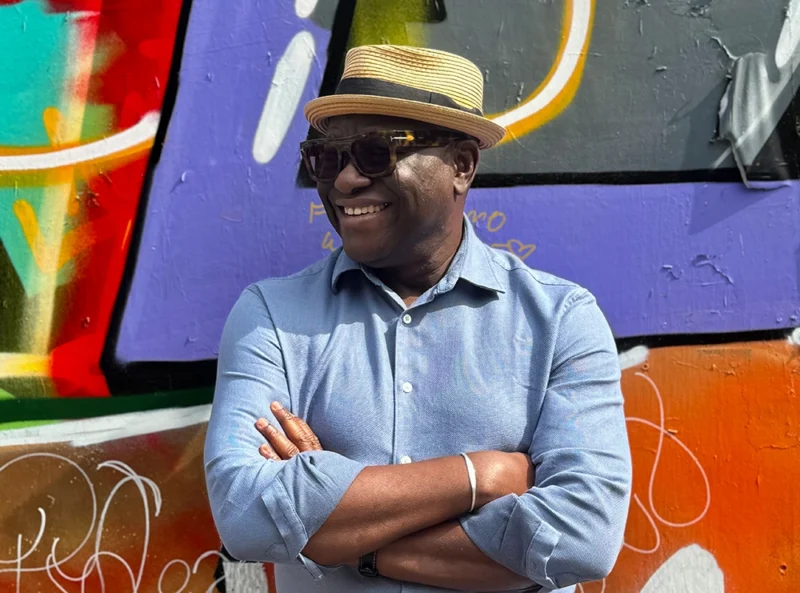

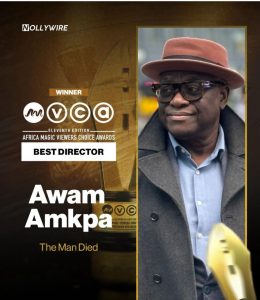
On the heel of its fetching the BEST DIRECTOR prize at the prestigeous 11th ‘Africa Movie Viiewers’ Choice Award on Saturday, May 10, in Lagos, “The Man Died,” the feature film inspired by the ‘Prison Notes’ of Africa’s first Nobel laureate, Wole Soyinka, is featuring at the African Film Festival New York, AFFNY, on Tuesday May 13. Below is reproduced a rare and full conversation by the poet, academic, DR NATHALIE HANDAL of New York University, Abu Dhabi. with the Director of the film, AWAM AMKPA — as sourced from GUERNICA Magazine.
Amkpa is unstinting, and the intricacies of his artistic vision are bold, offering a lens to see imprecisions as a way of understanding discord and harmony. The film captures Soyinka’s resilient spirit—through solitary confinement, torture, and voluntary starvation—stirringly
AWAM Amkpa is as eclectic as the highlife music of 1960s Nigeria—a fusion of African rhythms played with Western instruments. It is in this spirit of merging that he directed The Man Died, inspired by Wole Soyinka’s prison memoir.
The Man Died connects Soyinka’s heartbeat to Nigeria’s. The past to the present. The film’s intuitive quality makes us ponder on what a country means to a man. In the metaphorical opening scene, the protagonist, played by Wale Ojo, is on a lyrical hunt. His enduring footsteps become the hum of the story and establish the pulse of the film—in conflict the daily recurrence of death is an act of rebirth. The film’s photography, a subtle palette of amber, pewter, and midtone rust, accentuates each composition.
Amkpa is unstinting, and the intricacies of his artistic vision are bold, offering a lens to see imprecisions as a way of understanding discord and harmony. The film captures Soyinka’s resilient spirit—through solitary confinement, torture, and voluntary starvation—stirringly.
“It is a story whose theme still haunts Nigeria,” Amkpa tells me. “It is an African story because of ethnocentrism as one of the most divisive ways of organizing African countries and societies. It is a global story because it’s centered around injustice and concerns for human rights.”
In Yoruba culture, the person telling a story starts with a call, and the audience responds. The storyteller says, Àlọ́ ọ́oo to which the listeners respond, Àlọ̀ọ̀ọ̀ (both meaning story). Soyinka and Amkpa have been practicing a version of this call and response for the past four decades.
A New Yorker and nomad with the ancient beats of Africa resonating through him like the immeasurable and poetic Sahel, Amkpa was born in Kano, capital of Kano State in northern Nigeria, of parents from Lokoja, capital of Kogi State, central part of the country. He received a Bachelor of Arts in Drama from the University of Ife, Ile-Ife, a Master of Arts in Drama from Ahmadu Bello University in Zaria, and a PhD in Drama from the University of Bristol.
Like the meaning of Sahel in Arabic, shore or edge, Amkpa takes us to the edges of multiple spaces—vibrant, tragic, opaque. He translates, builds, expands and moves between and through physical and metaphorical spaces. And does it with the same fervor as that of love letters that wandered ancient worlds, or the Onitsha Market of Eastern Nigeria, where a powerful vernacular epistolary literature was produced. And everything Amkpa creates merges to transform our vision of the world and of ourselves.
He tells stories through myriad mediums. His films include Winds Against Our Souls; It’s All About Downtown; National Images and Transnational Desires; A Very, Very Short Story of Nollywood, and the feature film Wazobia! He has directed and written over 100 plays including Rebecca in Four Stanzas, Ajasco, and the epistolary play Not in My Season of Songs. Among the numerous visual arts exhibits he has curated globally are Black Portraitures; ReSignifications; Africa: See You, See Me; and AfroEuropa: Incontri; and he has published articles on representations in Africa and its diasporas, modernisms in theater, postcolonial theater, and Black Atlantic films. He was a lecturer at King Alfred’s College in Winchester in England, a professor a Mount Holyoke College in Massachusetts, and joined NYU in 1999. He started contributing to NYU’s global network over two decades ago, and with Manthia Diawara and others, established the Ghana site. He is currently Vice Provost for the Arts, and Dean of Arts and Humanities at New York University Abu Dhabi.
The following interview took place over many months and various cities—Abu Dhabi, Accra, Lagos. Each time we part, the scraps of paper Soyinka wrote on, smuggled out of his prison cell, re-appear in my mind, like letters never sent. No wahala, Amkpa tells me, what’s missing will be found.
GUERNICA: How did you come to know Wole Soyinka?
Awam Amkpa: He received a letter about me from one of my high school teachers in England, Derek Bullock. When I was admitted to the University of Ife, Ile-Ife, where theatre was innovatively studied as an intersection between dramatic literature and performance traditions, and where Wole was head of the Dramatic Arts Department, I sought him out.
My fascination with the location of that university was that it was far from my northern part of the country. This was what people would deem the centre of Yoruba civilization. Topographically stunning and carved within a luxuriant tropical rain forest, deeply mythical and heavily endowed with ancient and new history. The South was exuberant. I’d never seen so much beauty, especially the women, and I felt I’d come to another universe.
Guernica: How did the African playwrights of the 1970s inspire you?
Amkpa: There were many in Africa, Nigerians were the majority, and Wole was one of them. Their works were transnational because they were translating indigenous storytelling into literature, especially European literary forms, and then they brought in performance traditions into that mix. The Dramatic Arts Department was also supporting this generation of educated Africans who were a melding of cultures, had access to European culture, and spoke European and indigenous languages.
That generation inspired me to study dramatic arts. But I was also desperate to know everything. I took philosophy, religion, literature, linguistics and theatre classes. I learned to be a carpenter, I learned to weld, I learned to light. I was the electrician in the theatre. I moved sets, painted, and became a stage manager. Everybody in my cohort at that time wanted to be a filmmaker, and I just wanted to be a storyteller. I needed to know how to tell stories, weave the narrative, structure the settings, set up emotions in the narrative.
Guernica: You told me for you that theater became a principle, a vehicle for decolonizing reform. How did you integrate your dramatic skills to your filmmaking?
Amkpa: The principle of what the theatre engaged with in the Nigerian space is still the same thing that the Nigerian film industry continues to engage with. In other words, theatre is not simply an illustration of culture in Nigeria but a set of practices that produce culture. It’s a lexicon, a language that Nigerians use to understand the space they live in, the conflicts in that space, the ethical. Films expanded that. As a matter of fact, most people like me who trained in the theater were the intellectuals of that film industry.
Guernica: They are interconnected.
Amkpa: They are, and my own directorial focus is the audience. I wanted to make a film that was quintessentially Nigerian, that’s oversaturated with multiple genres of filmmaking, and find out how I land in that space. I’ve been a scholar of that space and wanted to know how I transition creatively from theatre to filmmaking. I was talking to an audience that’s familiar with the language of filmmaking, which is different from the language of theater. I felt the best people to help me talk to that audience would be people who live in the industry.
Guernica: You have mentored, launched and introduced many artists to the world. This is apparent in who you decide to work with in this film. For the past 14 years, you, Femi Odugbemi, a leading producer of film and television content, and producer of The Man Died, along with associate producers Jahman Oladejo Anikulapo and Makin Soyinka, have produced IRep, a documentary film festival in Lagos. You are invested in the younger generation of storytellers, tell us more about the young screenwriter Bode Asiyanbi.
Amkpa: First of all, the premise was this film should be as Nigerian as it can be and using the language of filmmaking as a medium of articulating social reality. That cultural and visual literacy was critical for me as a pool to draw on, a place to get the technicians, actors, writers, and everyone who knows that lexicon.
Beyond the memoir, was the book’s translation in the language of a very visible and highly dynamic and innovative Nigerian film industry, which came out of television. That industry, socially speaking, recruits more diverse skills than the oil industry, which provides the country’s main revenue. And it employs people into what we largely can call an informal economy.
In regard to the specifics, I wanted a writer who was intellectually adept and able to translate Wole Soyinka’s thinking into a more popular medium. Femi, who was also commissioned by MultiChoice, a South African television and film company, to set up an institute for training young filmmakers from Africa, introduced me to Bode. He had just finished his MFA from Lancaster University and read everything Wole wrote.
The conversation between Bode and I centered on what kind of genre the movie could be imagined in? Wole kept giving us backstories, things he couldn’t write in the book, because of people who were still alive, people who helped him, people he conspired with, people he had all kinds of relationships with. When Bode asked if he had salacious stories, he told us about his story with the nurse. That conversation set so many fires into our imagination, because the book as we knew it became different. That’s when we decided to fictionize, and the film became inspired by the book.
The Man Died was the first written testament of the kinds of political risks that Wole takes. It was one of the grandest ways of experiencing reprisal from the Nigerian state. The book is a historical monument. It’s about a country in the making during the height of the Cold War, where oil becomes a critical source of revenue. In the making of this new independent country, the question of the rights of people, the question of the genocidal impulse, had to be resolved. He was adamant that people should go to war for resources, that was the basis for the book.
Guernica: Such powerful performances by stars such as Sam Dede, Norbert Young, Francis Onwochei, Edmond Enaibe, Segilola Ogidan, Abraham Amkpa, Christina Oshunniyi and Simileoluwa Hassan. Can you speak about the cast?
Amkpa: They are multi-generational from the well-established Nollywood actors to a newer generation. You also find actors of Nigerian origin who trained overseas. We created a hub of styles and traditions. It is a subject matter that taps into their various skill sets. The subject matter and the production set also brought a certain discipline in production. They were all there on time, well-rehearsed, and ready to roll.
Guernica: Can you speak about the visual translation and the director of photography, critical to the patina of the film.
Amkpa: Agbo Kelly, the director of photography, was originally the lighting designer. It wasn’t just about the skillset, it was also about the responsiveness of that person to my directorial outlook. I wanted to focus on the length, height, and varieties of angles on the shots. He knew my directorial approach was not going to be simply based on the story, but the photographic techniques of telling it.
The other thing—which is something I teach to my students at NYU—is the history of the technology of filmmaking. In this case, the camera. In that regard, Nigeria became an intriguing platform that arguably decoded the history of the camera in filmmaking.
The varieties of pigmentation that you can put in front of a digital camera at low light and still get an amazing photograph illustrates the claim. In the analog days, you couldn’t put people of two different skin pigments in one shot. It was expensive. One person gets too light, one person gets too dark. That’s why the patina of earlier filmmaking preferred light-skinned people in early 20th century films.
Guernica: You play the saxophone, and music is an important part of your creative life. What role did music play in the film?
Amkpa: The kernel to that answer would be about language. Nigeria is a polyglot environment, and language is musical in the Nigerian space. We speak English differently. We bring different tonalities to the way we speak, and it makes sense because of the heterogeneous nature of that environment. Music becomes like an impulse. The musicality of communication is what carries the emotion, the logic, the highs and the lows.
So yes, I’m fascinated by music, it’s an obsession, and a primal way of accessing emotions. I use it to process things, to imagine how I would deliver meanings to my audiences, even to my students. I pay attention to the musicality of my delivery and Femi knows that about me. But could we afford the kind of music we wanted for the film, and was that music just an ornament, or something that has continuity, like the story?
The music of that period was called highlife music, a very eclectic kind of music—about cities, the anxieties of living in a city, the anxiety of being lonely in a city when you’ve left your family in the rural area. Highlife music was critical in the early 1960s in Nigeria. It started in Ghana and Sierra Leone. It was a West African coastal music. Some of the musical skillsets was learned from the church, some from the military. It was the music of urban life. The foundation of Afrobeat today came from highlife music. I listen to it every day.
Guernica: Nigeria is an intensely musical space.
Amkpa: It’s a place where you can’t walk by in silence. Even within chaos, you will hear strings and other competing musical trends. Music was part of the fabric of the audience that I wanted to access, so I needed a musician or a set of musicians that would give me that raw aspect that I could build on.
Guernica: How did you find Afolaranmi Olaoluwa Abiodun aka Afowoslide (Abbey Trombone)?
Amkpa: I went out with friends for a drink one night. In the distance, this guy was playing the trombone and these days it’s a rarity. The trombone is like this hidden prince. The image was cinematic, and I loved his theatricality—a man playing an instrument that, when he stretches it out, is taller or as tall as him. I told my producer I wanted to work with him.
Like everyone else on the film set, he was an enthusiastic collaborator. Why go for big names when I can create something fresh with this guy. He and seven other musicians went to his studio, mixed things up beautifully.
Guernica: The radio is a critical character in the film. A variety of radios are part of the setting. We hear broadcasts from the small transistor to the furniture in the living rooms. We hear voiceovers from the radio. It made me think of Boubacar Boris Diop’s quote: “I don’t listen to the radio to find out what’s happened, I listen to it to find out how the happenings have been distorted.” Can you speak about the role of the radio.
Amkpa: I can’t believe you even asked this question because this was a big obsession for me. I was going to be working with a crew that was brought up on television and did not really understand the significance of the radio.
The visual language of my generation was heavily influenced by television but the radio played a big role in my childhood. It was the soundtrack of my house. My parents would listen to the BBC. I knew all the jingles.
The radio in the film gave an expansive idea of the context of the time because you’re hearing things being reported from elsewhere. But you’re right that the radio is also very subjective because those who are broadcasting are giving you their subjective view of a reality. As a matter of fact, some of the things that were not in The Man Died, which we gleaned from other biographical details, involved the radio, with Wole Soyinka helping the dissidents set up a pirate radio station, which could not be found. This became a medium to express himself later on.
The radio broadcast gave people a sense of country.
Guernica: Speak more about the scene in the film where Wole Soyinka goes into the radio station at gunpoint and threatens a technician to replace the broadcast with his own tape.
Amkpa: He literally took over the broadcast. He was subsequently arrested for this act because he took hostages. He was tried, but on several technicalities, they couldn’t convict him. If you ask him that question, his response will be, “I was accused, I was arrested, but I was not convicted.”
This story is not in the original prison memoir, but we added it as part of the buildup to what got him into political trouble.
Guernica: This idea of the radio delivering truth and lies prompts us to ask questions, and makes me think of the Nigerian proverb: You know who you love but you don’t know who loves you.
Amkpa: Absolutely. In Nigeria’s political space and history, the radio played a big role. It played a role with military coup d’états.
Guernica: To you personally, the radio story-wise was what gave the illusion of a community?
Amkpa: Yes, I needed the radio to play that role as the community was precarious, fragmented and in conflict.
For me, audiences can use these platforms of primary communication to reimagine and reinvent a country. If you go to the Nigerian Broadcasting Corporation radio stations, you will see military tanks parked there. This is an effigy of the past where soldiers could drive into a radio station and broadcast to the entire nation that the country is being taken over.
Guernica: Speaking about community reminds us that all great social justice groups in society had the principle of love. bell hooks said that “The word “love” is mostly defined as a noun, yet… we would all love better if we could use it as a verb.” Love being an action, how does that come into play with what you’re talking about in relation to Nigeria.
Amkpa: The film is a love story of Nigeria where justice emerged as a theme of conflict between the rulers and the ruled. It is a love story, distraught, disappointing, tragic, painful, like most love stories can be, but it is what drives the protagonist. It was the ethic of a love story that’s fulfilling for everyone, rather than one that is sectional and impartial. If you go back to bell hooks, that’s really when love is a verb, because the human impulse is to create community—where justice is elusive, it leads to the bestial aspects of human relations. Wars come out of that.
Guernica: Nigeria is multiethnic. You are multiple. We’ve had vivid discussions about temporality, belonging, cultural pluralism, nomadism, the art of wandering. And here you are going back to your country of birth, and diving into its soul. Can you speak about routes and rootedness.
Amkpa: Like the tension between roots and routes. If I use that as an analogy, it’s about going back towards roots, but really the roots were not real roots, they were a constellation of routes. It’s like going back to a moving stream. You’re not really going back to the original, it’s always changing.
You can never go back to it, but you can always be part of it. It always influences you. I think that’s the way I’ve rolled in the world, that sense of becoming, rather than a sense of belonging.
I didn’t necessarily go back to Nigeria, Nigeria put in me the resources of who I’ve become today, as somebody who’s always going through the world with that evolutionary mindset. Whether people are conscious about it or not, the human impulse is to go back to the roots. It’s easy, it’s emotional. Everybody talks about roots and uprootedness, and that’s a conflict between place and spaces. I emphasize spaces rather than a place.
Guernica: That’s also what the film and the protagonist is saying, if we want this place, it must be a place that accommodates multiple spaces, where the relationships between those spaces enhance each other, rather than diminish each other.
Amkpa: Exactly, and it’s the same ethos that influences who I am as a person, an artist and a scholar.
Guernica: Edward Said said, Human identity is not only natural and stable, but constructed, and occasionally even invented outright. How has your identity evolved?
AW: I went through an identity crisis, belonging everywhere and nowhere. I encountered people who celebrated their belonging and rootedness. I was rootless and bouncing. It was much later that I came to understand that kind of rhizomorphic idea of identity, that you can plant roots everywhere, you can uproot and go somewhere and replant.
Guernica: Where were you when Wole Soyinka received the Nobel Prize in 1986, and what did you do?
Amkpa: I was en route to Bristol to do my PhD in Drama. I sent him a letter.
Guernica: Can you remember what it felt like writing to him?
Amkpa: More like what it felt like receiving a letter, letters from him in general. What was unique about his letters was not so much the content, but his handwriting. He wrote in a kind of scattered way. You can see they were written in hurry, but I was always fascinated to receive them as they acknowledged the receipt of my letter.
Guernica: Circa 2017, you started curating the visual arts—the photography of the Pan-African world, the African diasporic world. How do you approach curating?
Amkpa: My curatorial practice reflects my training as a theater director. Because of the visual perspectives that I impose and the performativity of even static objects. Every time people walk into the space I curate, they feel like they’re walking into a staging of this work, and they become part of the work. That it is an extension of my storytelling skills from theater and filmmaking.
Every exhibition I’ve done is an extrapolation from an ongoing project. I explore how to structure, manipulate, and present them to varieties of audiences.
This was what I taught at Tisch School of the Arts. I was fascinated by its interdisciplinarity. I wanted to bring together storytellers who used photography, performance, dance, film to create this kind of motif.
Guernica: Africa: See You, See Me is a striking exhibit on the history of African photography and its influence on non-African views of Africa. How seeing can be imposed and alter reality seem to captivate you, as well as the mystery of photographs—subjects seeing themselves as they’ve never before?
Amkpa: Seeing is framing history.
I was commissioned by the city of Lisbon to do a retrospective of African photography that didn’t just look at Lusophone African photography, but a new idea of Africa and how photography helps to take us there. I looked at it through the motif that migration invented Africa, and that motif of migration became the essence of Africa: See You, See Me.
Ai Weiwei and the Africa-China Chamber of Commerce saw the work in Lisbon and invited it to the Caochangi Photo Festival in Beijing and then to the National Museum of Macau.
Another version of that show went to Florence and Rome. In both cities it was in photography schools and their galleries hosted this kind of counter-ethnography. Photography vis-a-vis Africa had a colonizing history which flattened and primitivized the continent. The exhibition decided to reverse that trope with a counter ethnography. I was interested in how African photographers changed the gaze and started telling their own stories. The way they composed the picture, the way they used visual art traditions to even inform composition of their photographs. Through patterns, structures, rhythms as backdrops to tell the stories. And the way they did portraits.
Guernica: How has Black Portraitures, an academic conference series that studies African diasporic art and culture, which you started working on 14 years ago, evolved?
Amkpa: My colleague and friend Deb Willis initially started it at Harvard, and it has since grown with more collaborators, created more platforms for artists and scholars, and traveled around the world.
Guernica: What are portraitures to you?
Amkpa: That’s an interesting question. It is textual. I don’t mean literary. I mean, it’s a visual text that combines the setting and the subject within that setting. I keep using the word subject rather than object in the setting, so it’s really the composition of a setting that accentuates the subject of the portrait itself. The portrait itself resonates outwards, so the spectator is framed by what the spectator is looking at.
Guernica: Many of your paintings are portraits, but most are faceless. Why does this manifest?
Amkpa: That’s a very intriguing question. I play with the motif of the gaze. It feels like you’re gazing at something, but you are looking at yourself.
This was something that I developed in the theater. The performance confabulates a reality which includes the spectator. And the spectator keeps asking, am I in this story? That relationship between what is seen and what is felt and interpreted is critical for me.
Guernica: In all your artworks where does the personal meet the collective?
Amkpa: I’m curious about the individuals that emerge and relate to the collective. It’s like a chord in a music. And it can be contrapuntal or harmonious. And what I told you about the portrait and the spectator is an extension of it too.
I looked at all the continents. Then at how Africa was imagined outside Africa. Because the Africans too reimagined themselves continentally through the African diaspora, especially Haiti. I looked at photographers from the Caribbean, from Europe who were fascinated by African migrants. Some of them were European photographers. I created this big encyclopedic motif with Africa: See You, See Me.
Wole’s art collection—mainly African statues—was a thing of fascination for Henry Louis Gates Jr. He asked Wole if he could exhibit the collection at Harvard, and Wole asked me to curate Wole Soyinka: Antiquities Across Times and Place in 2018. I was asked to curate ReSignifications in the same space that year—the exhibition reframes the history of how African bodies have been represented in European art and culture, and initially premiered in Florence in 2013.
Guernica: A poignant moment in the film was when Wole got out of prison and discovered his statues were missing. Seeing his legendary house and collection in the Abeokuta forest was transcendental. The wood, the carvings, the abstractions, the hums in every statue, sometimes an entire orchestra could be heard in one statue. The exhibition closed at Harvard and was shipped to Haiti [later that year to Manifesto 12 in Palermo]. What was your experience in Haiti?
Amkpa: Wole’s retrospective was exhibited in the Ethnology Museum in Port-au-Prince. He was honored with the Toussaint L’Ouverture Medal by the then president. It was really emotional. Haiti has a lot of resonances for Wole. For me, what started as a particular set of cultural references from Nigeria, got transported to the United States then Haiti, and that gave the experience a different resonance, a kind of depth of meaning and universality.
Guernica: You met the great Frankétienne who writes, “The night is thick, the night is tough. But still our hope is kept safe in the depth of our hearts,” You believe artmaking is hope and a mode of organizing signifiers?
Amkpa: And these signifiers become signified.
Guernica: In one line, Wole to you?
Amkpa: When I was younger, a guiding light; then he represented modes of being in the world; and now, a spirit. His aliveness has a spiritual dimension.
Guernica: What do you think you discovered about yourself that you didn’t know before this journey?
Amkpa: I learned that I was still very focused on these principles—scholarship, art, humanism—but instead of them being different boxes looking for connections, they are whole. I used to think they were separate fragments of my reality, but I realized that they’re not.
Guernica: They are integrated.
Amkpa: Tightly integrated. There’s no space between them. If I pick up a camera, it’s my humanism looking for an expression. If I look through the camera, it’s me looking for the language of capturing different moments in time.
Guernica: Wole turned 90 years old this year. Both of you unstoppable. What next?
Amkpa: Our sails are primed and ships ruggedly afloat the seas of happenings.
Guernica: Onitsha Market Literature captivates me. Chinua Achebe admired these letter writers, and Wole has 90 original copies.
Amkpa: These letter writers wrote mellifluously on behalf of migrants coming from rural parts to the city: Dear 99 and three quarter percent of my heart.
Guernica: It reminds me of contemporary Nigerian singers like Simi. Her song Complete Me, come to mind: “It’s like faith without belief / Like a heart without a beat / What’s a heart without a beat?” As a writer interested in the epistolary, in the history of love, how would your letter start?
Amkpa: Dear Crown on my head, the melody of my songs, what’s a heart without your beat?
******
Awam Amkpa: And So On
In a sequel interview, the Nigerian director Awam Amkpa speaks about the missing scenes in his award-winning film, The Man Died, inspired by Wole Soyinka’s 1971 “prison notes.”
The story of the impact Wole has on Nigerian society. He was one of the founders of the first fraternity in African universities. I would have loved to be able to go into that space because these are groups of people who are the spaces of resonance of his spirit of resistance, through a movement that was physical and still exists in every corner of Nigeria
What’s missing will be found. Or maybe nothing that’s missing should be found. Maybe the missing scenes in the final cut of The Man Died are also its final hums. A place of reinvention.
Since the film’s Special Premiere for Wole Soyinka’s 90th Birthday at the Alliance Francaise in Lagos and The Africa Centre in London, July 2024, it has won numerous awards, namely, Best Director at the Africa Magic Viewers’ Choice Awards 2025; Best Screenplay Award at the Carthage Film Festival, Tunis and African International Film Festival, Lagos; Best Audience Choice Award at Eastern Nigeria International Film Festival; Best Film That Tackles an Important African Issue’ at the Luxor African Film Festival.
The Man Died continues to be featured in film festivals internationally, including Accra StreamFest, Labone Dialogues; Jo’Burg Film Festival, African Film Festival, Atlanta; Nollywood in Hollywood; Festival de Cine Africano y de la Diáspora, Costa Rica; and it’s a 2025 New York African Film Festival Official Selection, among others.
Sir John Akomfrah, the pioneering Ghanaian-British filmmaker and a founding member of the influential Black Audio Film Collective—alongside Lina Gopaul and others—says, “The Man Died is that rare thing in contemporary African cinema.”
Wole Soyinka asked Amkpa to direct this film, about a moment in his life that symbolizes his commitment to truth and justice. During the Nigerian Civil War from 1967 to 1970 between Nigeria’s federal government and the secessionist state of Biafra, Soyinka wrote an article calling for a cease-fire, and also crossed over to Biafra. He was accused of conspiring with the Biafra rebels and imprisoned for 27 months — 22 of which he spent in solitary confinement. He was released in 1969.
Soyinka’s choice was precise. Apart from Amkpa’s captivating visual storytelling and intellectual depth, is his ability to transform absence into a powerful cinematic presence. He is an intuitive filmmaker. With each viewing, I uncover a subtle yet significant gesture. It is this resonant quality that led to this sequel interview.
The Man Died leaves us questioning: Maybe our trauma isn’t ours to pass on. Maybe death is a preparation for the next life, and life pulses at the frequency of death. Maybe we can never know exactly what happened. Maybe once we get something back, we have lost it.
Amkpa and I continue our conversation in Bristol, where he hasn’t returned to since 1993—the years when he played a doctor in the BBC series, Casualty, and was cast as the ghost in Anthony Minghella’s 1990 film, “Truly Madly Deeply.” There, the three words he continuously uses, And so on, crescendo. Robert Frost’s line comes to mind: “In three words I can sum up everything I’ve learned about life: it goes on.”
Except for Amkpa, life—like his signature rhythm and beat, And so on—reverberates with the same tenacity as desire does when it dares us to reimagine its contours. —Nathalie Handal for Guernica
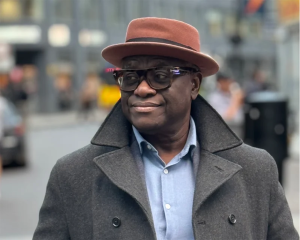
Photo Courtesy Nathalie Handal
Nathalie Handal: Theft is an important part of the film’s plot. There is the theft of Wole Soyinka’s freedom. The theft of the things he created in custody. The theft at home. In the journey of a film, some important and intriguing parts didn’t make the final cut, can you speak about them?
Awam Amkpa: As a team we wanted to have a broader perspective of what was going on in Wole’s life beyond his incarceration and conflict with the Nigerian government. One of the most poignant was the impact of his activities on his domestic life. How did they impact the life of his then-wife Laide and their children? They too were tortured by his arrest, detention and the uncertainties of his life. Asking him details provoked resistance because it meant swinging into more intimate aspects of the domestic conflicts. I had to be careful with how to access that information. I had the advantage that Makin Soyinka, one of his children from that period, was an associate producer. The screenwriter Bode Asiyanbi did a broad questionnaire for him to ask his mother. The responses we got were what we used to build her character in the film because Wole didn’t write about her in the book. Although the entire book was dedicated to her for her resilience, there was a domestic conflict in that space, and we didn’t want to make that the subject of the film. Instead, we wanted to make it an access point to developing the character of Laide.
Nathalie Handal: What challenges did that pose?
Awam Amkpa: It’s tempting when you’re doing a biopic on a character to put other people in that secondary perspective. Instead, we put her almost like a parallel perspective. We wanted to show her in all her complexities, and all the range of her emotions.
Nathalie Handal: Did Christina Oshunniyi, who played Laide, ask any questions that Wole Soyinka didn’t want to answer?
Awam Amkpa: A lot. She asked about how the motivations should be seen. She asked: Did you think he really loved her?
I answered, absolutely. Now, was it the kind of love she was looking for in their relationship? Those were the questions I left for Christina as a motivation for her as an actress. I needed to direct the actor’s visceral response to this dilemma. Is this the love that Laide had acquired, or is this the love that she’s still looking for? And that’s the way we pitched that character; it’s almost like she got him back and was losing him again. Perhaps she wants him to be a different kind of person. And that different kind of person occasionally comes into direct conflict with who he is—a very restless person who always wants to get involved.
Nathalie Handal: In the opening film sequence when Wole is hunting, his grandfather’s words return because he was close to him: Wole, your parents are Christians. They want you to turn the other cheek. You will have to fight. You will be involved in many fights, but there are some fights that you cannot fight by yourself.
Awam Amkpa: We did that deliberately as the opening to show that the film is not portraying a messiah for Nigerians, but a person in conflict between what looks like a messianic impulse and relevance to the people on the ground.
Nathalie Handal: When he was in detention, Wole Soyinka was denied access to reading glasses, reading and writing materials. Can you speak about his reaction to this violation?
Awam Amkpa: For a person who lives in the imaginary world, this was torture. In prison, they gave them a chewing stick, a kind of birch from a tree used in place of a toothbrush. It has antiseptic elements. He sharpened it and made it a pen.
Nathalie Handal: Where did the ink come from?
Awam Amkpa: He made the ink from the droppings of cockroaches. He would crush them together, grind them, and put water in them, which created a brownish kind of ink.
Nathalie Handal: How did he know how to do that?
Awam Amkpa: I don’t think it was a question of what he knew how to do. Rather, what drove him was his need to find a way to create something that is color that would help him write. He used a nib created from wood with the ink he created.
And with the toilet paper, newspaper scraps, anything that anybody who happens to be passing by his cell could drop off that was in a written form, he would collect them, make a pulp with them in his cell, use water and create his own paper. Sometimes he would try to find means of fortifying the toilet paper.
It would almost be like starting the process of the paper all over again before it became thinned out into a toilet paper. He would put them all together and then create sheets. His cell was raided from time to time but they never really found these papers. Because they would see them as trash.
Nathalie Handal: In the film, we see him stealing a pen from a doctor. Why did you choose to use that scene instead?
Awam Amkpa: Because some of the writings in prison were also from pens he stole. Wole doesn’t have fantastic handwriting, so how does he write even on this fortified paper?
He called the ink he created S-O-Y-I-N-K. If we had a three-hour film or a series, it would be intriguing to show his torture and attempt to transcend all these constraints. But we didn’t have that, and we had to be economic. That was why we only saw the theft of the pen.
Nathalie Handal: In the film, despite all odds, he managed to get the poems out of prison and to Laide. But these poems disappeared and have never been found. These missing poems remain a difficult memory.
Awam Amkpa: It took a lot of effort to write these poems and find a way through his networks to get them out of prison. He didn’t have the opportunity to organise his friends to get those poems, and if he sent them to friends, they too could be incarcerated. He sent them to his wife through his network because that was the easiest. But then the wife’s response was intriguing. On one hand, she felt it might mean he was dead. Or that the trauma and torture were ongoing. Or she might have felt tired of all of it. We left it open-ended deliberately.
Nathalie Handal: She called the police in the film.
Awam Amkpa: Because the guy who brought the package was trying to extort money from her for the service of stealing these messages. We put it in the film to provoke questions.
Nathalie Handal: Makin Soyinka is one of the producers, as well as her son. Did he ask his mother what she was thinking?
Awam Amkpa: We asked him to but he didn’t as his mother had declared silence on it, and so had Wole. That’s another movie, the search for those poems. Did she burn them? If she did, why? Or did somebody trash them?
Nathalie Handal: Did Wole Soyinka remember any of the poems, a stanza, a line?
Awam Amkpa: He claims that they went back into the other works that came out after prison. But it was the authenticity of that moment that was lost. If you look at the other thefts in the story, you can see how anyone could want to focus on theft in the film.
You begin to see that the authenticity of the trials he transcended and the material he created was stolen by the loss of those poems.
The artefact of the moment was lost.
Nathalie Handal: On the other hand, the theft of his beloved statues had another outcome. He found all of them. Maybe the poems are reborn in the act of finding these statues.
Awam Amkpa: In a way, we also introduced that to avoid creating villainy out of the wife’s possible actions. We didn’t want her to be a villain when the materials came and disappeared on the home front where she was in charge. She was also there when the statues were lost. But she was the one who led the rescue mission, as a way to regain their relationship. But how does she restore her integrity? Even if it was Wole’s brother who stole and sold the statues.
Nathalie Handal: She might have trusted that the brother was acting in Wole’s best interest.
Awam Amkpa: The household was managed and violated by Wole’s brother. But it still comes back to her. Just like what happened to those poems comes back to her.
When Wole came home and saw that his office was violated, his artwork stolen–that theft devastated him, especially when he found out that it had been committed by a member of the family.
Nathalie Handal: Who and where were they recovered from?
Awam Amkpa: From various people that his brother sold them to—mainly art collectors and expatriate professors who were returning to the UK. Laide had gone to some of the send-off parties, saw them and asked that they not take the works away, and maybe even compensated them.
Nathalie Handal: Another intriguing and missing scene touches on how mathematical principles helped Wole Soyinka survive, despite the fact that he has mentioned not caring much for math.
Awam Amkpa: The mathematical experience is in relation to the confined space he was in. How he would pace in that space for exercise. How he mentally measured the length and the breadth of the cell and his movements, as his pacing was calculated in relation to the geometrical dimensions of the space. But it was also a way of producing a map of thinking. A map of a survival structure in that cell, rather than being at the mercy of the torturers. A mapping of how he would take interrogation, translate it into this emotion, and ways of beguiling and/or of resisting interrogation, and then what he would use to fight back, including starvation. The mathematics was a reasoning structure for him, and he would replay it until it became almost like a mathematical theorem. The number of days he stayed was calculated using these mathematical permutations.
Since he couldn’t write or read, he had to find other ways of keeping himself mentally in charge, otherwise, they would have stolen his mental ability to take care of himself.
Up till today, if you’re with him for a few minutes, you’ll hear him hum. And you’ll see that even his body language communicates a thinking process in patterns. He has a hearing impairment, so the older he gets, the louder the hums.
Nathalie Handal: The humming has to do with the mathematical thinking process?
Awam Amkpa: It does because it’s about recall, repetition. If he has a song in his head, he will break it down mathematically into the structure and the patterns of the rhythm. He will pace to it. He will hum to it. It’s about dimensionality within the physical dimension of being in solitary confinement and the dimension that he has no access to; how he can imagine the dimension of the sky, the dimension of the city he’s in, the dimension of the spaces of activity. This was a very physically active guy who went hunting. So how does he remember all of that?
Wole discovered mathematical permutations to look at the dimensions of his being physically and metaphorically in a confined space. But, more importantly, metaphysically, because he is deeply spiritual about African metaphysical processes.
Nathalie Handal: He wrote about the African conception of tragedy, inspired by Yoruba mythology, in the chapter entitled The Fourth Stage in his book, Myth, Literature, and the African World. Unlike Western tragedy, which often centres on individual flaws and fate, Yoruba-influenced tragedy portrays the hero’s downfall as a disruption of cosmic and moral-spiritual order, which affects the entire community.
Awam Amkpa: Yes. It’s about mythologies and mythologizing, and playing with myth and mythologizing as a metaphor. I would call some of his metaphysical plays “mythoclastic.” In other words, you see a myth or concept that guarantees certainty, yet that certainty is a ploy to talk about uncertainties. He questions tyranny of any kind. Hence the title of the book, The Man Died. It’s about the man who dies if he is silent in the face of tyranny. The whole idea of mathematics stems from that and isn’t a simple process of calculations.
Nathalie Handal: It’s metaphysical.
Awam Amkpa: It’s creating structures in his mind, their patterns, the rhythm through repetition and the dimensionalities, not just in the physical but in the metaphysical.
Nathalie Handal: Wole was tortured, and he witnessed the torture of others—the missing torture scenes seem to be present in soundscape.
Awam Amkpa: Torture was not just silent or physical, it was also loud. The jailhouse, the prison was loud. You could hear screams of people being tortured and beaten up, people in states of despair. He was enveloped by the sounds of torture, of incarceration of different kinds of individuals in that space.
Nathalie Handal: The journalist at the end of the film brought a telegram to Wole, and the telegram just said, “The man died.” What’s the missing story behind that?
Awam Amkpa: The telegram at the end of The Man Died is really about a journalist who wrote about the excesses of government.
If you remember in one of the party scenes, after Wole escorted the nurse out, and he came back, there was a young man who shook Wole’s hands to say, we admire your fight against injustice. You also see him when Wole was first detained.
In reality, Wole saw that young man being violated by policemen. He was also incarcerated and tortured. They had to send him overseas for medical help, and he died.
Nathalie Handal: The man who died is that journalist. Why is that not clear in the film?
Awam Amkpa: Even in the book, it’s almost like a microcosm of a macro idea of people who resist tyranny. It basically says, if you tolerate tyranny, you are physically dead anyway.
Nathalie Handal: If you don’t resist, you die.
Awam Amkpa: You’re dead already. I flipped the meaning and its relationship with time as the man—the journalist—died when he dared to speak out. So, we deliberately brought it to the end of the film to show that it’s not over. It is a repeated ritual.
You actually provoked that when you were questioning that transition to the end of the film.
Nathalie Handal: Did you press Wole on some issues he did not want to answer?
Awam Amkpa: We were pressing very hard for him to recall an incident that happened over fifty years ago. Some of the traumas he had transcended or locked up somewhere in his psyche, and we kept pressing those buttons. He resisted by saying, just because you want to make a good film, that doesn’t mean you are entitled to some of my trauma.
He almost felt like the silences were part of his therapy, because everybody wanted to know exactly what happened.
For Wole, the trauma is not about a paralysing existential situation. It’s more a catalyst for reinvention.
Some of the trauma he told us later, but there were some elements of the story that he didn’t disclose because they would upset a lot of people who were alive at that time. We only introduced one of them, the nurse.
Nathalie Handal: Is there something missing that you personally wanted to add?
Awam Amkpa: The story of the impact Wole has on Nigerian society. He was one of the founders of the first fraternity in African universities. I would have loved to be able to go into that space because these are groups of people who are the spaces of resonance of his spirit of resistance, through a movement that was physical and still exists in every corner of Nigeria.
I wish the film structure allowed me to show it almost as a cliffhanger looking at the kind of impact that he’s had, particularly on Nigeria, but also globally. The global part is fine, but the private part is not fully told and well told because that fraternity is a private society and its privacy is sometimes shrouded in secrecy. The mystery and the mythology of this group are also part of its identity. It’s a huge story that I wish I was able even to put as a signal in the story, but I couldn’t. Maybe one day.
Nathalie Handal: As much as he’s revered, some people feel he’s caused harm. Do you want to say anything about that?
Awam Amkpa: I will not be an impartial adjudicator, but yes, there are people who disagree with him intellectually, artistically, and in the field of human rights. I made a film where I talked about the way we are socialised in post-colonial Nigeria, wherein ethnocentrism is a way of being, and it actually stops people from properly seeing those people who are anti-ethnicity. He was consistently anti-ethnic and anti-any ideology or religion. This led people to question if he was insulting their religion or political ideology.
Nathalie Handal: Wole has said I’ve prepared for my death, I’m prepared for dying, and you’re an important part of this journey. It seems the fact that there’s a preparation for death relates to the title, The Man Died — which of course also means something else — but in a way, there’s this link. He seems to be saying I’m preparing for death because I’m not actually going to die, even if I might not be around?
Awam Amkpa: He is 90 years old. He’s a very organised person. As a writer, he has organised different chapters of his life. He has published some of them, and is still writing and publishing, but he wants to ensure that everything is organised rather than accidental.
Wole has always been preparing for death, but the question is, is death a terminal event or a transition? And from all his writings, plays, dramaturgy, and philosophical writings, he talks about death as a transition rather than a terminal event. So, by that token, he’s always been preparing for that transition. That’s why he takes this daring action to say, I’m gonna go prevent the soldiers from killing and plunging the country into war. If I die in the process, I really won’t die. I will only die if I do not do something about it.
If you read the body of Wole’s works in what we’ll call the metaphysical plays and novels he’s written, you will see that for him, death is a transition. And the essence of being human is what he constantly celebrates. That humanism is what expands the connections between human beings.
Nathalie Handal: Like the missing poems, the physical manifestation died, but they are alive.
Awam Amkpa: The essence of the poems lives because the essence is the resistance to any kind of tyranny.
Nathalie Handal: The handwriting is difficult to decipher. What are we missing when we see his handwriting?
Awam Amkpa: The movement of the lines in his calligraphy.
Nathalie Handal: His calligraphy?
Awam Amkpa: His own invented calligraphy. You see a rhythm to the way he signs his name. This is something that you find people have talked about when they look at other languages, like the Arabic language, and how the calligraphy is written, you see that it’s not like the Gutenberg idea of individual letters, but it’s about the joining and the flow of the join. You see that in most African languages and in the way poets, performers, and artists think. That flow is so critical, that mellifluous idea of items is so important. It’s not just about the lines; it’s really about the flow.
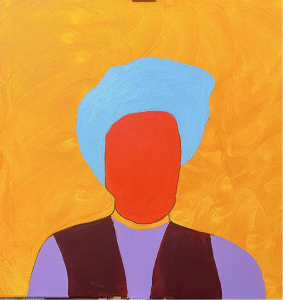
A painting by Awam Amkpa
Nathalie Handal: While you were creating this film, you did a stunning painting of Wole Soyinka, which you’ve gifted him. The colours are luminous, and that luminosity is a spirit. In the body of your painterly work, there’s often no face. This one as well. But you’ve managed to capture his face. Nobody can miss him. Can you speak about this painting—which sighs, stirs, sings.
Awam Amkpa: It’s conceptually about abstraction. Symbolism. About taking over from just the utilitarian idea of a person or a theme. There are moments where you want people to go into deep reflections, because as an artist, you want that response to be in partnership, in rhythm with what you’re doing. That painting for me was like asking myself, over the 40 years now that I have known him, what does Wole look like?
I want to capture an essence that’s abstract, deeply symbolic, and has multiple dimensions. I’m working on a two-dimensional structure, and I want to use the colours to give it the other dimensions. The colours do not harmonise. Like how in music, you are contrapuntal, the colours in the painting are contrapuntal to each other in order to create almost like a sculptural idea on a two-dimensional surface.
Nathalie Handal: Tell us about the colours you used.
Awam Amkpa: I chose red, orange and cadmium yellow, and then I made my own colour for his hair. There are too many paintings, pictures, drawings of his hair. It’s almost like a halo, right? And grey now. I wanted to do something else. I was looking for the best colour that would capture it, and none of the primary colours did. I had to mix my own paint—it’s almost like a cobalt blue, but it’s lighter.
Nathalie Handal: It seems you mainly wanted to go into a deeply symbolic space. That the multicoloured template of the painting is meant to capture the rhythms, emotions, and sense of perspective that you have of him. I see your colours as the missing words.
Awam Amkpa: Yes, the painting was a meditation about what Wole means to me. His essence to me is more spiritual now than physical. That spirituality is what I tried to capture with the colours, dimensions, and abstractions. And so on.
About the author
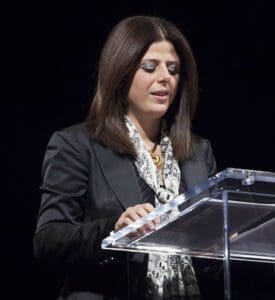
Nathalie Handal is described as a “contemporary Orpheus.” She has lived in four continents, is the author of 10 award winning books, translated into over 15 languages, including Life in a Country Album, winner of the Palestine Book Award; the flash collection The Republics, lauded as “one of the most inventive books by one of today’s most diverse writers,” and winner of the Virginia Faulkner Award for Excellence in Writing and the Arab American Book Award. Handal is the recipient of awards from the National Endowment for the Arts, PEN Foundation, Lannan Foundation, Fondazione di Venezia, Centro Andaluz de las Letras, Africa Institute, and is the winner of the Alejo Zuloaga Order in Literature, among others. She is Professor of Literature and Creative Writing at New York University-AD, and writes the literary travel column, “The City and the Writer” for Words without Borders.
- https://www.guernicamag.com/awam-amkpa-and-so-on/

