

THE New York Foreign Press Center on Friday hosted a briefing addressed by Bob Harvey, the president and chief executive officer of the Greater Houston Partnership; and Christopher Olson, director of international and trade affairs for the City of Houston. Sadiq Yishau reports that Mr. Harvey gave some background on the partnership’s role in positioning Houston to lead the global energy transition to a more efficient and sustainable low-carbon future while accommodating global demand growth. He also captures Olson’s words about Nigerians in Houston. Excerpts:
The Greater Houston Partnership
By way of background, the Greater Houston Partnership is the Houston region’s principal business organization, operating as both the chamber of commerce and the economic development organization for the greater Houston region. We represent about a thousand member companies. We work closely with our elected officials, including of course, the City of Houston, Mayor Turner, and others.
So before I turn to the energy transition, which is most of what I want to talk about, let me say a few more words about Houston itself. In terms of population, as Daphne just mentioned, we’re the fourth-largest city and the fifth-largest metro in the United States. Our metro population is about 7.1 million. We have a roughly $500 billion regional economy. It’s powered by one of the youngest, fastest growing, and, frankly, most diverse populations in the nation and is known throughout the world, frankly, as a great place to do business, with global connections, a great quality of life.
Frankly, it’s both enjoyable and affordable, and if you haven’t visited Houston recently, you should. We have great food, great sports and entertainment, great arts and culture, most anything one would look for, and I’m very pleased that just this past week we announced that Houston would be one of the host cities for the 2016 World Cup – 2026 World Cup, excuse me.
Now, with respect to our ties to France, thinking about a trip that we’re going to be making next week, France is our 16th-largest trading partner. A lot of Houston firms operate in France, as you would expect, and many French firms operate subsidiaries in Houston, as you would also expect. People like Air Liquide, Arkema, EDF, Engie, TotalEnergies, and others, and we both claim Schlumberger as being our company, so we’ll fight over that later.
I would say this: Our geographic location in the center of the United States, combined with our top-ranked port in terms of both tonnage and vessel movements, our two international airports, our extensive rail and highway system, our very large foreign-born population – all of these factors combine to make Houston a top location for foreign companies looking to enter or expand in the U.S. market.
And in addition to energy, Houston enjoys leading positions in life sciences, and of course, we leverage the fact that we have the largest medical center in the world at the Texas Medical Center, and I suspect most of you are familiar with MD Anderson Cancer Center, which lies at the heart of the medical center.
We also lead in technology and manufacturing in aerospace, of course leveraging the Johnson Space Center, which is still the hub of manned space flight, whether it’s government-owned or commercial in nature. We’re also a corporate headquarters city with twenty-five Fortune 500 headquarters in Houston. That’s the third most of any U.S. metro.
So now let me turn to energy. It’s fair to say that over the last several years there has been a remarkable movement by Houston businesses and civic leaders to position Houston as the leader in the global energy transition. As you know, Houston has been inextricably linked to oil and gas, power, and petrochemical industries for over a century, and I think it’s fair to say energy was the central driver to our region’s success as a leading global commercial and cultural center in the 20th century.
But as a result, we’re known throughout the world as the energy capital of the world, but as the energy capital of the world, Houston understands completely the responsibility and the opportunity we have to tackle this dual challenge of meeting the global demand for affordable and reliable energy while lowering the world’s carbon footprint to net zero by 2050. And we believe Houston is the only city in the world, frankly, with the technology expertise, the commercial skills, the manufacturing talent, the infrastructure to lead the transition to a more sustainable low-carbon future on a global scale.
So last summer, the Greater Houston Partnership launched the Houston Energy Transition Initiative, which goes by the acronym HETI. We all call it HETI, and that HETI initiative set forth a strategy for how Houston can leverage its energy leadership to accelerate global solutions for this energy-abundant low-carbon future, and this vision calls for leveraging Houston’s strengths and building on our history of leadership in the energy and petrochemical industry, all of which will be critical for a successful transition. But it also calls for attracting new and innovative talent, startups, and capital to Houston focused on this low-carbon energy issue.
And by the way, that includes the large established players who are setting up low-carbon business units all over the world, so our analysis tells us that if we do nothing but follow the path of the traditional energy industry, Houston will likely shed a half million – 500,000 – jobs by 2050 on a base of about 3.1 million jobs. That’s if we – you might say do nothing, continue to be involved in traditional energy, nothing else, while that industry becomes more and more efficient and less and less the driver of global energy consumption.
But on the other hand, if we take the lead in enabling sustainable and equitable growth in low-carbon technology, we think we can add, we estimate, 560,000 net new jobs. So in other words, that’s a swing of about a million jobs in Houston. And we can have a positive impact for the environment and position Houston as a leading hub of clean energy and climate tech innovation.
Houston Energy Initiative
The Houston Energy Transition Initiative, HETI, is led by 18 of our key industry leaders, most of whom operate at the global level. This group has established four sector-specific, industry-led working groups. One is around carbon capture, use, and storage, CCUS. Another is around clean – excuse me – clean hydrogen development. A third is around what we call industrial decarbonization, which is to say how do we lower the carbon footprint of current operations in energy but in other hard-to-manage sectors? And then the fourth working group is focused on capital formation, which is to say, how do we fund the literally trillions of dollars of investment that will be needed to reach the net-zero goal by 2050?
So in addition to these four working groups, we also have some cross-cutting initiatives, one of which is the development of policy and regulatory frameworks that support investment in clean tech. This requires a whole new set of legislation at the federal, state, and local level to permit this investment to move forward. And another team is looking at community engagement and environmental justice, which is to say, how do we ensure equitable outcomes for all of this work in the coming decades?
In just the last 12 months, we are already seeing this strategy translate into tangible projects and actions that truly demonstrate Houston’s commitment to and leadership in the energy transition. One you may have heard about already: ExxonMobil’s proposed vision for decarbonizing the Houston Ship Channel using CCUS. That effort now has 14 member companies working together to develop an implementation plan. And we continue to see other Houston-area CCUS partnerships being formed and projects being announced.
Our hydrogen working group, which is actually led by an affiliate of the partnership called the Center for Houston’s Future, just released a whitepaper outlining the case for Houston to be the epicenter of industrial decarbonization and clean hydrogen for Texas and the Gulf Coast.
And it’s not only the incumbent industry that is driving the transition forward in Houston; we are fast becoming one of the world’s leading innovation ecosystems, particularly for clean energy and climate tech solutions. In fact, new venture capital investment in the Houston region has seen a nearly fivefold increase since 2017 – fivefold increase since 2017. Over 60 – 6-0 – new low-carbon and climate tech startups have launched in our – launched in or relocated to Houston over the last two years, including several that emerged abroad but opted to relocate to Houston. Why? Because they have access to the industry and to the infrastructure that’s here locally.
A new report that just came out of an organization you may be familiar with called Startup Genome – they produce a report every year. They did it this year in conjunction with the Global Entrepreneurship Network. And it ranked Houston fifth among the world’s top 100 emerging ecosystems for startups. And that was relative to the report last year, which ranked Houston number 19. So real progress on that front.
We’re just getting started. We’re very excited about sharing these developments with all of you. This marks the official I’ll call it international launch of our Houston energy transition strategy. And as you can really imagine, collaboration is a common link that connects our vision and we look forward to working closely with our international partners. It will clearly take all of us around the world working together to achieve a net-zero outcome by 2050.
Next week, Mayor Turner and the Greater Houston Partnership will be leading an economic development mission to Paris, and during that week-long trip we’ll be meeting with civic and business leaders, talking about a variety of topics but most particularly the global energy transition.
Relationship with Italy
Well, we certainly do work with Enel Eni closely, and as you know, the CEO of Baker Hughes, we can never quite figure out what city he lives in, whether it’s Florence, London, or Houston. So he keeps us very well connected to Italy. But we’ve always had strong relationships between Houston oil and gas companies and Italy, Houston power companies and Italy, and major manufacturers, again, like Baker Hughes, and Italy. So it’s always been a close relationship.
And I’ll go back to one point I made earlier. No one has the technology yet to reach net zero by 2050. We don’t have it individually; we don’t have it collectively. The only way we’re going to get there by 2050 is by building these relationships between technology, sophisticated companies and countries that have technology that are leaning into this topic. And in many respects, we would say – I would say in Houston we’re somewhat following the lead of Europe because, frankly, Europe embarked upon this journey before we did. Now we’re heavily invested in it. We need to build those connections. We need to leverage the progress you’ve already made and then figure out how we can move forward together.
But certainly would look forward to working with Italian companies and political leaders. And Chris, I don’t know what connections you’ve had of late.
I failed to mention one of the most important linkages between Houston and Italy, and that’s Roma, the football club in Rome. And Dan Friedkin, a Houstonian and the president of the Friedkin Group, as is well-known in Italy and perhaps across Eddurope, bought the team just a couple of years ago. So we – Dan has got us all wearing Roma jerseys, keeping up with the record, and all that.
The energy industry
The energy industry itself is extraordinarily technologically driven and advanced. And again, we could talk about Schlumberger, which – a company that we both share and is a true technology leader in all facets of energy, and therefore will be an energy transition. But the vast majority of technologists in Houston, Ph.D.-level technologists work for or with one of these energy companies that are here.
But we also have a strong presence in cloud computing. All the major cloud players are here in Houston. By that, I mean the Microsoft, Google Cloud, AWS, and what-have-you. Perhaps of most note, Hewlett Packard Enterprise, one of the stalwarts of – you might think of Silicon Valley technology moved its headquarters to Houston a year and a half ago. They already had a major presence here, but they decided frankly that looking ahead and looking at talent and looking at diversity and looking at the industries they wanted to serve and be part of, it made more sense to locate in Houston than to stay in Silicon Valley. So that was a huge win, I’d say, for Houston to have them move their headquarters here and expand their presence here.
I’m trying to think of other examples. We have leading players like Crown Castle that’s a leader in 5G and they’re already talking about 6G and – on the telecom side, so they’re well-connected with all the other major providers in that space. I could go on. We – just in terms of the industries we’ve alluded to, in life science – Chris probably made more of this point than I did – we’ve always had some of the leading clinical institutions in the U.S. MD Anderson, number-one-rated cancer center in the world; Texas Children’s Hospital, the number two children’s Hospital in the U.S.; Baylor College of Medicine, one of the top medical schools in the U.S. We’ve always had great clinical facilities, medical education facilities. What we’re developing now is the commercial side of all that. We do a billion dollars a year of sponsored research in life sciences here in Houston, and heretofore, that research was often licensed by a company elsewhere – New Jersey, Boston, San Francisco, San Diego.
And now we’re building out what’s called TMC3, which will be a new element of TMC focused on this issue of commercializing the research and allowing commercial companies for the first time to participate on the TMC campus. We’ve never allowed for-profit businesses to operate on the Texas Medical Center campus.
So what’s going on? Obviously, we have other leading manufacturers here in Houston. It’s very much a manufacturing city. We still make things here across the board – electronics of all sorts and other goods.
Fossil fuel
The world is going to continue to need more and more energy. Every forecast has energy demand continuing to grow for decades, and virtually every forecast even has fossil fuel growth at least for the next decade.
So our question is: How do we make that activity most environmentally sensitive and sustainable. How do we reduce the carbon footprint as much as we can of that activity? Scope 1, scope 2, scope 3, how do we across the board reduce the carbon footprint, anticipating a day when we will not have the requirement for fossil fuels like we have today, like were likely to have in the relatively near term? But it does no good for the climate effort to drive the cost of energy to a level that the consumer cannot withstand, and frankly, we don’t want to lose the support of the public around the world and consumers around the world by driving energy prices to a level where they start to question the wisdom of a low carbon, net zero carbon aspiration.
So I would certainly suggest that we support energy projects around the world that are managed in an environmentally sensitive manner, low carbon footprint. We really talk seriously about, all right, where is – where and how is the best way to produce oil and gas around the world such that it has the least greenhouse gas emission element to it on a per barrel, per cubic foot of gas basis?
And we’re finding that there are some parts of the world that are, frankly, much more environmentally efficient than others, and that’s where we’re trying to put our energies and efforts.
Nigerians in Houston
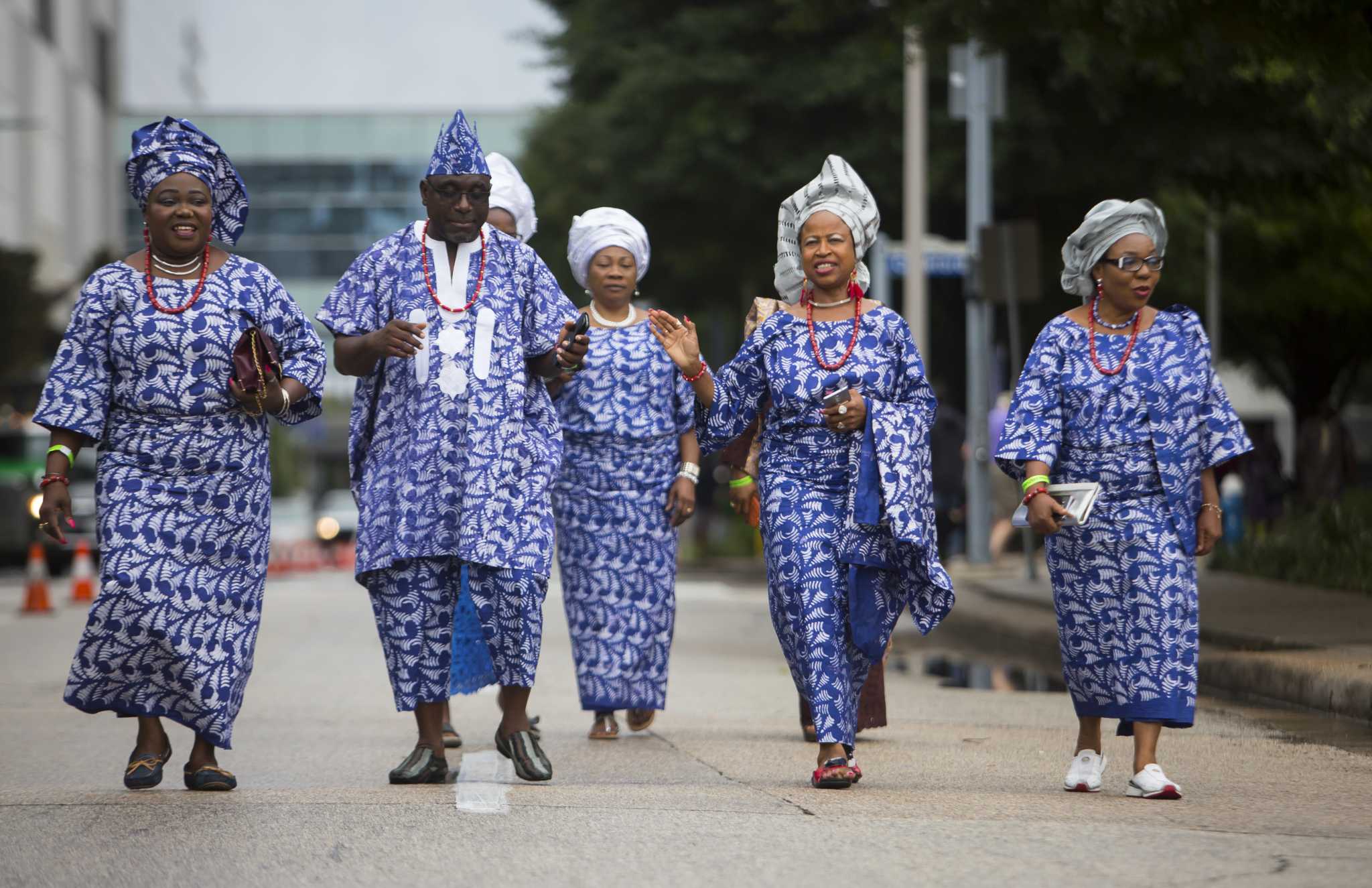
MR OLSON: Houston has one of the largest Nigerian populations outside of Nigeria, certainly one of the largest in the United States. We’re still trying to get a consulate here, which we put a plug in every time we meet with the government. But we have an extraordinarily robust Africa engagement program.
We just on Africa Day hosted one of the largest community Africa Day celebrations in the United States. We had the African Union ambassador, as well as 17 ambassadors from Washington, D.C., come down to Houston to take part in a celebration that was partly business oriented so we could talk about the economic opportunities and building economic ties between Houston and the African continent. It was partly an executive kind of conversation between the mayor and the diplomatic participants of how we can increase that government-to-government collaboration. And then we had a huge social celebration where we brought the culture of Africa in our extraordinarily diverse African diaspora that’s here in Houston to showcase food and culture and business that really enriches the Houston environment by bringing the African diaspora into the conversation and really putting it up on the pedestal and bringing more light to what that community brings to our city.
That is something that we’ve hosted for the last five years now – one year off for COVID. We did a virtual version of it a second year. But one of Mayor Turner’s initiatives when he came in was: how do we increase our collaboration with Africa? And we’re currently on the planning process of an Africa-Houston summit for this fall where we’ll be bringing together leaders from Africa with leaders in Houston to have some of the conversations around energy that you mentioned: how does Houston and Houston-area companies help power Africans’ future? And that’s not just one form of energy; that’s not just production and extraction. That’s energy in all ways, shapes, and forms across the continent.

