

*Honoured by Nat. Assoc. of Nigerian Theatre Art Practitioners, Ibadan Film Club, others
*’I want to be remembered as a Moviemaker’ – Ogundaisi on the ‘Warm Seat’ of IFC
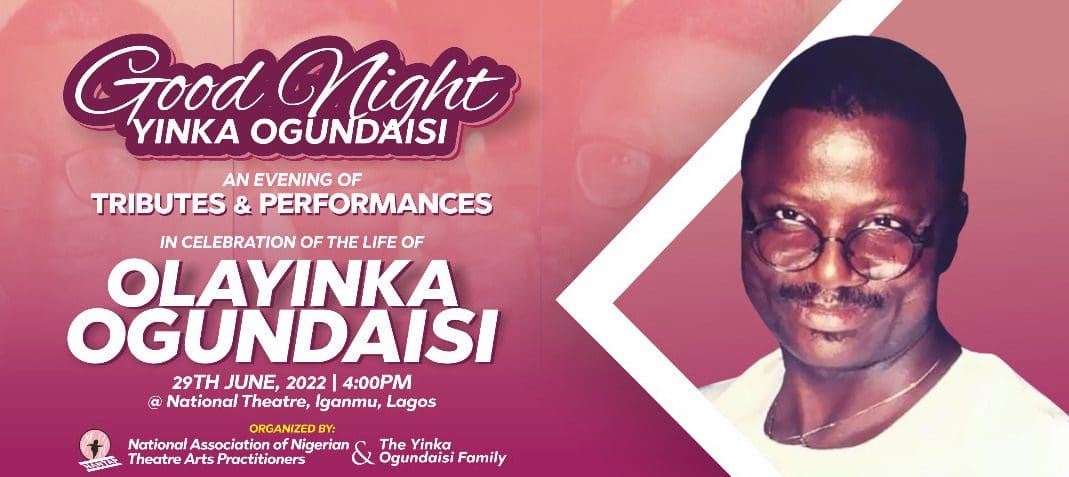
TODAY at the National Theatre Iganmu-Lagos, a rite of passage will be held in honour of the late Olayinka Ogundaisi, the multifaceted artiste – actor, theatre and movie producer-activist – who passed on June 16, 2022.
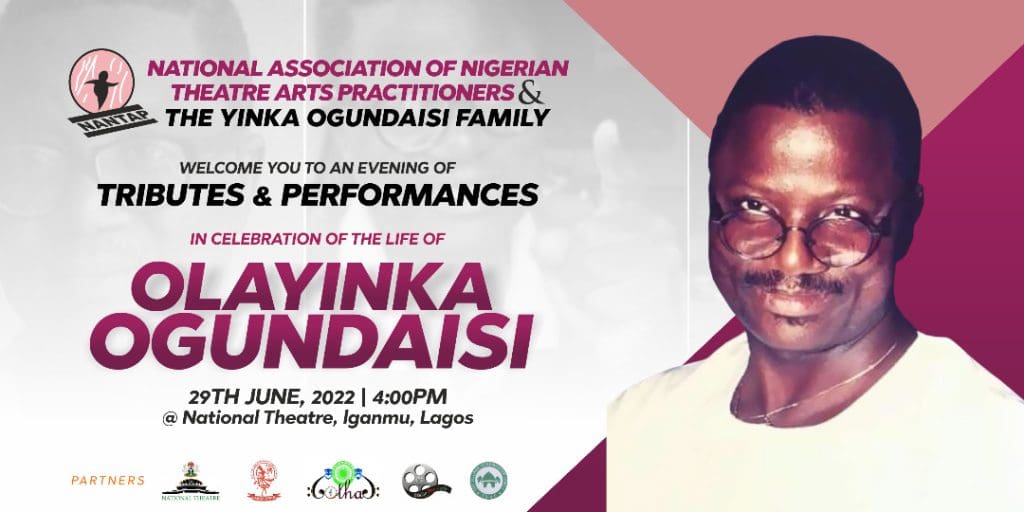
Titled, ‘Artiste Night’, the session titled: “Good Night, YINKA OGUNDAISI: An evening of Tributes & Performances in celebration of the Life of OLAYINKA OGUNDAISI (Feb 18th, 1953 to June 16, 2022) — is organised by the Lagos Chapter of the National Association of Nigerian Theatre Arts Practitioners, NANTAP, to which the late artiste was a member before his long bout with illness and subsequent death. The NANTAP is supported by other affiliate organisations, in which the deceased was an active member. It will start at 4pm.
To join virtually, guests have been advised to:
https://us05web.zoom.us/j/4115378835?pwd=enBLVFlvMVFSbDdmOHJtSENHTjNrZz09 to start or join a scheduled Zoom meeting.
*****
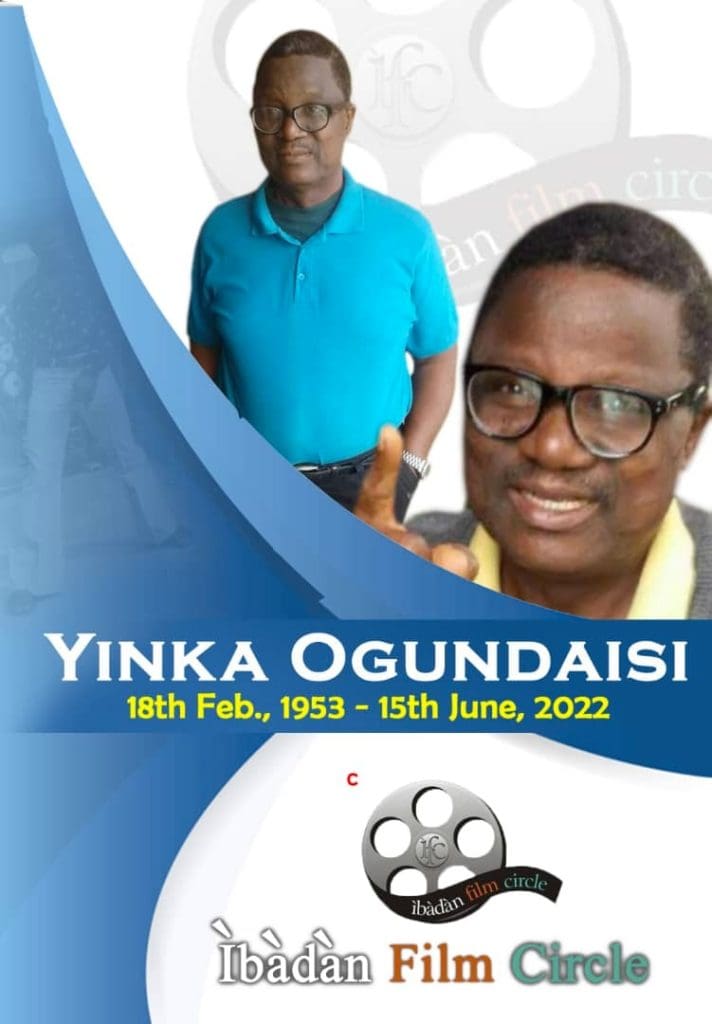
APRIL 27, 2016, Ogundaisi, was a guest on the ‘Warm Seat’ session of the Ibadan Film Circle, IFC, in which he was also a vocal and active member.
As is traditional to the session, Ogundaisi, fielded questions on his life, career and issues affecting the profession he loved with passion. “He responded to 16 questions from housemates for two hours in the session moderated by actress film producer, Judith Fought,” stated Ropo Ewenla, moderator of the IFC online group.
In a preface to the release of the transcript of the session, Ewenla stated:
“It is the tradition of Ibadan Film Circle (IFC), a group of film makers, scholars and critics to have what they call a Warm Seat session for their members from time to time so as to gauge their views on topical issues of the industry and sometimes to also get a glimpse into biographical pieces that might have shaped their lives over time. This is some sort of group self-documentation. Considering the fact that the group set itself apart as an exclusive film and allied matters advocacy group, the weekly warm sessions were always something to look forward to. It featured, now late actor, director, producer, entrepreneur, writer and art advocate, Yinka Ogundaisi.”
Excerpts from the session:
…’I want to be remembered as a Moviemaker’
IFC: Mr. Ogundaisi, what, in your own opinion, is the solution to lack of conscientious and gazetted patronage of the Arts by government?
Yinka Ogundaisi: Please enlighten me more about this “patronage by government of the Arts.”
Budgeted funding and including the arts as part of non-oil sector to be explored.
First, I think we have issues with our political leadership that we need to straighten out. Our leaders are yet to buy into culture and arts as viable alternatives to extractive wealth.
As someone who has seen a bit of everything in this industry, could you please appraise the logjam within ANTP (Association of Nigerian Theatre Practitioners), that culminated into the birth of TAMPAN (Theatre Arts and Motion Picture Practitioners of Nigeria) and the state of things right now.
The real issue is the chaos in the marketing of our movies. It rendered many people jobless and as a way out, jostling for positions became the alternative. Tomorrow, if we sort out the distribution problem, most of those now fighting for positions in the associations will face their jobs of productions
As a member of the National Video and Film Censors board that prepared the framework for marketing, do you think the plan worked out? If “yes”, enlighten us please; If “no”, what are the reasons for its failure?
The new distribution and exhibition framework is about implanting enforceable standards in the process of movie and music distribution. It is an industry-driven project. Government’s roles through the board are to license the distributors from national to community levels, subject them to stipulated guidelines and closely monitor them to ensure compliance. The price a producer fixes for a distributor to pay for the movie’s distribution is left for the parties to independently negotiate and agree upon.
A major guideline for a valid contract is the period of between six (6) months and five (5) years which the producer and the distributor must agree upon. A movie in distribution must also not go beyond the area agreed upon by the parties. The implementation was in two phases. The first, exclusive to the Board, was the licensing of the National and Regional Distributors who are the wholesalers. The second was jointly with state governments to license the States, LGAs and Communities’ Distributors who are the sub-wholesalers and end-points retailers.
The licensing of national and regional distributors has been done but the second phase is still outstanding and that is why it looks as if the policy has failed. No. It hasn’t. The main problem now is that while the national and regional distributors operations are regulated, it is not so with the end-points retailers and; that is why piracy is thriving because the retailers are not operating as they should; and the agency appears unconcerned once they pay their licensing fees.
If you are the GM of the National Theatre today, what main policy and actions will you take to give the creative arts the needed relevance for national development at the present time?
I had written extensively about National Theatre. The summary is that whatever funding is required can be sourced through a Business Plan that maximizes its present potentials. The Theatre/Exhibitions Hall could be leased out to big-time literature bookshops, with a portion reserved for regular arts exhibitions. Whenever an artist sells, commission is taken off the sales. Cinema Halls should be run by hotels and classy restaurants but their package must now include regular movie screenings to their patrons. Producers will be paid a share of the day’s bills. Banquet Hall is for corporate bodies to fund in return for their corporate/brands’ events and the main hall can be incorporated and marketed using the Wimbledon’s elite placements and reservations strategy.
Distribution has been identified as one of the major problems of Nollywood; why is the issue with actualising the National Distribution Framework of the NFVCB which you helped to design?
This question is already answered above. The addition is that censorship and, of course, distribution is on the concurrent list of our constitution which means both the federal and states can legislate on it and with different political interests, we have the stalemate actualising the ideal distribution. It is not helped by the jostling for positions by some of the stakeholders. I am sorry to say this, but there are elements within the industry whose relevance centred on the chaotic situation of the industry. Outwardly they seem committed to resolving the matter but in actual fact perpetuation of the chaos is really their objective
You have been instrumental to the formulation of a number of policies in the culture sector. How do you feel seeing that these efforts are often abandoned ultimately? The film distribution model launched with pomp refers.
I feel bad, very bad but after I sold a house to make up for the loss I incurred in my first and only Yoruba movie in 2007 and I subsequently became bankrupt, with its toll on me till now, I am now more concerned about surviving! I have learnt not to take people’s public posturing seriously again.
You have always been an advocate of the Home Video market even when some think that investing hugely in community cinemas could restore the hope of filmmakers in their investment. Are you so ‘stuck’ to this position so as to sustain the NDF, despite the problem of piracy? As a marketing expert, are there other areas that we need to look into?
The simple reality is that 99.9% of our movies are DTH so the NDF remains the only way out. The cinemas as they stand today are more elitist and only a negligible fraction can access them. This is not hearsay. It is from my personal experiences. On the community cinema, the issue is viability. 80% of the costs are fixed which means certain level of income must be made and the costs of putting the cinemas in place. Finally, the economic situation of people working 26-18 hours a day doesn’t encourage patronage of the cinemas.
Why do you think artists in Nigeria have low mortality rate, and what can be done to arrest this?
I believe being in the public eyes and not having the wherewithals to back up the public expectations is really an issue. High blood pressure, heart attack… What can be done simply is for government to put the right people in the leaderships of our arts and cultural agencies. It would go a long way to calm frayed nerves.
You once featured in full Sango gear with your hair made for the role somewhere in Lagos, many years ago. With your passion and expertise now devoted to the movie world, do you still see yourself doing the Sango stuff anymore like in those OYA days?
In 2004, I revived late Chief Duro Ladipo’s group to stage OBA KOSO live, first at my club, Lagos Country Club and Gateway in Otta. The above is to demonstrate my commitment to live theatre. If tomorrow, a producer wants me on stage as Sango, I am ready!
Just for the records, sir. Can you state briefly w) hat exactly is your stance on the MOPPICON (Motion Picture Practitioners Council of Nigeria ) Bill review?
Thank you. I believe the stakeholders through their various associations can evolve a national body who, can now decide whether or not we need a Moppicon law. However, since the review committee is now in place, I believe they should be allowed to complete their work.
What is the censors board doing to make sure the state government play their roles in the framework so as not to make it a total failure, because when distribution is not getting to the end-users and piracy still thrives, it will be seen as a failure?
The incumbent DG, Patricia Bala used to be a friend like other directors then when (Emeka) Mba was the DG. After Mba’s exit, I wormed up to Bala and we were set to continue the job. In passing, my last assignment for Mba was to get a bank to provide us with seed-money to conclude the implementation in 2011, and I reported this to Pat when she took over but for some reasons best known to her, she decided against my consultancy with the board and since 2011 till now (2016), the board has not made any pronouncement on the fate of NDF. It is sad!
How can artists patronize the arts themselves?
Right now, artists, because of all the agencies not getting their acts right, are “endangered species” Let’s talk about their survival first. There was a question on piracy and NDF which I need to clear. Nigeria has one of the most potent copyright laws. The major hindrance now is our unstructured distribution. I do not know how a stiffer piracy laws as being clamoured for will change the situation if we don’t first structure the distribution. The N500k that is stated as fine is not for the big-time pirate but the retailers in whose domains the piracy happens. Beyond this is that non-registration of the retailers, giving them territories and POC has made them the distribution chain of the pirates. Tomorrow if the operations of the retailers are structured, it will break the lifeline of the pirates because as of today, eight (8) out of ten (10) CDs in a retailer’s shop are pirated copies; so deal with the retailers to deal with the pirates.
Do you think there is a future for Nigerian filmmaker aiming to run a successful film production company?
Yes. There is – provided we stop playing ostrich with our distribution challenge. If I had my way, I would say declare emergency or stop producing until we solve the distribution issue. BOI (Bank of Industry) Nollywood fund and now Access bank are tied to distribution but the question I am asking is where are the distributors acceptable to the banks in Nigeria today? Why are the producers the distributors of their movies?
What is one big professional step Nigerian artists should take to improve on their acts and improve their networth?
I believe the first step is to ensure only qualified heads are engaged by government to run our agencies. This is because except the atmosphere is conducive enough there is pathetically little that an artist or a group can do. Late Fela in 1978 when he founded Movement of the People (MOP) captured this succinctly that he had to go into politics because so long as wrong people are in charge, nothing he did as an artist will ever produce the right result. For example, he cited Nigeria being classified as a third world country which according to him means if he became the country’s no 1, he will still have to take his position behind the worst from the countries classified as the second world members!
What will you really call yourself sir? A director, actor, or producer. In what aspect of production lies your passion
A moviemaker!

