
The ‘Nigeria Imaginary’ is particularly appropriate in view of the challenges we are currently going through as a country. We face what can only be described as an incredibly difficult time in Nigeria with an economic crisis that has caused most Nigerians to see their earnings and savings decimated by devaluation and inflation
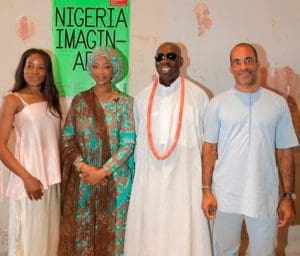
Curator of he exhibition, Andrea Emelife; Minister for Arts, Culture and Creative Economy, Hannatu Musa Musawa; Governor, Obaseki, and Director of MOWAA, Philip Ihenacho, at the opening of rhe exhibition
…as ‘Nigeria Imaginary’ exhibition to tour internationally
EDO State Governor, Godwin Obaseki, has said that the Nigerian Pavilion at the 60th edition of the Venice Biennale has showcased “the rich potential of contemporary Nigeria art, which mirrors the peculiarities of the country’s present challenges and hopes.”
The Pavillion, initiated and managed by the Museum of West African Art (MOWAA), which is promoted by the State government, hs garnered a lot of positive reviews since it was declared open on Wednesday April 17, by the Nobel laureate, Professor Wole Soyinka, who also praised the choice of artists and the curatorial, service, rendered by Aindrea Emelife.
Stated Obaseki at te opening, witnessed by over 100 people, “I am serving as Commissioner of the Nigeria Pavilion at the Venice Biennale for the second time, working with the Federal Ministry of Art, Culture and the Creative Economy. I am particularly pleased to see this Nigerian Pavilion unveiled to the world with truly exceptional works by eight outstanding Nigerian artists being showcased in such an extraordinary venue.”
the governor also praised the artists featuring in the showcase, saying, “I want to express my profound gratitude to each of them, namely – Tunji Adeniyi-Jones, Ndidi Dike, Onyeka Igwe, Toyin Ojih Odutola, Abraham Oghobase, Precious Okoyomon, Yinka Shonibare CBE RA, and Fatimah Tuggar. Let me also appreciate the Curator – Aindrea Emelife, and the organizer of the programme – the Museum of West African Art, for making the Nigeria Pavilion at the 60th edition of the Venice Biennale such a success.”
On the theme of the exhibition, the governor said: “The ‘Nigeria Imaginary’ is particularly appropriate in view of the challenges we are currently going through as a country. We face what can only be described as an incredibly difficult time in Nigeria with an economic crisis that has caused most Nigerians to see their earnings and savings decimated by devaluation and inflation.
“It is during trying times like this that hope for a better future and a belief in the ability to make a difference become essential. This exhibition – Nigeria Imaginary, looks back to great moments of Nigerian history, imagining where we could have been as a nation, but also invokes hope for a brighter future. The great artistic traditions and rich cultures of Nigeria and West Africa have had and continue to have a profound impact on global arts, music, fashion, and culture.”
Obaseki added, “As some of you may know, this is my last year as Governor of Edo State, and at this stage, one begins to think about legacy, and review what one has managed to achieve in the last 8 years. I can say unequivocally that the thing that I am the most proud of is igniting the spark that has become the fire called MOWAA, the Museum of West African Art and the 13 acres Cultural District which is now under construction in the historic part of Benin City in Edo State. It is my aspiration that it will serve as the venue for the homecoming of this Nigeria Imaginary exhibition when it comes to Nigeria.”
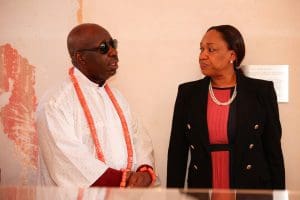
Obaseki with the Charge d’affair of the Nigerian Embassy in Italy, Gwen Omijie, at the opening of the pavillion on Wednesday, April 17
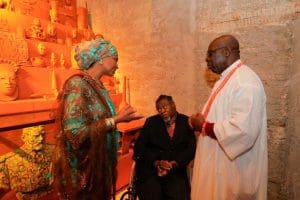
Arts, Culture and Creative Economy minister,, Hannatu Musa Musawa; and Governor Obaseki, with the artist, Yinka Sonibare (in the background) at the opening