
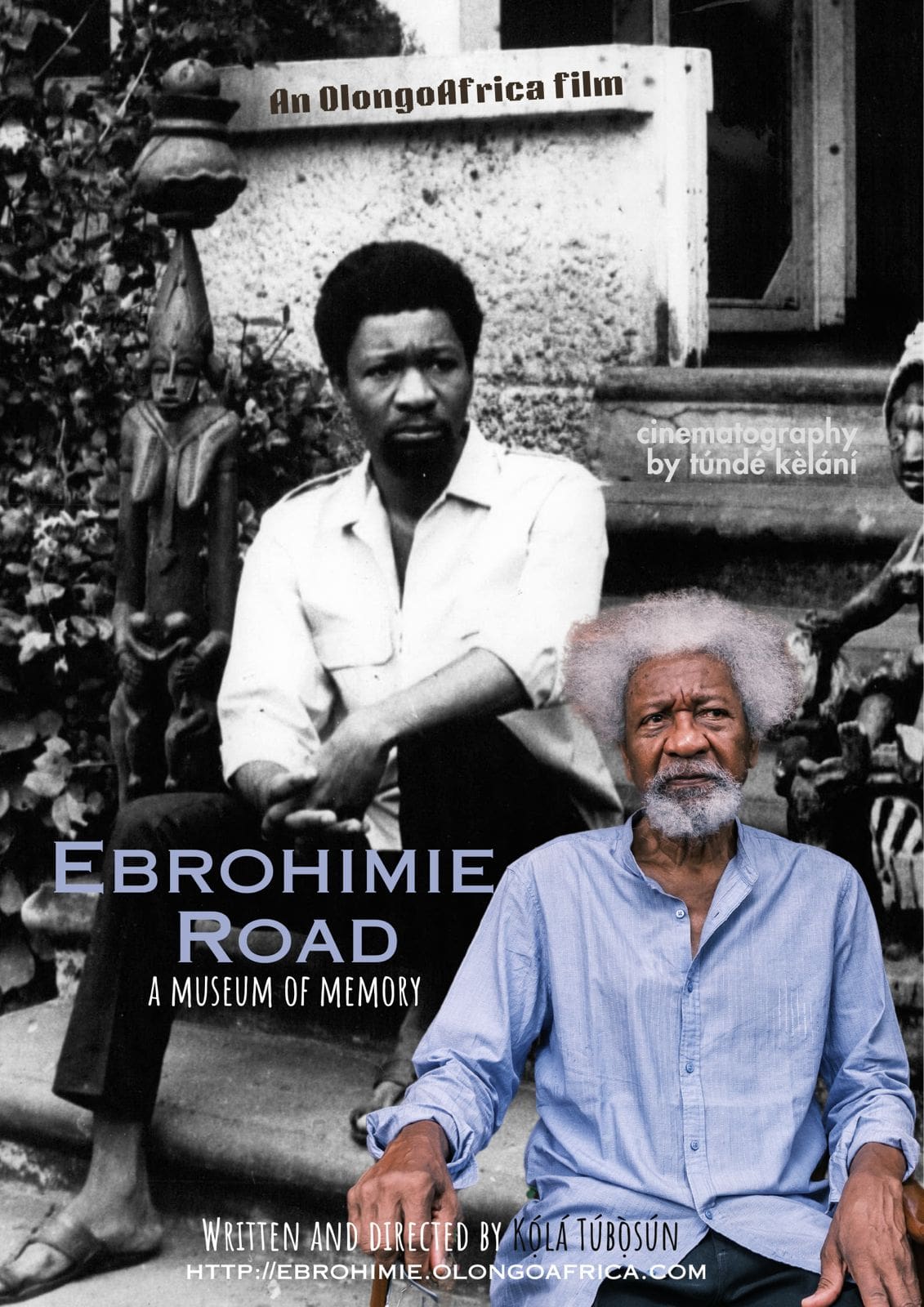

Produced by Olongo Africa, Ebrohimie Road… which featured revealing interviews with immediate families, relatives, associates as well as comrades of Soyinka, will also be screened on July 20 at the WS90 celebration in London, jointly organised by the WSICE and The Africa Centre. It will thereafter move around other cultural and historical centres in Nigeria, parts of Europe, North and South America, as well as festivals across continents.
.jpg "For Soyinka at 90, ‘Ebrohimie Road, A Museum of Memory’ on screens in Lagos, London, Ibadan, other cities 7") |
| .Prof Wole Soyinka, captured in an archival picture on Ebrohimie Road |
Ebrohimie Road: A Museum of Memory… examines how the personal became the national, through the recollection of central and peripheral characters; how a small campus residence became witness to some of the most significant issues in Nigerian social, political, and literary history, many of which remain unresolved. And how ecological changes contribute to the erosion of history and a sense of place. Through stories, visuals, and historical records, we unearth what makes Ebrohimie Road more than just a campus street or physical location, but a place of history and a museum of memory.
Produced by Olongo Africa, Ebrohimie Road… which featured revealing interviews with immediate families, relatives, associates as well as comrades of Soyinka, will also be screened on July 20 at the WS90 celebration in London, jointly organised by the WSICE and The Africa Centre. It will thereafter move around other cultural and historical centres in Nigeria, parts of Europe, North and South America, as well as festivals across continents.Confirmed and potential screening dates
WSICE2024/WS90 Symposium, University of Lagos, Nigeria — (July 11, 2024). 4pm
WSICE2024/WS90 celebration, Africa Centre, London (July 20, 2024) 3-5pm
Africa Centre, New York (TBD)
Centro Cultural Africano, Mexico (July 13, 2024)
Committee for Relevant Arts (CORA), Freedom Park, Lagos (July 14, 2024). 6pm
Senior Staff Club, University of Ìbàdàn (TBD)
Institute of African Studies, University of Ìbàdàn (TBD)
Hutchinson Center, Harvard University, USA (September 2024)
University of Leeds, UK (October, 2024)
Lagos International Poetry Festival Lagos, Nigeria (October 24th – 27th, 2024)
Lagos Book & Art Festival (LABAF/CORA), Freedom Park, Lagos (Nov 2024)
Synopsis: A small campus bungalow in the University of Ìbàdàn has played an outsized role in the life of one man, one family, one university, and the nation. It was in this house on Ebrohimie Road, University of Ibadan where, sometime in 1967, writer Wọlé Ṣóyínká was arrested after having returned home from a visit to Biafra for a personal intervention in the Nigerian Civil War that was just breaking out. — events already recounted in The Man Died (1971), You Must Set Forth at Dawn (2006), and other works. It was there, too, that he returned to from jail when he was released 29 months later, after which he went into exile in 1971. He never returned to Ìbàdàn, choosing to take up a role at the University of Ifẹ̀ in 1976, where he retired in 1985, a year before winning the Nobel Prize in Literature.
This house played host to many friends, family, and associates over the years while he was in solitary confinement, and features in his years of employment with the Ibadan University. And it was in that house where, in October 1969, after his release, he granted a famous interview to a journalist from Daily Times to express himself about the war and the events that got him locked up. The portrait from that encounter made it to the cover of Ìbàdàn: The Penkelemes Years (1994).
In Ebrohimie Road: A Museum of Memory, we examine how the personal became the national, through the recollection of central and peripheral characters; how a small campus residence became witness to some of the most significant issues in Nigerian social, political, and literary history, many of which remain unresolved. And how ecological changes contribute to the erosion of history and a sense of place. Through stories, visuals, and historical records, we unearth what makes Ebrohimie Road more than just a campus street or physical location, but a place of history and a museum of memory.
Ebrohimie Road enjoys supports from Open Society Foundation and Sterling Bank Nigeria.
Ebrohimie Road is in the southeast area of the University of Ibadan. It branches east from Lander Road and runs parallel with Oduduwa Road. Ebrohimie was the town founded in the latter half of the nineteenth century by Olomu (c. 1810-1883), a great trader on the Benin River. It was made famous by Olomu’s son, Chief Nana (1852-1916) who was appointed governor of Benin River (1884-1891) by the British Administration. (Source: UI Road Network).
- https://www.africanartswithtaj.com/2024/06/for-soyinka-at-90-ebrohimie-road-museum.html

