

Education in Nigeria has suffered greatly from past institutional neglect, policy somersaults, poor implementation, a gaping funding deficit etc. All of these shortcomings hinder the nation’s ability to grow the necessary human capacity to achieve its development potential. Meanwhile, the rest of the world, including several African countries, is roaring away to keep abreast with the rapidly changing times driven by digital technology
The President and Board of the Nigerian Academy of Letter;
Distinguished Fellows of the Academy;
Ladies and Gentlemen;
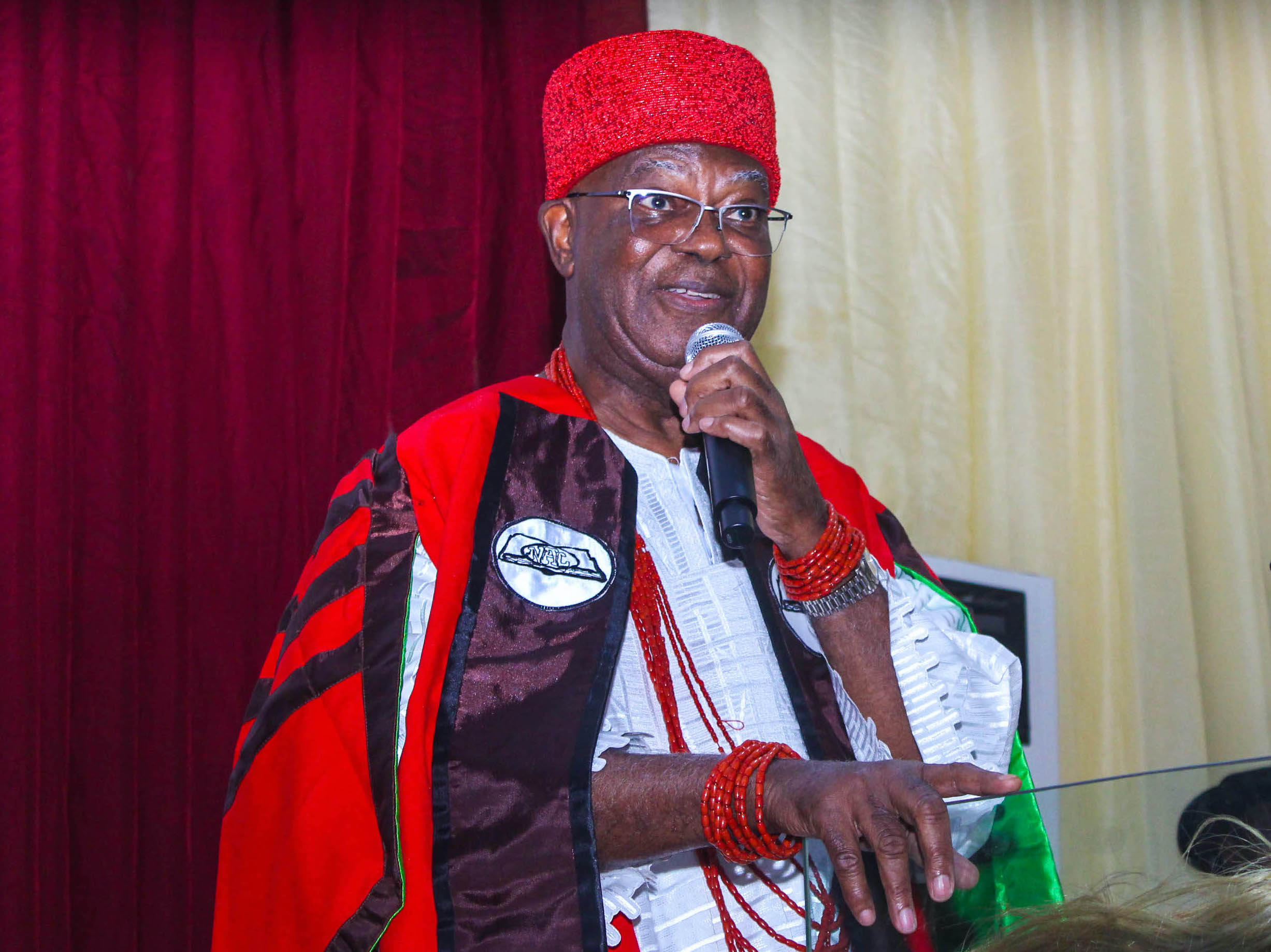
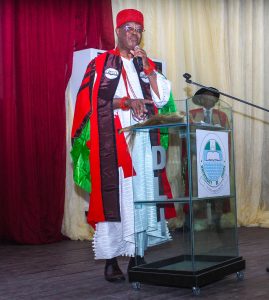
I AM humbled and honoured to perform this duty of expressing appreciation on behalf of my triplet colleagues, Mr. Jahman Oladejo Anikulapo and Dr. Lasisi Olagunju, and I, on the conferment of the distinctive honorary fellowship of the Nigerian Academy of Letters on us today.
I am not sure how the lot fell on me for this duty. I am mindful that my coawardees are manifestly more erudite than I, and would have handled the assignment far better. Indeed, erudition is part of the DNA of their profession.
So here am I, a traditional ruler addressing this intimidating gathering of the best and brightest of the men and women of letters of this nation. Some, including academics and politicians, have seriously but ignorantly argued that traditional rulers should be relegated and restricted to their palaces to devote their time to breaking kola-nuts, pouring libation and engaging in frivolities. How I wish they were here today!
Thank goodness, the fiery and irrepressible lawyer, Chief Niyi Akintola, SAN, a stalwart of the Central Council of Ibadan Indigenes (CCII), once said that the collective education and professional experience of the Ibadan Traditional Council far exceeded those of the Oyo State Executive Council. I believe that he was equally speaking for a host of other traditional councils in the country. Today, we have a Former Governor, a judge of the Supreme Court and a President of the Federal High Court, academic Professors in diverse fields, diplomats, oil industry executives, professionals and accomplished business executives, distinguished Armed Services Officers, Nigeria National Order of Merit (NNOM) recipients, etc, as traditional rulers. Their traditional councils are equally distinguished, with members who are happily giving back to their communities of origin and continuing to serve the nation in their respective vocational disciplines.
This brings me to the subject of nurturing our human capacity for national development, the cornerstone of which is education, particularly at the tertiary level. Professor Peter Okebukola, while he was the Executive Secretary of the National Universities Commission, between 2001 and 2006, once said that “With more than two million candidates striving to fill about 750,000 available spaces in the universities, the challenge of opening doors for more to enter the higher education system and ensure that quality graduates come of it in the face of resource handicap is stark”.
The situation foreseen by Professor Okebukola some 20 years ago has steadily become far starker today:
The country’s population has grown from 140 million in 2006 to an estimated 233 – 237 million in 2025, and so also has the demand for education, particularly at the tertiary level:
- Education has more often ranked below Defence, Infrastructure, and the National Assembly in our annual national budget.
- The average annual allocation for education in 25 years since 2000 is approximately 7.81% of the national budget, which is far below the UNESCO/National Policy on Education recommended guideline of 20 – 26%.
- The averages for some African countries over the same period are Ghana (24.37%), Kenya (21.70%), Senegal (21.32%), South Africa (19.94%), and Morocco (17.61%). We are far behind in the race in Africa and the world.
- The 2025 budget allocation by the Federal Government and 22 States is 7.3%.
- In 2025, only Enugu, Kano, Kaduna, and Jigawa States exceeded the UNESCO guidelines as the current Governors have summoned the political will to address the deficits of the past.
- In 2025, Kenya leads the African countries with 30% allocation, while several others exceeded 19%.
- Of the 262 existing universities in the country, 24 (9.2%) were established in the 42 years since the founding of the University College Ibadan in 1948, and the balance of 238 (90.8%) in the last 35 years. Consider the birthing challenge, funding deficit, faculty development, inadequate or non-existent learning facilities, collapsing infrastructure, etc.
- 147 (56%) of the 262 universities are privately owned and operated, and of varying sizes, qualities and dispositions, the oldest being established in 1999
 EDUCATION in Nigeria has suffered greatly from past institutional neglect, policy somersaults, poor implementation, a gaping funding deficit etc. All of these shortcomings hinder the nation’s ability to grow the necessary human capacity to achieve its development potential. Meanwhile, the rest of the world, including several African countries, is roaring away to keep abreast with the rapidly changing times driven by digital technology.
A further complication is the JAPA phenomenon, which is a brain drain from Nigeria to the developed countries, whereby some of our best middle-level professionals are relocating abroad out of concern for the upbringing environment for their young children.
There are more depressing metrics, but this is not a lecture. So, let me briefly draw attention to the future and then sit down.
Digital technology has exploded and is affecting every aspect of our lives. In education, virtual universities are increasingly becoming the norm whereby lectures, seminars, and symposia, medical procedures, scientific research, etc, are conducted virtually.
Artificial Intelligence (Al) is roaring away at a frightening speed for good and bad, just like human nature. It is now obvious that academic institutions, business organisations, governments, etc, would ignore Al only at their own peril. Indeed, Bill Gates has predicted that Al has the capacity to replace human beings in performing tasks sooner than we would expect.
Thankfully, Nigeria’s internet penetration at 60%, driven by affordable smartphones and increased data availability, is one of the highest in Africa. But we still lag behind Moroссо (92%), Botswana (81.4%), South Africa (76.5%), Egypt (72%) and Kenya (68%).
From the foregoing snippets, one should ask: Quo Vadis Nigeria? How do we dig ourselves out of the Education quagmire of several years in the making? Do we focus on remedying the past before aiming to catch up with the present and the future? Or, could we skip the past and leapfrog directly to the present and future?
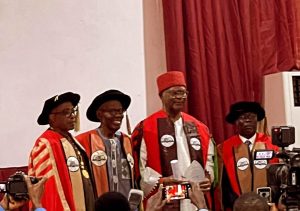
Igwe Nnaemeka Ugochukwu Achebe, CFR after his induction as Honourary Fellow of the NAL
HRM Igwe Achebe with fellow honourees, Dr Lasisi Olagunju, Editor of Saturday Tribune, and Jahman Anikulapo, Exec Director of Culture Advocates Caucus, CAC, and elderstatesman, Chief Emeka Anyaoku GCON, GCVO, CFR
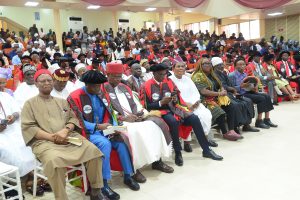
Cross-section of the Honourees and guests
Photos: SEGUN OLAYEYE (LasGidiFest)

