

*…behind regional average by 1.5%, less than 6% global
*’Uneven vaccination means unequal growth‘
NIGERIA lags behind other economies as the International Monetary Fund (IMF) reviewed the 2021 and 2020 output prospects.
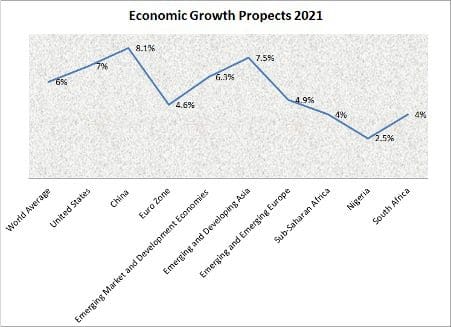
The review captured in the July World Economic Output (WEO) Update just released suggests that the IMF in the past two months is indifferent about Nigeria’s growth this year as it retains its April 2.5 per cent growth rate prediction.
The figure puts Nigerian behind other major economies but Saudi Arabia whose output estimate was downgraded by 0.5 percentage points, from 2.9 to 2.4 per cent in the latest review.
South Africa, which is picked alongside Nigeria as the flagship economies in sub-Saharan Africa, is projected to grow at four per cent. Despite the social unrest in the country in recent weeks, its economic growth prospect got a mark up by 0.9 percentage points.
The former apartheid country is put in the same basket with the entire economy of sub-Sahara Africa, which is also expected to expand at four per cent in the year.
Nigeria is behind the regional average by 1.5 per cent points.
It is also far less than the six per cent global average, the same spot the regional projection was in April, the previous review. Advanced economies are projected to increase by 5.6 per cent, with the United States expected to grow by seven per cent, which is 0.6 percentage points higher than the April forecast.
Emerging and developing Asia economy, which includes China, is expected to record a growth of 7.5 per cent if the current recovery continues till the end of the year, IMP data noted. Asia, where the COVID-19 started, has the brightest growth prospect across regions.
The muted or sluggish growth in Nigeria and other developing countries underscores the double-track recovery caused by uneven Covid-19 vaccination. On a global scale, 27.7 per cent have received at least one jab of vaccine as against 1.1 per cent that has been received in low-income countries. Also, the global average of those fully vaccinated is 14 per cent or 1.1 billion, according to statistics sourced from Our World in Data this morning.
Unfortunately, only 0.7 per cent of Nigeria’s population or 1.4 million people have received a complete dose of vaccine. The uneven progress, the World Bank, early warned, would reduce Africa’s share of fresh investments.
The IMF reinforced this concern in today’s report. “Achieving the 40 per cent vaccination target by the end of 2021,” it stresses, “will require sustaining the growth in global vaccinations and ensuring their equitable distribution”.
At the end of June 2021, it says, the pace of daily global vaccinations stood at about 40 million doses a day, with China alone accounting for more than 20 million and high-income countries accounting for seven million doses a day. By contrast, fewer than 100,000 doses a day are being administered in low-income countries, IMF disclosed.
Growth, it states, “would be weaker than projected if logistical hurdles in procuring and distributing vaccines in emerging markets and developing economies lead to an even slower pace of vaccination than assumed.” It says such delays expose the globe to risks of new variants, with possibly higher risks of breakthrough infections among vaccinated populations.
There is a strong positive correlation between vaccination pace and economic growth prospect if IMF projections are taken at their face value. The United States, the United Kingdom and China are among the leading countries in vaccination efforts, with the US achieving 49.7 per cent vaccination. The countries are also among those with the highest growth prospects. The US and UK are expected to grow at the speed of seven per cent while China’s projected at 8.1 per cent. The Middle East and Africa where vaccination is slow are witnessing a snail-speed growth.
Of Nigeria’s economy, it insists: “The overall fiscal deficit in 2021 was revised up by 0.3 percentage points from the April 2021 WEO, mainly because of the re-emergence of fuel subsidies as well as the additional COVID-19 and security-related support in Nigeria.
“Still, at 5.2 per cent of gross domestic product (GDP), the overall fiscal deficit remains well below that of advanced and emerging market economies, reflecting financing constraints – about 60 per cent of LIDCs are assessed to be at high risk of or in debt distress.”

