
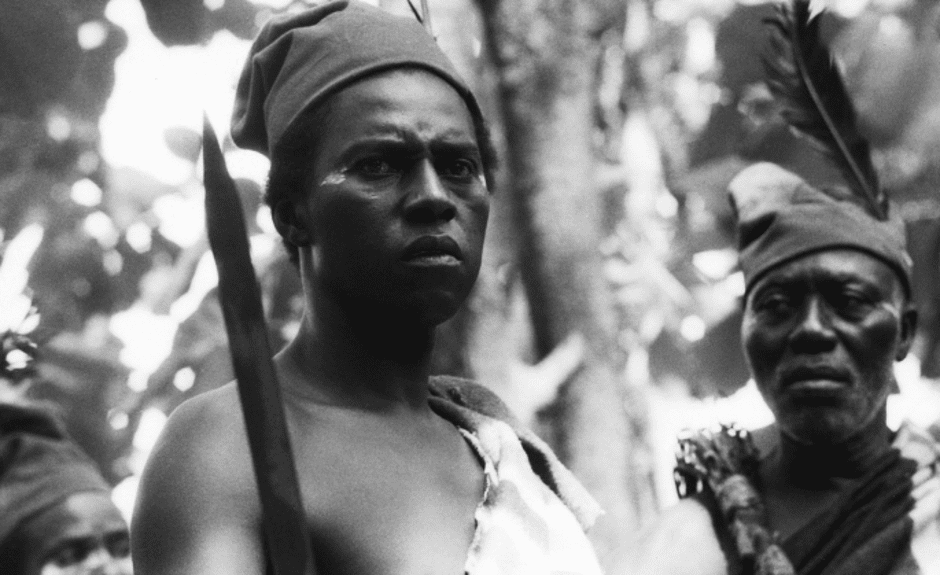

SHOT in 1971 by a cast and crew drawn both locally and from abroad, Things Fall Apart, a film based on Chinua Achebe’s epochal novel of same title, finally showed up for screening at its home, Nigeria.
It has been 50 years in coming!!!
Incredibly so, the film shot immediately after the civil war, has never been seen by even some of the local actors and crews who featured in it.
But last Saturday, July 31, some of the participants in the legacy project saw the film for the first time at the ongoing Festival of the Forgotten Films, holding at the Nigeria Film Corporation, NFC, Ikoyi.
Iyabo Aboaba (now a septuagenarian Chief Operation Officer of Freedom Park Lagos) saw herself in the role of Bisi, she was then 23-year-old! And Tunde Adeniji, 84, who was the assistant director also saw the film for the first time!
The week-long festival ending Sunday, August 8, is also showing some other films shot or produced here, but which have since disappeared from the radar of Nigerian film industry. This include, Kongi’s Harvest, the legendary film based on Wole Soyinka’s play of same title. Directed by American legendary cineaste, Ossie Davies, and produced by Francis Oladele, the film, which also starred Soyinka in lead role, is considered the door opener of Nigeria’s contemporary film industry.
Other “forgotten” movies including Shehu Umar by Adamu Halilu (based on 1955 novel by Abubakar Tafawa Balewa, Nigeria’s first and only Prime Minister), the film was recently restored by the Nigeria Film Corporation with funding support of Berlin-based Arsenal; Countdown at Kusini by Ossie Davis (Nigeria, USA 1976, produced by Ladi Ladebo), and Handsworth Song, by John Akomfrah (UK 1987), are featuring in the festival.
After last weekend’s showing, the festival adjourns screening to Friday, August 6 (tomorrow), which will mark Day of teh Festival, with the outline:
FRIDAY /06/08/21
3:00 pm-Film Screening- Spell Reel by Filipa Cesar (Germany 2017, 96min), after which there’s talk, Q&A.
5:30 pm-Film Screening- Handsworth Song by John Akomfrah (United Kingdom 1987, 59min), after which there’s talk, Q&A.
6:30 pm-Post-Screening Conversation & Drinks.
***
DAY 4
SATURDAY/ 07/08/21
12:00 pm-Tribute- The Films of Eddie Ugbomah, after which there’s talk, Q&A.
1:45 pm-Film Screening – Uma Memória em Três Atos | A Memory in Three Acts by Inadelso Cossa (Mozambique 2016, 64min), after which there’s talk, Q&A
3:15 pm: Break
4:00 pm-Panel Discussion- On the culture and politics of memory.
5:00 pm-Film Screening- La Zerda et Les Chants de L‘oubli | Zerda or The Songs of Forgetting by Assis Djebar (Algeria 1978, 60min), after which there’s talk, Q&A.
7:00 pm-Film Screening-Mes Voisins | My Neighbours by Med Hondo, (France 1971, 35min)
7:35 pm-Post-Screening Conversation & Drinks
***
DAY 5
SUNDAY /08/08/21
3:00 pm-Film Screening- Countdown at Kusini by Ossie Davis, (Nigeria, USA 1976, 101min).
Memory Also Dies, by Didi Cheeka (Nigeria 2020, 5min), after which there’s Q&A.
5:15 pm-Presentation-What Has Happened to Nigeria’sPostwar (1967-70) Cinema?
6:30 pm-Closing Reception / VJing: Funkadelia: The Sound of Forgotten Music
*******

…Why the festival of the Forgotten Films
IN his explanatory note to the festival, the head of the Lagos Film Society, Didi Cheeka stated:
What has happened to Nigeria’s Postwar (1967-70) Cinema? Imagine if the entire collection of Holly-wood Classics, Italian Neo-Realist Cinema, German Expressionist Cinema, and the French New Wave were destroyed and the memory of them erased as if they had never existed?!
Almost five decades ago, one of the pioneers of African cinema, Paulin Vieyra, spoke of the need for the ‘filing of filmed documents’ and the possibility for the ‘establishment of a pilot archive centre in one African region’. In parts of Africa – Nigeria, for instan-ce –, where archival collections still exist, the use, access to and management of the films, are defined within a narrow and unsustainable framework.
The Festival of Forgotten Films is an International Film Festival that screens outstanding films using the unique power of archival footage to drive their narrative. The goal is to consider such key issues as: the relationship between archives, films and festivals and the impact of digital technologies.
As part of efforts to rediscover Nigerian and African cinema, Lagos Film Society in collaboration with Modern Art Film Archiv will present – along-side other half-forgotten films from and about Nigeria and Africa – Things Fall Apart (1971) by Jason Pohland, which was rediscovered from the Deutsche Kinemathek in Berlin.
*********
The report below is excerpted from the blog: https://eyesofalagosboy.com
Things Fall Apart (1971) film viewed in Nigeria for the first time
FILM Society in collaboration with Modern Art Film Archive and the Lagos Photo Festival is currently staging the Festival of Forgotten Films. Guests are being hosted to screening of old films of the 60s through the 70s at the cinema hall of the Nigeria Film Corporation, in Ikoyi Lagos.
Curated by filmmaker and archivist, Didi Cheeka, the festival’s highlight was last Saturday’s screening of Things Fall Apart, shot in Nigeria in 1971 but rediscovered by the Deutsche Kinemathek in Berlin.
The July 31 202 screening was the first time the film would be screened in Nigeria!


The scenario is a spin-off from Chinua Achebe’s internationally acclaimed novels, Things Fall Apart and No Longer At Ease. The film together with more than 2000 unpublished film stills, various production papers, correspondences, as well as a film print of the production with location in Lagos and Ibadan from September 1970 were found in the estate of Berlin filmmaker Jason Pohland (1934-2014), who was also the director.
Things Fall Apart was made in Nigeria shortly after the Biafra war and had been lost for decades. As a result, little was known about the circumstances and the creation of this film. It was premiered in Atlanta in 1974 and also shown in Germany a few times thereafter but was never viewed in Nigeria.
Executive Producer Francis Oladele (1933-2015) established Calpenny Nigeria Films Limited in 1965 with the intention of providing a platform for artistic expression in a more profound way and opening the Nigerian arts to an international audience. His debut film Kongi‘s Harvest (1970) already set standards. The film is based on a play by Wole Soyinka, who also plays the lead role.
Oladele‘s second feature film, Things Fall Apart is another key part of the beginnings of Nigeria’s pre-Nollywood movie industry. The film, made by a few international but mostly local crew members, was directed by Jason Pohland.
Things Fall Apart highlights the societal issues that plagued Nigeria in the 1960’s as the country was in the grip of a civil war. Obi Okonkwo, a journalist trained abroad returns home with his heartthrob, Clara Okeke (Elizabeth of Toro), a freshly graduated nurse. The couple’s togetherness is in jeopardy, her being born into the Osu caste – an ancient practice in Igboland that discourages social interaction and marriage with a group of persons called Osu (outcasts) – it remains a hot topic in Nigeria today.
Obi represents modern Nigeria. Through his gaze, his own expectations and disappointments, those of his environment and the woman he loves become visible. Obi experiences the spreading corruption, the dominance of the Europeans and the conflicts with the values of traditional societies. In flashbacks, his struggle is interwoven with that of his grandfather Okonkwo. The latter experiences the first foreign influences in his village of Umuofia, from the arrival of Christian missionaries to British colonialism.
The 91-minute film is a complete work of genius, colour and sound that have stood the test of time even as it was locked away in Germany for decades. The rights to the film – including cinema screenings- are held by Lanre Oladele and his brothers. A copy will be given to Iyabo Aboaba, who can also be contacted.
Some crew members of the film went on to make success of their careers: the still photographer Stephen Goldblatt became a director of photography, shot Batman films and was nominated twice for the Oscars; Ivan Sharrock, the sound mixer, won two Oscars. The assistant editor Alhaji Arulogun became one of Nigeria’s pioneer Television adminisrator and later headed several ministries for the government of Oyo State.
*******
…Reconnecting the past


Aside the screenings, a selection of archive findings are on Virtual and open-air exhibition with large-scale installation in the form of 74 printed photos by Stephen Goldblatt two by two meter fabric tarpaulins all around the lively Tinubu square, Lagos Island, curated by Berlin based Akinbode Akinbiyi, Gisela Kayser. The exhibition runs till September 4, and is presented by Lagos Photo Festival.
Lagos Photo Festival shows Achebe on set, Orlando Martins (born 1899) – Nigeria‘s first international film star – in his last role as Obierika, the Ugandan princess, lawyer and later diplomat Elizabeth of Toro, who shortly after the movie shoot became her country’s foreign minister, John Sekka, the popular Gambian/ Senegalese born actor in the leading role of Obi Okonkwo.
*********
…Things Fall Apart reigns at Tinubu Square


At the open air Photo Exhibition on Tinubu Square, Mareike Palmeira, founder, Modern Art Film Archive said “An exhibition on the beginnings of Nigerian film of this size in such a busy city square is both: an experiment and a challenge. How will the people of Tinubu Square react? In a bygone era, the heart of the city once beat here, but the city is in a never-ending process of transformation and no postcard views of Tinubu Square have been printed for a long time.” Palmeira continues “There were basic conditions: it should be an open air exhibition, because of the pandemic, and we also wanted to reach the people you don’t meet in galleries. Even during the set-up work, there are surprising moments: schoolchildren stop, look, talk, a boy stands in front of the text panel with a serious expression on his face and his arms folded, reading with great concentration. A young man from the so-called ‘Area Boys’ takes a photograph from the exhibited photographs. Later he tells me that Things Fall Apart has been translated into about 60 different languages, ” including Flemish, but not a single Nigerian language.” His knowledge surprises me, I had not known that.”
*Adapted from arrticle originally titled: Things Fall Apart (1971) film viewed in Nigeria for the first time

