

‘Covid 19 lockdown…
‘I found myself rolling from desk to bed to the dining table back to the desk for five months continuous writing’
IF you listened to and watched a video recording of a recent literary event where Professor Wole Soyinka was guest at Goethe Institut Accra, Ghana, you would have asked yourself the same question Ivor Agyeman-Duah posed to him: Where does he find the energy to do what he has done for much of his life and is still doing at his age?
As Ivor himself confessed during the conversation, the question is not even original, not his. It is credited to Soyinka’s colleague, contemporary and close friend, JP Clark, who, sometime back, adlibbed to Ivor how often he wondered about Soyinka’s boundless energy, his productivity – literary and otherwise — despite his age.
In the same age bracket with Achebe, Okigbo and Soyinka, JP should know because they are united by a common interest – writing — starting off round about the same time in the same department at the University College, Ibadan, done nothing more all their living lives except that and have become grandees of Nigerian literature whose works are compulsory reading in secondary and tertiary institutions in Nigeria, if not Africa, many of them translated into several different languages.
In the intervening years, from their student days to now, things have happened — some tragic, some near tragic, some cause for joy and celebration and so on. There was the Nigeria/Biafra civil war which consumed Okigbo (too early and too tragic), Soyinka’s solitary confinement at about the same period, the Nobel, Achebe’s auto accident which paralysed him from the waist down and his death seven years ago, leaving the last two pioneers of modern Nigerian literature standing.
Both have written quite some in the last couple of years, had their new plays produced or old ones revived. But only one of them is known for his political and human rights activism as he is for writing. More than any writer of his generation and after in Nigeria, Soyinka has been in the headlines for decades, not only for his extraordinary creative output resulting in a Nobel prize but his interventions in the political, socio-economic lives of his countrymen and beyond, sometimes staking out his own life in the process.
It is no wonder JP expressed his surprise at Soyinka’s incredible vigor to their mutual friend and anthologist from Ghana, Ivor, who, at the very first opportunity, put that question to the professor at a public event.
“We live in a new world order. You lived through many things and many experiences. You lived through the Biafra war, you have had your exile years, getting out of Nigeria to live elsewhere. You have survived cancer, you have also had many problems with leadership in Africa, especially in Nigeria,” Ivor began by asking him in a one-on-one conversation this past September 26 in the Ghanaian capital.
“How does this condition that we are in now, Covid-19,” Ivor went on, “compare to what you’ve lived through?”
In typical fashion, Soyinka disagreed that the pandemic has brought about a new normal in peoples’ lives. As a specie, humans are not unfamiliar with epidemics of one type or the other, and they have lived with and survived them as they are doing now.
“I beg to disagree that we live in a new world. No!” Soyinka responded. For the author, new normal is “one of those convenient expressions to remind us that we have to make certain adjustments, that’s all. From the very beginning, don’t forget that the continent, not just this continent but the world, has lived through pandemics, it is a history of pandemics, go all the way back centuries. There is nothing extraordinary about what happened. We are not out of Ebola yet; SARS is still around. HIV took its toll and so on. My attitude was to say that, well, this is somewhat different from other epidemics but is just another epidemic. And humanity has a will to survive albeit, hopefully, having taken some lessons on board.”
Continuing, Soyinka voiced his concern about the response of leaders in Africa from the moment the pandemic made its ugly appearance, insisting that what distressed him “was our inability, collectively, leadership collectively, to evolve, considering the fact that we’ve been through so many of these things, an immediate strategy of its own. I don’t suggest inventing the wheel, I don’t suggest there is anything about being different or being different for the sake of being different. No! But there was what I called ‘herd panic’ in leadership which disappointed me quite a bit. It was like following what was happening in other places without reflecting on the very special sociological realities of our own societies which is very different from others. The result, of course, is that many of the measures taken by leadership just did not work.”
Forever outspoken Soyinka played, again, his interventionist role. “I got straight into a polemical situation with the government,” he said to Ivor. “I told the government not to tend to centralise the responses. Obviously there are aspects in which there must be centralisations but do not take on what you’re – you’ve shown yourself already that you are incompetent in many directions – let the various states, for instance, local governments, let them decide how far they want to go, they need to go, they are able to go efficiently on a de-centralised basis.
“Don’t come from Abuja to come and lock down the relationship between my community and the next one. You have no competence to act in that respect. In the end within a few weeks, they went back to what I had said and even went beyond that to say, you know something: ‘we think they should decide by themselves.’ It was not even a proposal, so I said, let’s work together now… so that was a certain level of disappointment. On the other hand, of course, because rules have been passed which could not work, the public went overboard and would not even observe the commonsensical preventive measures… This was because, especially in a place like Nigeria, they have developed this mentality which came with military coups and it is like this is the law, this is the reaction to a particular situation. There is no sense of a holistic assessment, a sense of relationship between cause and effect and the possibility of stemming the effect. So, it was more or less the same kind of leadership panic, lack of imagination. And, it is a miracle, in fact, it is a miracle that we’ve had this low level, comparatively speaking, low level of casualties as a result of Covid-19. What one hopes will emerge from this is a sense of greater autonomous seizure of the circumstances of our existence in the African continent.”

A Season of Anomy – Covid-19 and the Creative Muse’
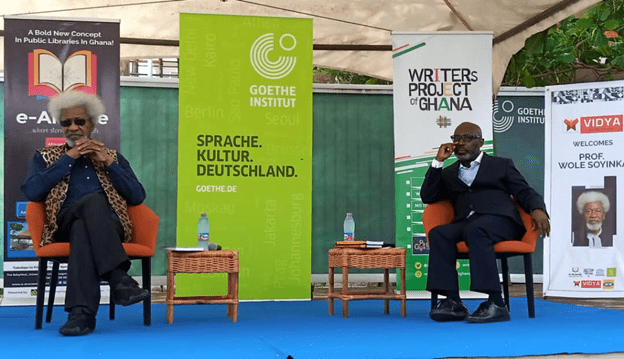
SEEING the electric-haired professor sitting cross-legged for much of the time that weekend, anyone would have imagined him in his sitting room in any one of his residences anywhere in the world. Besides, Ghana is like a second home to him: He spent some of his exile years in Ghana, Nigeria’s coastal cousin and sometimes regional rival, taught in a university there for years and has visited now and then up until late last September.
There was a feeling of not being locked in despite the lockdown in the open-air venue at Goethe Institut, un-littered lawn in the background, leaves ruffling overhead from a see-through awning, the kind of setting Soyinka would have felt very much at home. He was.
The theme of the event, “A Season of Anomy – Covid-19 and the Creative Muse,” could have been a found story dropping on a writer’s laps. It was for Soyinka.
Like the rest of us, he is living through the pandemic, having experienced it first-hand after a recent trip from the US, monitored closely by health authorities in Ogun State and praised them for their efficiency. If anyone should know a thing or two about the creative muse, Soyinka is that person.
For much of the last six decades, he has done nothing else but write — plays, poems, memoirs, edited and published anthologies (one is expected soon) not to mention the seminal essays on African literature, myths/ mythology. He has not stopped, tellingly describing himself to Ivor as “suicidal” when it comes to writing.
Anyone can interpret that to mean pushing himself to the limits, pointedly noting in the same conversation that “until I work myself to death, I won’t be satisfied.”
It is true that writers never really retire. As long as they have their wits about them, if they don’t become amnesic or suffer from some such degenerative disease that might impair their writing as they age, they can be as productive as the day they started. Soyinka is a glaring example of this, even in his dotage.
He is well north of 80 but walks erect with brisk paces and not the C posture or doddery steps we associate with people of that age. Most of all, he has not stopped writing. Anytime from November, for instance, Soyinka’s third novel, after Season of Anomy 1973, will be published first in Nigeria by Chronicles, and then Stateside late next year.
In December, he will co-direct Death and the King’s Horseman, to be staged at Terra Kulture in Lagos.The play itself,knocked off over a weekend, say those in the know, was cited by the Swedish Academy, classifying it as “an antique tragedy with the cultic sacrificial death as theme. The relationship between the living and the dead, to which Soyinka reverts several times in his works, is fashioned here with very strong effect. Soyinka confirms his position as a centre of force in drama.”
There are certain individuals whose only form of relaxation is to work, to be busy doing what they know best. The five-month lockdown provided ample opportunities for Soyinka to do just that – triangulating from the desk to the dining table and bedroom, then repeating the entire process all over not in any particular order.
Part of the result of all that is the soon-to-be published novel. Not only that, he “discovered some lost poems by just browsing through my files, my papers, they will go into the anthology which is coming out.”
The lockdown also gave rise to the forthcoming production at Terra Kulture. In response to Ivor’s question, he let on that the lockdown was “blissful” for him as a writer.
“You just find yourself literally rolling from your desk to your bed to the dining table back to the desk for five months continuous writing,” Soyinka said. “At the end of that exercise, when you finish that book, you will want to stretch your mind in a different direction. So, with a combination of circumstances, it occurred to me that, wait a minute, it might not be a bad idea to do a production. I haven’t done one for about three years since I directed Beatification of Area Boy at Freedom Park.”
If the project comes off, which of course it will, Covid-19 or not, Soyinka would have secured for himself a place as the oldest working theatre director in Nigeria, and maybe the world.

‘One of Africa’s most imaginative advocates of the creative culture’
THE audience at the venue was sparse because of state-ordered restrictions and more because such literary events are far from musical jamborees. Still, you got the impression of a fairly adequate world representation.
There was Mr. Abdourahamane Diallo, Country Representative of UNESCO. Soyinka was UNESCO Goodwill Ambassador from 1994 to 2009 “in recognition of his dedication to the ideals and aims of the organisation,” Diallo said, describing Soyinka as “one of Africa’s most imaginative advocates of the creative culture.”
All through his spell as Goodwill Ambassador, Diallo continued, the professor made crucial reports to the world body to address “the issues about African social development.”
One of the ways through which the continent can attain that development, Diallo inferred, is through books to which UNESCO subscribes. In his words, UNESCO launched a World Book Policy “creating a consensus that books have their benefits for human beings including cultural support essential to development and humanity’s happiness. The book appears as an instrument of freedom conveying thoughts, ideas, knowledge, symbols and dreams elaborated by other human beings reputed to have been able to build bridges between other human societies with books constituting one of the major defences of peace because of the innermost influences in the intellectual and creative climates of friendship and mutual understanding.”
In support of that, Diallo quoted the Director General of UNESCO Mrs. Audrey Azoulay: “When we celebrate books, we celebrate activities – writing, reading, translating and publishing — which helps individuals to raise and fulfil themselves. And we celebrate the fundamental ways the freedoms that make them possible.”
There was the chief hostess herself, Heike Friesel, director of Goethe Institut in Ghana, a German with connections in Austria. The educational and cultural institution she presides over in Accra is a magnet to writers and other culture activists from West Africa. She had waited with breathless anticipation for the Conversation with Soyinka. But just on the morning of that day, she had to contend with an unexpected domestic wahala. Her apartment was flooded after a water pipe burst.
On the flooding itself, Friesel quoted a famous saying in Vienna about enduring and living through unexpected temporary disasters: “What a luck, nothing worse has happened!”
True, the faulty plumbing was repaired in the end but the rest of the world is enduring Covid-19, prompting Friesel to remark that “worse things have actually happened in the world in the year 2020 and these are problems we all have to tackle together. People from around the world need to sit together and find solutions together instead of looking for scapegoats. We have to listen and to learn from each other and for that I think we are here today.”
Credit goes to the Council of Foreign Relations Ghana for making the event possible and, above all, for brining Soyinka to the conversation. MTN Ghana also collaborated in the project as well as Writers Project Ghana. In the house was Dr. Wale Okediran, Secretary-General of Pan African Writers Association (PAWA) and his counterpart of Ghana Writers Association.
‘Travel has become a pain… thanks to the irredentists, the salvationists of the world…‘
LONG before Ivor began his Q&A with Soyinka, the moderator of the event, Nana Osai, had set the pace for what would turn out to be an exciting afternoon. He could have been speaking for thousands of youths across West Africa when he recalled that his first encounter with Soyinka was through one of his poems, “Telephone Conversation.” He was 14. Though he went on to say he didn’t understand “the layers” in the poem, he was nonetheless hooked.
So were some of us in literature class in secondary school when we read it as a prescribed text along with other poems: “Lest we Should be the Last” by Kwesi Brew himself a Ghanaian, “Come Away My Love” (Joseph Kariuki), “Nightfall in Soweto” (Oswald Mbuyiseni Mtshali), “Night Rain” (JP Clark), “Viaticum” (Birago Diop) and many more in A Selection of African Poetry edited by Kojo E Senanu and Theo Vincent.
For Nana, “Telephone Conversation” resonates strongly in the world today as it did when Soyinka wrote of his imagined experience/ conversation with a British/White landlady in whose house he hoped to become a tenant as an African. On the strength of current evidence – George Floyd et al – race relations are very much in world discourse today, and may be for some time to come.
Conversation with Soyinka also had a six-minute aside when writer Martin Egblewogbe read from Between the Generations: An Anthology for Ama Ata Aidoo at 80 edited by Agyeman-Duah. Soyinka himself wrote the foreword.
But it was the Conversation with WS that got the most attention. You could feel the high-profile audience hanging on to his every word, every sentence he uttered, thus displaying a keenness of mind in informal conversations as he does in his writing. What’s more, he used the opportunity to blow up a few myths about him.
One, for instance, is the popular belief that he travels a lot, always on the move. Contrary to that, Soyinka told Ivor he used to in his younger years: “Many people believe that I move around so much. I hate travelling. When I was younger, no problem. I took it in stride. For me, it is routine: you had a workshop somewhere, you went; you had a conference somewhere, you went. An event you think is important to your work, you travel. But travel has become a pain in the neck over the years, thanks to the irredentists, the salvationists of the world who think it’s alright to blow up planes… travel has become increasingly strenuous.”
Even one of his favourite past times, strolling in the forest has also become increasingly unsafe. During the lockdown, he did manage a visit or two to the bush but not as he used to. “The bush is no longer as secure as it used to be because Boko Haram they are everywhere,” Soyinka said to Ivor. “You have to be careful wherever you go, even in the forest which used to be my personal property, I always believed, but now being contested by these mindless irredentists.”
On Soyinka’s commitment to creative writing, Ivor said: “You work, you write, and you are as creative as somebody who is aspiring to win the Nobel prize not somebody who has won one.” Soyinka jokingly responded that “it’s a pity that they don’t award it twice to anybody,” also making a point that he doesn’t necessarily write for prizes. “I think I just write and hope that the readership will pay for the book and get some royalties to live on.”
Running into nearly an hour, Soyinka spoke on just about any topic or question Ivor lobbed at him – as candidly as he could and as insightful, too. No surprise there, coming from one of the keenest minds in Africa.
One question you felt Ivor skipped or forgot to ask is about Soyinka’s expected third novel. Season of Anomy was published more than 40 years ago. It would have helped much to have a peek at the story, what it’s like, to have his guest whet readers appetite with what to expect in the book. It was not so.
Anyway, that won’t be long in coming. After all, December is just around the corner, after which you can be sure of many more conversations with the prof who has said of his life as writer that “until I work myself to death, I won’t be satisfied.”


0 comments
… [Trackback]
[…] There you can find 19498 additional Information on that Topic: naijatimes.ng/conversation-with-soyinka-in-ghana/ […]
… [Trackback]
[…] There you can find 95472 additional Info on that Topic: naijatimes.ng/conversation-with-soyinka-in-ghana/ […]
… [Trackback]
[…] Here you can find 92098 additional Information to that Topic: naijatimes.ng/conversation-with-soyinka-in-ghana/ […]
… [Trackback]
[…] There you can find 4012 additional Info to that Topic: naijatimes.ng/conversation-with-soyinka-in-ghana/ […]
… [Trackback]
[…] Find More to that Topic: naijatimes.ng/conversation-with-soyinka-in-ghana/ […]