
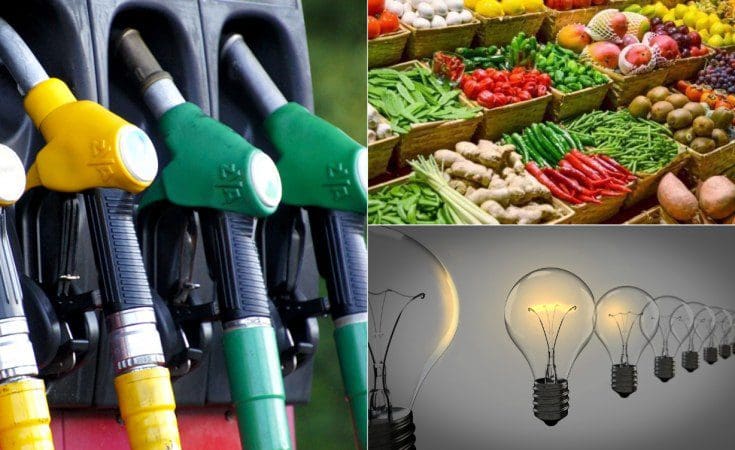

Just recently, Nigeria’s material circumstance fell due for public scrutiny as prices or costs of several public utilities like electricity tariffs, pump price of Premium Motor Spirit (PMS), etcetera, were reviewed upward almost simultaneously. In November 2019, the Federal Government was compelled by certain macroeconomic constraints or the vagaries of demand and supply to increase the Value Added Tax (VAT) from five (5) per cent to seven point five (7.5) percent. Then came the recent jerk in electricity tariffs and the pump price of fuel almost at the same time.
Whereas the electricity tariffs were moved from about N30.23 per megawatt to N66, the pump price of petrol was floated at about N160 from the last price of N148.50 per litre. As expected, this development has generated more heat than light. Several analysts and opinion leaders have however argued that given the persistent fall in government revenue due to the downward slope in the price of crude oil in the international market, it is understandable that government is pressed to look for other means of conserving money to run the economy.
Yet, they also argued, the timing of the price review is not auspicious for Nigerians, especially the poor masses, who are just trying to extricate themselves from the suffocation of several months of the COVID-19 lockdown. Also disturbing is the speculation which is rife in the air that the price of cooking gas may also go up. Even as the manufacturing companies are pushing the incidents of excessive taxation and high cost of production to the average consumer, the Nigerian Labour Congress (NLC) last week gave the Federal Government a 14-day ultimatum to reverse the prices or face nationwide industrial action. This action, if allowed to play out, would further drag the economy, which is already in dire straits, to breaking point.
While empathising with Nigerians for this unsavoury development, we at Naija Times appeal to Organised Labour and the Federal Government to embrace dialogue and come to a common ground. To every problem there is always an angle of solution. It is truly apposite that the government needed the political will to clearly end the unsustainable nightmare of humongous wasteful fuel subsidy.
But the government also needed the political will to allow due process to supervene in the deregulation of the downstream sub-sector of the oil and gas industry in spirit and in the letter. For this final round of the deregulation exercise to be acceptable to all stakeholders, the oil and gas sector of the economy must be fully liberalised. We must stop the process whereby product importation is wholly monopolised by the state. That is not deregulation.
Again, it is grossly anomalous for government to be announcing prices and then turn round to claim that it does not have a hand in the upward reviews of prices of petroleum products. Government has to terminate the appointment of all the regulatory agencies with their mandates. There is no need keeping the Petroleum Equalisation Fund and Petroleum Products Marketing Company in a deregulated regime.
Deregulation means inviting the private sector to invest in the industry and allowing prices to respect the laws of demand and supply. As has been made public recently, the multilateral finance agencies have made removal of subsidy for petroleum products and for power supply as well as the unification of exchange rates as preconditions for the approval of loan requests from countries. It is paramount to leverage on such demands to push through some of these urgent and badly needed policy reforms.
We tend to agree with those who hold the view that the four decrepit refineries in Alesa Eleme and Onne (Rivers State), Warri and Kaduna have become conduits or the albatross of the petroleum industry in the country. The refineries, with a combined installed capacity of 455,000 barrels of crude oil per stream day (bpsd), mean so much to Nigerians as all productive activities in all sectors of the economy are tied to availability and affordability of petroleum products.
In the years since 1997, when successive governments chose to neglect the mandatory Turn Around Maintenance (TAM) schedules of the refineries in order to create patronage systems around the lucrative business of fuel importation, most economic activities have suffered, with severe negative consequences on the quality of life of Nigerians. The situation got worsened as the exchange value of the local currency was forced into a continual downward spiral with severe inflationary pressure, due to the huge demand for foreign currencies for the massive importation we have witnessed so far.
Since this condition has become a major trend as the combined capacity of the refineries does not surpass 32 per cent, we are constrained to call on government, through the Nigerian National Petroleum Corporation (NNPC), to ship the crude oil for domestic consumption at production cost price to a refinery in a nearby country for refining. The landing cost inclusive of shipping cost would be much reduced by this process. This avoids subsidy payments and would ensure a low fuel price for domestic consumption. This was done in Venezuela.
While this is being experimented, it is our considered opinion that government should license more private investors, individuals and corporate organisations to set up private refineries. This would liberalise the sector and attract investor money to the petroleum industry. Even state governments should be encouraged to set up modular refineries, especially in the Niger Delta region. This would help increase the availability of the product, reduce the price and curb the perennial incidences of oil bunkering in the region.
As for the galloping electricity tariffs, it is high time we considered the review of our over-dependence on hydro technology for power generation. For once, government should allow private investors free hand to invest in the power sector and encourage the use of coal and solar energy to generate electricity. The initiative to promote alternative energy source outside hydro should include NNPC Renewable Energy Division, National Electricity Regulatory Commission, Ministry of Power and the operators coming together to drive this process in a collaborative efforts that would lead to cheaper power. The value chain for the power sector should be positively disrupted (generation, transmission, distribution, etc) to make power more affordable.
We enjoin the Federal Government to continue to subsidise tariffs to the downtrodden but the tariffs must be cost reflective if power must be delivered. Private investors, on the other hand, must strive to work in a regulated environment so that their inefficiencies are not transferred to the consumers. As it is, statistics seem to be opaque in the power sector especially as regards the actual cost of production of one megawatt of electricity as a basis for tariffing. Electricity distribution agencies should be more impactful about the availability of power. The authorities should also ensure proper and effective regulation to avoid energy theft. This might also mitigate the issue of increase in cost.
Above all, the gas sub-sector must be revitalised to feed the power sector. We align with President Muhammadu Buhari in his recent order for pre-paid metres to be given to all Nigerian families to reduce corruption and inefficiency in the power sector.


2 comments
… [Trackback]
[…] Read More Information here on that Topic: naijatimes.ng/hike-in-cost-of-public-utilities/ […]
… [Trackback]
[…] Read More here to that Topic: naijatimes.ng/hike-in-cost-of-public-utilities/ […]
Comments are closed.