

THE football house, globally, seems to be plagued by a monumental virus which has seen most of it leadership being buried in opprobrium, during or shortly after their tenures in office. The corruption virus knows no boundaries and thus afflicts global, continental, regional and national football bodies with reckless abandon.
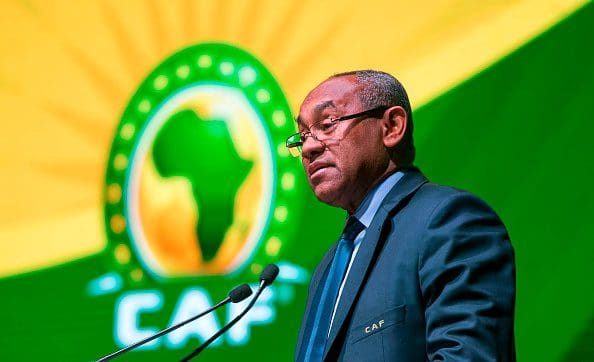
Just last week, the virus was detected in another victim who has since been quarantined away from having anything to do with international football management, at least for now. Ahmad Ahmad, the President of the Confederation of African Football (CAF), was told by the Federation of International Football Associations (FIFA) to stay off the pitch of football administration for five years over corruption charges. In addition to the sanction, he was fined 200,000 Swiss Franc.
Football followers in the continent believe that under Ahmad as President of CAF, African football had become a huge joke. In fact, he was christened the “undertaker” of African football.
Before his arrival at CAF headquarters over three years ago (since March 17, 2017), there were already whispers of corruption allegations in the body but a more worrying issue was the unending tenure of Issa Hayatou who, after 29 years on the saddle as CAF President, still wanted another term in spite of his failing health.
Allegations of corruption against Hayatou were rife. Many wanted to see him go. He had overstayed his welcome in office. His tenure by 2017 was almost half the age of the 60-year-old CAF. If he had his way, he would have been a life president. Unlike Ahmad, however, Hayatou left an admirable legacy which his staunchest critics would admit, even if grudgingly. He stamped his authority in CAF. Competitions ran on schedule; member associations benefitted from different FIFA grants for the training of teams, officials and development of the game. Hayatou had an over bearing presence and exhibited the airs of an emperor, and as it turned out, his word was law. He signed many lucrative television contracts for the game and the prosperity of African football was not in doubt. The Cameroonian made lasting changes to CAF competitions, imitating UEFA. He became a permanent presence in the affairs of African football in the manner of sit-tight presidents — a scourge of the continent.
Even with all his excess baggage, Hayatou’s tenure recorded some notable achievements. The same cannot be said of Ahmad who started showing symptoms of the corruption virus infection very early in office. A relatively unknown Ahmad was only elected CAF Executive Committee Member in Marrakesh, Morocco, four years before his CAF presidency. He had been FA President, a Director of Sports, Minister of Fisheries, and Vice President of the Senate in his native Madagascar by 2016.
Even in Marrakesh, when he defeated the more famous South African, Danny Jordaan, one of the pillars of the 2010 World Cup in South Africa and former member of the South African parliament, Ahmad was still not expected to amount to much in the perking order of the game in Africa.
However, in March 2017, he was elected CAF President, beating the incumbent Hayatou 34-20 because a coalition of Football Association Presidents wanted Hayatou out. Ahmad’s major campaign thrust was ending Hayatou’s monopoly of power over African football. He promised unity and inclusiveness as well as an entirely different administration from Hayatou’s.
Now that the genie is out of the bottle, Ahmad clearly had a different agenda. He abused his office through misappropriation of funds and offering gifts as CAF president and FIFA vice president. Ahmad’s conduct, in the opinion of FIFA’s Ethics Committee, was unacceptable. For example, he financed an Umrah pilgrimage to Mecca and he was also involved in CAF’s dealings with sports equipment company, Tactical Steel.
Allegations of corruption against Ahmad started early in his tenure. He dismantled everything Hayatou did and replaced them with systems which football followers said made Africa a laughing stock in international football circles. African football went comatose. A prime competition like the Champions League was ruined over Video Assisted Referee (VAR) controversies and CAF made bumbling decisions over the matter. Ahmad was accused of taking sides.
Broadcast rights’ contracts that earned CAF millions of dollars under Hayatou suddenly evaporated. Ahmad was reported to be at home with getting on the nerves of long standing CAF partners, by cancelling their contracts or awarding them to new comers who ended up providing poor equipment and services. One of those contracts landed him in trouble with the French anti-corruption agency during the 2019 FIFA Women’s World Cup in France. He was subsequently arrested.
Under Ahmad’s watch, things actually got worse. FIFA had to take over the running of CAF as Ahmad could not account for millions of dollars FIFA had given to the continental body for the game. More investigations followed. The result was the hammer last week by FIFA’s Independent Ethics Committee. He is to stay away from football for five years; and that automatically lays his second term ambition which he announced last month to rest. He was actually forced to hand over to CAF first vice president, Constant Omari, after testing positive to coronavirus. What is now left is the revival of CAF by those who know how the “undertaker” buried a once vibrant organisation.
Although corruption has become endemic in sports organisations all over the world in general terms, the story of the African continent is a particularly sad one. With the quality and number of talents across the continent, Africa would have been a monumental global powerhouse in sports. Unfortunately, that is not the case. Poor administration and decaying infrastructure have driven these talents to other places for greener pastures. With football administrators like Ahmad, Africa can never make progress in football. He is a disgrace to the beautiful game and, hopefully, his ban should be a lesson to others. In fact, Ahmad should stay away from all football-related activities for the rest of his life.
Africa used to be a major contender in global football with very strong teams from all the regions of the continent. Today, however, national teams from Africa are largely made up of imported players from premiership sides in Europe and Asia. Local leagues are almost non-existent and national teams are struggling to have enough of local players. Most African footballers prefer to play for foreign countries where they have naturalised largely due to the short-sightedness of greedy and shameless football administrators like Ahmad.
Countries have to pay heavily to bring back footballers who ply their trade in foreign leagues to play in their national teams’ colours in continental and global tournaments. This trend must stop if Africa wants to compete well and take its rightful place in global sports engagements. Sports administrators should focus on developing the sector instead of engaging in frivolous jamborees and financial scandals which have become the Achilles’ heel of the continent.


5 comments
… [Trackback]
[…] Find More Information here on that Topic: naijatimes.ng/ahmads-fifa-hammer-and-the-fate-of-african-football/ […]
… [Trackback]
[…] Find More here on that Topic: naijatimes.ng/ahmads-fifa-hammer-and-the-fate-of-african-football/ […]
… [Trackback]
[…] Find More on that Topic: naijatimes.ng/ahmads-fifa-hammer-and-the-fate-of-african-football/ […]
… [Trackback]
[…] Find More on to that Topic: naijatimes.ng/ahmads-fifa-hammer-and-the-fate-of-african-football/ […]
… [Trackback]
[…] Find More on to that Topic: naijatimes.ng/ahmads-fifa-hammer-and-the-fate-of-african-football/ […]
Comments are closed.