
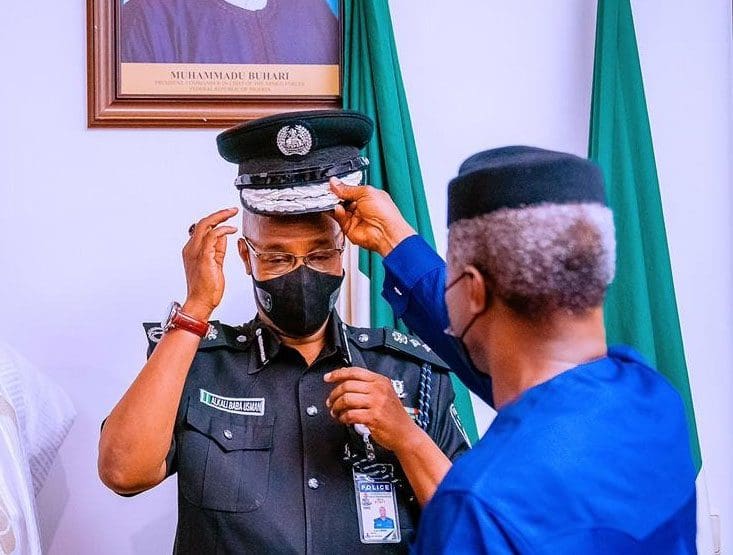

AFTER what appeared to be much vacillation, the President finally appointed an Inspector-General (IGP) for the Nigeria Police Force in an acting capacity. The new helmsman, Mr. Usman Alkali Baba, steps into the role following the abrupt termination of the three-month tenure extension granted his predecessor, Mr. Mohammed Adamu.
The somewhat tardy handling of the succession process was glaring as the former IGP was relieved of his position while on official assignment in Owerri, the Imo State capital. Apart from the bad optics which the approach sign-posted for the government, it threw up a number of legal issues bordering on the commitment of government to the faithful implementation of the Police Act 2020, signed into law by President Muhammadu Buhari last year. The legislation created a framework considered by legal experts as transparent and participatory, especially with respect to the appointment of the nation’s number one cop.
According to the provisions of the Act in Section 7 (3), “the Inspector-General of Police shall be appointed by the President on the advice of the Police Council from among serving members of the Police Force.” It instructs in Section 7(6) that “the person appointed to the office of the Inspector-General of Police shall hold office for four years.” These provisions appear to have been circumvented when the tenure of the previous IGP was extended, although the Attorney General of the Federation, Abubakar Malami, argued that by virtue of the fact that the office of IGP is a quasi-political office, the statutory issue of years in service or age limit does not strictly apply.
It was argued that Adamu’s tenure ordinarily would lapse in 2023 if counted from 2019 when he was appointed IGP, or 2024, if counted from 2020, when the new Nigeria Police Act came into force. According to him, the provision of section 18(8) of the Nigeria Police Act, 2020, which states that ‘Every police officer shall, on recruitment or appointment, serve in the Nigeria Police Force for a period of 35 years or until he attains the age of 60 years, whichever is earlier,’ was inapplicable to the office of IGP in the circumstance.
It was further argued that the IGP was only accountable to the President of the Federal Republic of Nigeria and the Nigeria Police Council and that made his office a quasi-political office with a tenure of four years pursuant to Section 7(6) of the Nigeria Police Act, 2020.
The confusion generated in the circumstance is better imagined. It was avoidable. For instance, it is doubtful whether IGP Adamu continued to command the respect and loyalty of his subordinates in the force. The extension granted to the former IGP also created a credibility crisis and must have affected the morale of the rank and file who may have perceived that their helmsman was staying on in office, contrary to what the law says.
With a new officer holding sway, it is important for government to put its house in order. This, it can do by first ensuring a smooth and seamless leadership transition within the force, in accordance with the law. Addressing the succession conundrum within the top hierarchy of the police force is important because effective policing has to be anchored on the rule of law.
The other critical issue to look at is the value the new helmsman and his operational team would add, in terms of effective policing of the country. As the top security agency responsible for internal security, it has the prime responsibility of maintaining law and order across the country. Therefore, even as IGP Usman Alkali Baba continues in an acting capacity pending his confirmation, Nigerians are rightly and deservingly curious about what he is bringing to the table.
The country is facing serious threats from an assortment of criminal elements and groups at different levels. The safety of lives and property, including the sanctity of human life, are constantly being undermined by organised groups of outlaws. Nigerians would, therefore, be looking up to the new helmsman to provide decisive, smart, innovative and sustainable approaches to deal with the rising wave of criminality in the land.
While citizens are not under any illusion that this is an exclusive task for the IGP and his team, they expect the new top cop to provide leadership and rise to the occasion in terms of providing a strategic road map towards making the country safe and secure. He must begin the process of decisively and effectively bringing criminals to justice. It must be clearly seen to be done otherwise the impression which has already been created, that criminals can always get away with their nefarious acts, will be sustained.
There is no doubting the fact that Baba is taking the reins at an extremely difficult time. Vice President, Yemi Osinbajo observed the same thing when he said IGP Baba has been picked to lead the Nigeria Police Force at a very challenging time. He has been called to duty at a time Nigeria is buffeted on all sides by various threats and actual manifestations of insecurity. In the North East, the Boko Haram insurgency continues to rage and all over the country, the menace of kidnapping, armed banditry and other forms of violent crimes are commonplace.
Therefore, reversing the current trend and restoring normalcy would require strong will, team spirit and a willingness to listen to citizens who bear the brunt of the near collapse of law and order all over the country.
Apart from the ideas the IGP may be considering, we must emphasise the question of holding lawbreakers accountable for their actions. It is critical to stemming the tide. The current reality in Nigeria is, when criminals are apprehended by law enforcement agencies, very little is heard thereafter. Ensuring that criminals face justice and are punished for breaking the law are fundamental to deterring and discouraging bad behaviour. If criminals get away with their acts without commensurate penalties, it becomes an incentive for more people to break the law.
Another area for the IGP’s immediate attention is the danger posed by the proliferation of small arms and light weapons. A recent report by the Abdulsalam Abubakar-led National Peace Committee noted that about six million small arms and light weapons are in the hands of non-state actors. With such a staggering number of deadly weapons in the hands of unauthorised persons, there is a tendency to constantly challenge the authority of the Nigerian State.
Although addressing this challenge is not something the Police can handle alone, they have a responsibility to lead the process of working out collaborative models with other security agencies to stem the flow of deadly weapons and also mop up those already in the hands of unauthorised persons. It is about time effective measures are put in place to secure our borders and prevent the continued flow of these deadly weapons.
The IGP also has a responsibility to properly mobilise his officers and men through incentives and welfare packages, to motivate them towards attaining set goals. No matter how strategic the policies and initiatives of the IGP are, if those who are going to help him achieve the goals are not effectively mobilised, it may well be just another walk in the wilderness.
As things stand, IGP Usman Alkali Baba has his work well cut out for him. He does not need to be told that policing a country as expansive and diverse as Nigeria, is not a stroll in the park. He needs to move quickly to affirm the sacred constitutional mandate in Section 14 (2b) of the 1999 Constitution as amended, which states: “the security and welfare of the people shall be the primary purpose of government.”


4 comments
… [Trackback]
[…] Read More on to that Topic: naijatimes.ng/new-ig-and-the-nations-quest-for-effective-policing/ […]
… [Trackback]
[…] Find More on that Topic: naijatimes.ng/new-ig-and-the-nations-quest-for-effective-policing/ […]
… [Trackback]
[…] Read More to that Topic: naijatimes.ng/new-ig-and-the-nations-quest-for-effective-policing/ […]
… [Trackback]
[…] Find More Info here to that Topic: naijatimes.ng/new-ig-and-the-nations-quest-for-effective-policing/ […]
Comments are closed.