
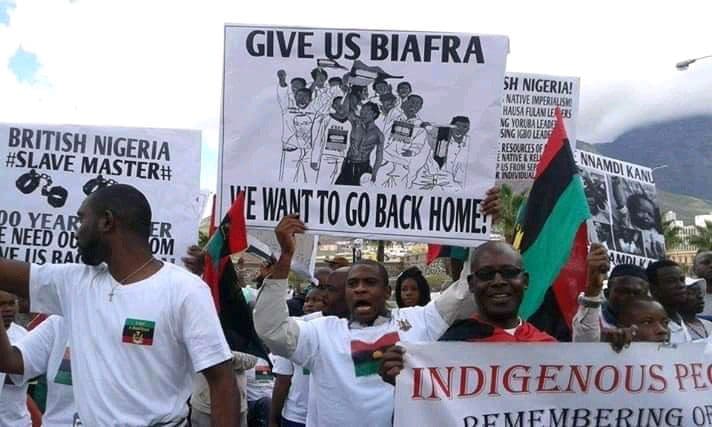

AS the daily toll of deaths from insurgency, banditry, and kidnapping across Nigeria becomes all too commonplace, few now doubt that the nation is in a crisis comparable to the 1960s or 1990s. This “30-year itch” of systemic collapse is upon the country again, driven by irresponsible elites who help themselves first to our national wealth despite the obvious ruin around them.
Amid the growing insecurity, population boom, massive poverty, economic dysfunction, skyrocketing corruption, and poor governance at all levels, it is no wonder that people across the country are coming back to the idea that breaking apart would improve their lot.
Since the British arbitrarily drew Nigeria’s lines on the map a century ago, separatist notions were doomed to be a constant threat whenever the centre lost power or legitimacy. Certainly, the nation has progressed far beyond the time when Chief Obafemi Awolowo could quip famously that Nigeria is a “mere geographical expression,” but the deep roots of the nation’s precolonial cultures all but ensure that whenever the federation underperforms, frustrated individuals will look to ethno-religious entities for solutions. No citizen of this nation has reached the age of 17 without asking themselves at least once: wouldn’t a smaller country of just “us” make more sense? Why do we have to have our futures tied to “them?”
These are important questions that every Nigerian has a right to ask whenever “Nigeria” as an institution is working against their interests, and at the moment that is about 92% of Nigerians, who must make do sharing less than half the nation’s wealth. Nonetheless, the next questions that must be asked are: would a Biafra, Arewa, Oduduwa, Niger Delta, or any other Republic for that matter, do a better job? And is the bloodshed that would be required to create such entities worth it?
Increasingly, young Nigerians nationwide are answering yes to both questions. The return of the spectre of separatism should thus be a wakeup call for Abuja to make the country work for everyone. Yet, Nigerians thinking about supporting separatism also need to consider the experience of South Sudan, which promptly descended into its own civil war after breaking away from Sudan in 2011.
Among these various groups clamoring for independence, the Biafran and the Yoruba separatists have caught the attention of the Buhari administration in particular. This is not surprising considering that the success of these groups, given their size and potentials, would certainly push other groups to attempt to exit as well, given what might follow.
In particular, a New Biafra would almost certainly make territorial claims on Niger Delta ports and oil producing areas to gain sea access and resources, which would certainly be contested by other groups in the area, leading to widespread violence. Signs are already there as Niger Delta groups have dissociated themselves from the Biafra gambit and have vowed to defend their territorial integrity if any attempt is made to annex them without their full consent.
The federal government, completely averse to these movements, has moved in to halt them. Some commentators are already saying that Abuja’s strategy of targeting IPOB is high-handed and likely to backfire. According to them, the approach has given legitimacy to the movement by making it appear to be so important as to arouse government’s anger, thus ensuring it regular media attention and credibility as the key fighter of Igbo marginalisation. They claim that prior to being designated as a terrorist organisation, IPOB was largely unknown with no military capacity and its leader, Nnamdi Kanu, was just a fringe online radio personality.
However, another school of thought believes that treating violent separatist groups with kid gloves is inviting a monster that would assume the Frankenstein status in no time. They point to the Boko Haram insurrection which started as a group of political stalwarts in Borno State, but which has now metamorphosed into a global monster, threatening Niger and the entire Sahel region of Africa. They insist that at the time Kanu was arrested, he had already crossed the red line, an action that cannot be tolerated by any government of a sovereign state, no matter how benevolent or democratic.
Speculations have been rife that the swiftness with which the administration arrested Kanu and responded to IPOB attacks on police stations and other structures of the criminal justice system in contrast to the many years that Boko Haram has gone undefeated, underscored perceptions that the federal government is hostile to the southeast; but there are claims also that using the non-defeat of Boko Haram to justify the claim of hostility against the South East begs the question of the criminality of the acts allegedly perpetuated by IPOB and the tendencies of its leader.
Meanwhile, separatists in the Niger Delta and the South West like Sunday Igboho, have been emboldened by IPOB’s activities. The growing insecurity nationwide, combined with ISWAP/Boko Haram – which can itself be considered a religious separatist movement — only means that Nigeria faces widespread insurrection with separatist groups across its entire South and the North East.
Individually, none of these movements are powerful enough yet to tip the nation into civil war, as it happened in the 1960s. The 1990s also witnessed such waves from the South West and the Niger Delta region. Ordinarily, there is nothing wrong with a group of people who are no longer comfortable belonging to a particular geo-political setting to want to opt out and be on their own; but such must be carried out within the ambit of liberal doctrine, the scope of international convention and dictates of sovereign laws. It must be done without breaching the freedom of others.
There is no doubt that some of the agitations could ordinarily be justified in the face of present realities in the country — a clear manifestation of monumental failure of leadership at all levels. Those who feel suppressed or short-changed have the right to protests; and even have the right to seek to opt out of the union. However, when promoters of such agitations employ violence or resort to violent means to press home their demands; and in the process threaten the stability of the state and the rights of others, the most likely scenario would be the intervention of the state in whatever form it deems necessary.
Secessions need to be strategically organised, and the state governors would have to be central players in any such efforts for it to happen. Clearly, state-level politicians are sensing opportunities in these separatist movements and are using the pressure created to press for greater decentralisation, which would be one positive outcome from the current crisis. Again, that would only happen if politicians from the different regions can find an acceptable compromise. In the least, devolving powers to the regions, allowing for fiscal federalism and establishing state police structures could help to push back separatism.
President Muhammadu Buhari could also do much to reverse the situation even now, by making his government more inclusive of all the component groups that make up the country; and encouraging leaders in the troubled regions to come to the bargaining table alongside their governors, in order to find a negotiated solution that would douse the raging fires in exchange for inclusive involvement and concrete development in their regions.
It is also obvious that some elements of the agitations witnessed across the southern regions have to do with the 2023 presidential elections. The zones of the South feel it is their turn to produce the next president; particularly the South East, which insists it’s the only southern zone yet to hold the position since the Second Republic. It is likely that much of the wind could be taken off the sails of separatism in the South if the main political parties signal a willingness to promote a southern candidacy in 2023. The continued prevarication of both the All Progressives’ Congress (APC) and Peoples’ Democratic Party (PDP) on which zones gets the ticket has continued to fuel apprehension among southern politicians who feel they might be short-changed, going by the body-language of their northern counterparts.
Bold leadership by the President and from the hierarchies of both the APC and PDP could still do much to ensure that Nigeria’s 30-year-itch of separatism is scratched as it was in the 1990s, with a reasonable solution that made an aggrieved region feel that it had something to gain from being in Nigeria, rather than the path chosen in the 1960s.
That, combined with a nationwide strategy of negotiation and inclusiveness, could do much to convince more Nigerians overall that the nation served their interests and that, for all its problems, Nigeria remains a better choice than the alternatives.

