

*Exhibition continues till Nov 10 at Nike Gallery, Ikate Lekki
(Being text of critique of the works in the exhibition, FOOTPRINTS by Kunle Adeyemi, MFA, Ph.D., FSNA, as contained in the Catalogue)
“Attitude is the reflection of our own selves, its roots are inward, but its fruits are outward, it is our best friend-or our worst enemy, it is more honest and more consistence than our words. It is a future outlook based on the past experiences. It draws people to us or repels them. It is never content until it is expressed. It is the librarian of our past. It is the speaker of our present. It is the prophet of our future.’’ Maxwell (2001)
CHIDI Kwubiri to a large extent is no longer a greenhorn in the practice of art particularly drawing, mixed media, installation and painting genres at both local and global space judged from many outstanding solos, joints, group exhibitions, workshop participations, and facilitations, projects and commissions to mention just a few; he has lunched and endeared himself, his works and his art practice into the minds and collections of his audience, protege or mentee, students, art dealers and collectors alike. John Maxwell’s statements above have been spotlighted on Chidi Kwubiri’s lifestyle of positive visual thinking, learning and work ethics, and I found out that maintaining a positive attitude and sincerity to his art practice has been a major key to his professional and personal success.
Heraclitus Thomas Jefferson, the third President of the United State of America said, “nothing can stop the man with the right mental attitude from achieving his goal; nothing on earth can help the man with the wrong mental attitude.”
Creativity
At this junction one is tempted to ask what is creativity. Creativity is not going into art school to study arts nor wearing crazy jeans, pants, tattered clothes, funny hats, bushy unkempt hair and looking funny and stupid. Rather it is the ability to make something new that did not exist before; to do things in a new way; when one stops doing the regular, steps or think out of the box and refuses to judge himself but end up creating something that stands out. Creativity is when someone defiles the box of limitations or the regular. When flexibility exists in someone’s thinking and drives away completely from the known.
In some of Chidi Kwubiri’s works which will be discussed later in this paper, I see creative capability runs in his arteries and veins. This seemingly is in the area of his paintings, drawings and pictorial compositions. In almost all his canvases, he inputs an irresistible inspired impulse to create, to fashion, and to organize his forms and paints. His urge is like that of a writer who assembles 26 letters of the alphabets; writes books that are practically engaging, mind boggling, attention keeping; crafting out sentences and paragraphs to form the entire book. You will agree with me; it takes hard work, resilience, determination and dedication to take words, create tenses to make rhymes of poems, to take the greens of flowers and turn them to a beautiful garden, to take wood; designed it and turn it into beautiful furniture, to take a primed canvas, paints, found objects, pre-conceived drawings; make a beautiful painting and make humanity pay thousands of euros or dollars for its value.
Creativity generally reminds us of how much greater God is. He is the best and the greatest. -Ashimolowo (2018). Little wonder a Chidi Kwubiri who has committed himself to visual arts creative vibes; feels restless until his small and large canvases has been converted into that unique painting which amaze, trail blaze, document, inform, entertain, engage, blesses, draws or makes humanity feel better and enjoy the world from his own perspectives and perception of life. A close look at the works on displays in Chidi’s “footprints” might convinced one that some of the works grows out of serendipity meaning an unsought, unintended and unexpected but sudden discovery that was not planned; but creates a learning experience while some out of curiosity by questioning and challenging the impossible. Some of his works in this exhibition are a tale of turning “why to why not”. He, I am sure deliberately push his eyes to see his creation and at the same time the mind to appreciate them. He gave himself to answering some social, philosophical, political, psychological, environmental and entertainment questions and began to create the works even when the value may not be obvious.
I will briefly discuss in this paper some of my observations of about Chidi Kwubiri’s works that takes him out of the ordinary. He, I believe creates his art beyond the convergent information in his possession. He prods on high level long visual thinking in creating his subjects. He engages the extra-mile factor in his painting presentations. He breaks out of the box in creating subjects that are aesthetically pleasing, socially informing, consistently entertaining, educatively documenting, and politically relevant to his time in space. In some of his works, he creates a potpourri of several things by mixing the unmixables. He synthesis the old and the new, tradition and modernity, etc. Despite Chidi’s calculative forms, fine draftsmanship, thematic designs, he allows randomness, freedom and spontaneity. In his works, he engages and interrogates simple thinking.
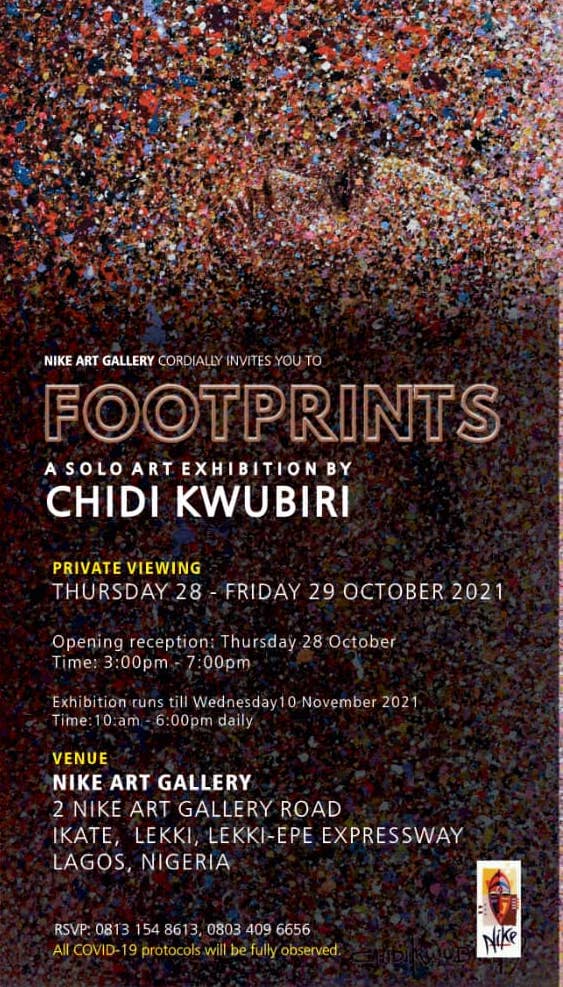
According to him, his sources of inspiration are his culture, people, music playlists, sweet hot egusi soup, vita and of course his mood of happenings around him locally and globally. His themes just like any other artists revolves around nature, universal existence, hope, contemplation, reflection, cohesion, diversity and unity, compassion, kindness, respect, and human interactions. All these are pointers to the fact that Chidi Kwubiri in his works can be seemingly referred to as a missionary, teacher, philosopher, historian, journalist, social scientist, narrator, home moulder, preacher, thinker and above all an ‘aspiring sage’. Footprint is an admixture of artworks that tells both storming and sweet stories about his personal life; about people who in one way or the other that have left their footprints in his life and stories of people he has impacted and would still impact positively in the course of his sojourn on earth by giving directions on life matters, sharpening perceptions on issues, triggering or reflecting thoughts on individual, collective, community or global reasonings that would make the world a better place.
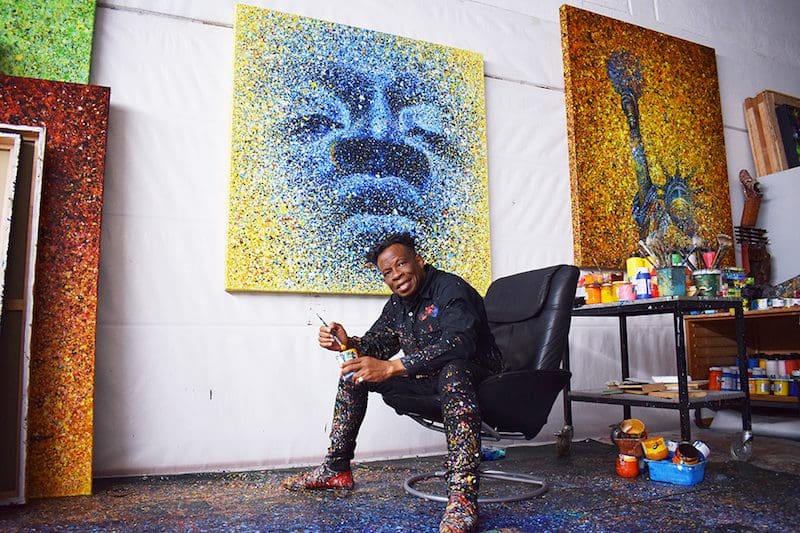
To say that Chidi Kwubiri has enjoyed and combined the art trajectories of two worlds is an understatement. This he achieved and interrogated by virtue of his training, practice cum University Education in Germany, and the advantage of being a “home boy or son of the soil” in Nigeria. The fusion and synthesis of these two worlds is a plus in the art practice of Chidi. His works negotiates the complexity of two different cultures while still holding strong to his local roots. He has constantly advanced and innovated his own form of pointillist painting technique that engages layers of dripping paints which eventually creates forms and optical illusion. He is perhaps one of the modern African artists that uses new materials, ideas and techniques; experimenting in ways that hitherto were uncommon and Eurocentric.
In looking at Chidi Kwubiri’s work and career, one sees an impressive paradigm for the emergence of the late 19th century pointillist style made popular by Georges Seurat (1859-1891). Though he has over the years avoided a categorical definition on his styles, his artistic sensibility on pointillism is in fact readily identifiable. In his recent works, he developed a love for astonishing juxtapositions of fragile found objects; such as his studio working clothes, painting shoes, used brushes or dried out color palettes and color pots which he self styled “creative up cycling ideas” are affixed on his canvas giving a quasi relief mixed media outlook which forms an interplay of color tactile texture and an ability to make masterful old techniques come to life with contemporary relevance.
Sometimes Chidi’s works are intentionally inconclusive and contradictory making them aesthetically resistant to the kind of interpretative paraphrases that are often necessary to relate works of art to an artist’s life and environment. His dripping layer-bound dots acrylic on canvas with human image or forms gives a mirage-like visual tricks on the viewer. This is a radical style of representation, in which objects in the works are manifested and suggested by deep realistic or abstract signs that minimally intervene in planar field.
Chidi’s originality is evident in his “dots paints-dripping” style as well as tapestried multilayered panellation soothing harmonious colouration and other inventions of his that is gradually becoming imbedded in the African aesthetic vocabulary. His works in ‘frontprints’ expoused me to his deep and incredible sense of spirituality and realist, surreal versatility. His poetic prowess and vast knowledge of his subjects, literature, folklore, music and ethno- cultural issues are remarkable. Little wonder he paints with wild and unimaginable intensity backed by artistic integrity. Interestingly, he works largely from nature imagination through pictorial composition and visual ideas to the extent that no matter how elaborate or expansive the work becomes; he still makes himself felt as the central idea of the painting.
Despite the simplicity in some of his works, the subject of his paintings can sometimes be described as relatively esoteric with intense emotionality and explosive eroticism. (A state of love at first sight and sexual excitement). Over the years, Chidi Kwubiri has shown in his works and style a rich variety of poetics in the deep registration of the spirit of eclecticism, contradictoriness, cultural collage and curiosity.
Today in “footprints”, the many stories, deep meaning of his works which are sometimes parallel, and sometimes divergence, but more often intertwined, represent the story of an intriguing and precious passion. Despite the distance of his base in Germany he sings his songs to the admiration, danceability and mediation of his African descent. The permeability to differences and social, cultural and spiritual contents makes his works contemporary propositions that are open to the future. The extent of their colourful tonal range, the optical illusory dots, drippings, layers, variety of technical draftsman accents and the ever emerging potential to inject dissonances that accentuate the harmony of the entire dimensions are the dynamic elements that make Chidi Kwubiri’s work standout. The intensity by which the reality in “footprints” is addressed is evident in Kwubiri’s display of works with vast and immense tones of traditional minstrel and foreign paradigms with visions shaped by the harsh realities of the times.
Conclusively, “Footprints” in the annals of documented solo and group exhibitions participated and displayed by Chidi Kwubiri will be difficult to ignore particularly his technical maneuvers in the use of lines, forms and colours. This seemingly confirms his basic, sound technical, foundational, instructional footings from German Art School. His understanding of the use of lines, forms, colours as well as his skillful management of painting compositions are delightful and successful. The dynamics of his pictorial compositions are filled with actions and non-static gestures signaling a newness of a creative consciousness, of action packed real live theater or the kinetism of a film show. He has succeeded far above the formalist concerns of the popular 19th century modernist pointilist Georges Seurat (1859-1891).
All that can be seen from my pin hole is that the artist’s traditional, cultural, technical synthesis and millennial or generation outlook seem quite expansive. This according to Aniakor (2011) is like a thematic journey from ancestral legacy to modern transformations. Just like works whose surface tapestry is like array of hidden plastic codes, seeking for some forms of explication in the quest for meanings. Yet their plastic references as aesthetic codes cannot be divorced from the African cultural patrimony, its appropriation and domestication as well as Kwubiri’s exposure to the paradoxes of global urban life, its beauty and decay, its joys and sadness. Undeniably, his works take their root from the seamless range of compositional phrasings, as well as the razzmatazz of colours under the tendering effects of ennobling brush work.
Chidi Kwubiri in ‘footprints’ has come to redefine how the world looks at African art. He is indeed one of the pioneers in the dots, dripping multi-layered forms of representing the multiple, shifting realities of contemporary African art. He represents a section of a major part of the future of African art, and potentially of world art.

References:
Aniakor, C (2011), foreword to contemporary African Art, my private collection of Onyema,
Offoedu-Okeke, Brown Brommel Ltd; 12A Caroline Atounah, off Durosimi Etti Drive Lekki Peninsula Scheme 1, Lagos, Nigeria.
Anueyiagu, O. (2011), An Introduction to contemporary African Art, My private collection of
Onyeka, Offoedu-Okeke, Brown Brommel Ltd; 12a Caroline Atounah, off Durosimi Etti Drive, Lekki Peninsula Scheme 1, Lagos, Nigeria.
Ashimolowo, M. (2008), The creative Edge, Mattyson Media (MAMM), Buckmore Park,
Maidstone Road, Chatham, Kent ME59QG UK
Chidi Kwubiri (2021), Artist Statement on Footprints Chidi-Kwubiri.com, Retrieved October, 2021
Chidi Kwubiri (2021), My Art and Biography, www.Chidi-Kwubiri.com, Retrieved October, 2021.
Ibsaleh 2305, Opera News, retrieved (October, 2021) A man’s character is his fate, Heraclitus,
Thomas Jefferson, http//ng.opera.news
Komolafe, O. (2007); Thoughts on Granite African wisdom and Philosophical Reflections on Life,
iUniverse, 2021 Pine Lake Road, Suite 100, Lincoln, NE68512.
Maxwell, JC. (2001), The power of Attitude, River Oak Publishing, Tulsa, Okalahoma,74170-0143,
USA.
Thesaurus (2021), Wiktionary CC BY SA 3.0. LICENSE

