
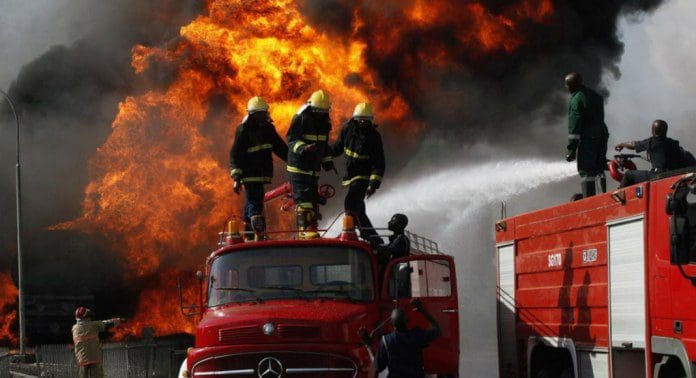

APART from the routine news of criminal gangs wrecking havoc across the land and a surfeit of building collapse, another regular fare on news bulletins about Nigeria is explosion involving fuel tankers or gas facilities. It is becoming so commonplace that it no longer evokes the kind of emotions that it ordinarily should. Whenever it happens now, the reaction is merely “yet another explosion.”
Unlike terrorism, banditry and violent criminality which require intense strategic and logistics operations, curbing gas explosions only requires relevant regulatory and prosecuting agencies being diligent in their duties. Rather than take preventive actions to ensure that these disastrous incidents never rear their ugly heads in the first place, leaders of such organisations are more interested in sermonising after the deed has already been done.
Unfortunately, whenever such incidents happen with accompanying loss of lives and property, those who should have ensured strict compliance with regulations but clearly abdicated their responsibilities, return unperturbed to their seats and continue with the same greed and laxity; and the society continues to suffer from their impunity.
Siting of gas plants and refill facilities is not supposed to be taken for granted. The Department of Petroleum Resources, (DPR), State Town Planning Authority, the Fire Service and the Federal Road Safety Corps, (FRSC) have statutory mandates to carry out intense due diligence surveillance on the location, construction and service operations of any of such facilities because of the combustive and destructive nature of the product. Going by what has been happening, and waiting to happen, it does not seem like these agencies have been, or are at all interested in, diligently carrying out their statutory responsibilities.
It is also obvious that the National Emergency Management Agency (NEMA) and the various state arms; government officials – federal and state — are only interested in responding to incidents and coordinating relief materials when disaster occurs instead of insisting on strict regulation to curb them.
Professional bodies are also interested in reacting and mouthing non-compliance with procedures after very serious incidents have already happened. They do not put their foot down on issues concerning standards when they should, but wallow in excuses and threats when their sidon-look attitude has contributed to monumental damage to lives and property.
Also, Nigerians seem to prefer convenience to safety. While the lawless entrepreneurs connive with regulatory agencies to flout rules governing the location and operation of certain facilities that are capable of endangering their lives, they look the other way as long as it serves their purpose. They fail to report irregular activities to relevant government agencies and expose such agencies when they refuse or neglect to act accordingly. They wail, lament and blame others only when disaster occurs.
Government officials and agencies are now more interested in post moterm rhetoric. For instance, at the scene of the latest incident of October 16, 2021 in Mushin, Lagos State, the Managing Director of Lagos State Emergency Management Agency (LASEMA), Oluwafemi Oke-Osanyintolu, was obviously satisfied with the emergency response than the fact that the incident was allowed to happen at all.
“At 7:50 am, we received a distress call and we activated all our emergency responses. With a combined effort, we were able to put out the fire within an hour. After the rigorous effort …, we were able to pull out ten persons and five of them had already died, while five others survived. The survivors were treated on the spot and were released immediately.”
As far as they are concerned, response is the issue, not prevention. Casualties are just statistics, nothing more. They await the next incident and officials, including governors, would come around and mouth the now very familiar verses that accompany the several otherwise preventable disasters that occur as a result of official negligence of regulatory standards.
The Senate, after the Mushin incident, challenged the relevant agencies to review their mode of operation, safety procedures and licensing regimes of the potentially combustible business as well as mode of transportation of gas in Nigeria. Recall that the Senate said the same thing in October 2020, when a massive gas explosion occurred at the Cele Bus Stop, Iju-Ishaga in Ifako-Ijaiye, Lagos State. Then, it vowed to “move” to avert further deaths through gas explosions. It turned out to be motion without movement.
Similarly, when the country was witnessing a string of gas explosions last year, the Nigerian Institute of Town Planners (NITP), lamented that the situation was becoming worrisome. It vowed to work with other stakeholders to address the situation. While admitting that the issue had never been given serious attention, NITP stated that the recurring development has made it mandatory that deserving attention should be given to the phenomenon. From what is going on, it does not look like that pledge was taken beyond mere rhetoric.
However, the issue might not be about rules and regulations; it is more about implementation and enforcement of existing laws. There are enough and clear regulations on where and how gas storage and dispensing facilities should be sited and operated.
There are also specific qualifications for those who should operate such delicate facilities. The fundamental challenge lies with the lawlessness of some entrepreneurs, the greed and complacent attitude of regulatory agencies’ officials, indulgence by the people as well as the carelessness and ignorance of the operators of such facilities. It is easy to effectively deal with these infractions if only the relevant regulatory agencies are made to carry out their assignments diligently; and if appropriate sanctions are meted out for negligence and complicity.
We cannot continue to routinely wail and lament over a situation that can decisively be arrested by just doing the right thing. It is high time people started paying for their lawlessness, negligence and bad behaviour. Defaulters have to be prosecuted to serve as a deterrent while those charged with the responsibility of regulating and supervising proper conduct must be sanctioned appropriately.
The level of lawlessness is becoming unacceptable and the price is getting too high. We cannot continue like this. We must insist that sanity prevails in our society because no one knows for whom the bell tolls next.

