
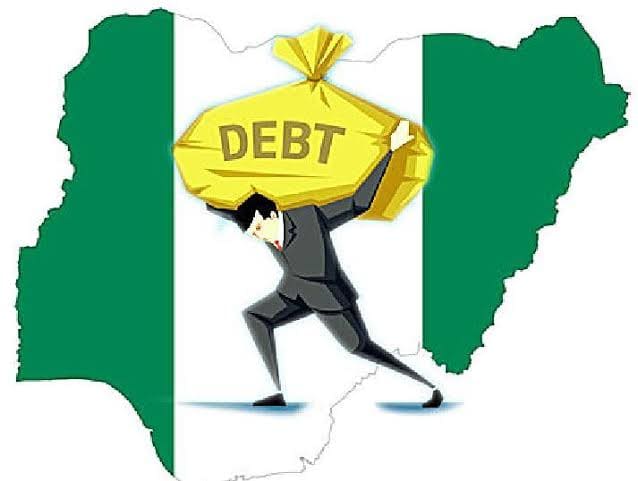

IN the last two weeks, discussions have returned to Nigeria’s increasing debt profile following the approval by the National Assembly for the country to draw down another tranche of the loan which forms part of the deficit component of the already approved Federal Government budget.
Each time that happens, there will be another round of concerns that government has gone for a fresh loan that will overburden the finances of the country and create more challenges for the future. They point to the already burdensome repayment regime that has seen a greater chunk of the country’s meagre revenue going into debt servicing.
Government officials, including the Director General Budget Office of the Federation and that of the Debt Management Office, battle to explain the status of the country’s loan vis a vis the gross domestic product (GDP). They point to the fact that Nigeria is still within reasonable limits and not any way near the red zone. They insist also that the country has the capacity to service its liabilities.
Quite apart from the hysteria generated by opposition politicians and some ill-informed civil society organisations about the frequency of “fresh loans”, there are however genuine concerns about issues surrounding the country’s loan history. Those concerns are sound enough to generate and sustain apprehension.
It is an obvious fact that Nigeria is not making the kind of money it used to make in the years gone by, but the level of wasteful spending in government ministries, departments and agencies (MDA) belies the dripping nature of the country’s revenue stream. The revenue streams are not flowing in as before, but expenditure is going up without visible signs of development. The question arises: what are they spending the money on? Transparency and accountability are obviously lacking; and so suspicion and scepticism creep in and fuel the apprehension.
Loans are in themselves not bad, it is what they are being used for that raises genuine concern; how much waste is being cut off and the monitoring mechanism put in place to ensure the direction of utilisation. These are the issues. Although this argument may go against the popular narrative, it is better to borrow now than later because if we don’t solve the challenges of today on the excuse that we do not want to borrow or owe, the problems will escalate to a level that it might be more difficult to access credit, and the country will be sinking.
So, the issue is not much of getting loans, but what it is being used for against the backdrop of the history of what was done with the other loans in the past. That is where Nigerians become suspicious, sceptical and apprehensive.
The people are not bothered about the percentages or whether the country has reached the borrowing threshold. The question is also not basically about the act of obtaining loans, it is more about what it would be used for. Government has variously explained that the loans are for critical infrastructure, but the issue still remains: is there an effective mechanism to monitor the application, to be sure that the loan is used for what it was obtained in the first place? The question keeps popping up against the backdrop of the history of obtaining such loans. You get the loan today and it is diverted to something else that was not the reason for the loan in the first place.
The same goes for taxes. In the Scandinavian countries where taxes are very high the people seldom complain, because they can visibly see and benefit from what the taxes collected from them are used for. They enjoy free and better services in the education and health sectors; basic infrastructure are in place and well maintained. Government can take as much as it desires as taxes, but the basic problems should be taken care of. Let the services be easily and freely available and let the infrastructure be provided and maintained. Let the people see and benefit from the taxes they pay.
If the people see a positive correlation between what is obtained in form of loans and taxes and what is actually achieved on the ground, there will be less complaints about taking loans and collecting taxes. What generates genuine concern and fuels the hysteria is the issue of inverse relationship. The more loans obtained, the less visible the output. That is why people are becoming sceptical and asking questions.
Critical attention must be directed at curbing wasteful spending. The country may after all not have need for the volume of loans obtained if wasteful spending is curtailed. Truth be told, the country has a history of spending carelessly. The issue of wasteful spending must be tackled as a matter of priority and urgency because at the end of the day the country may not exactly need the amount obtained from whichever credit agency if it is capable of saving some money.
Nigerians become worried because of the history of these loans being mismanaged. It is most likely that if Nigerians see the result of the loans obtained, they will not complain that government is obtaining loans. The fact is, they hardly see the result. The difference between African countries and so many developed nations is the visibility of the application of taxes. They know why they are paying taxes.
As part of ways to put a tab on the country’s borrowing, there must be an effective monitoring and evaluation system to ensure that loans obtained are used exactly for the reasons for which they were obtained. If a component of the loan was meant for the building of a new airport, for instance, there must be a progress report for the construction of the airport. People need to see what is being done with the money.
Another serious systemic problem that must be dealt with is corruption. How are we going to ensure that corruption does not swallow the good intensions put on the table while sourcing for and obtaining the loan? The monitoring and evaluation mechanism must be structured in such a way as to eliminate or minimise corruption.
The National Assembly has a huge responsibility in monitoring and evaluating loans sought and received by government because it is always involved in the entire budget process, from the beginning to the end. The legislature has been a major factor in the wasteful application of loans obtained as members not only misappropriate funds during budget considerations but divert allocations meant for critical infrastructure projects to frivolous constituency projects. Their oversight activities ordinarily meant for evaluation of projects have been turned into money making business. The legislature must take its responsibilities seriously in the interest of the people and the country.
Importantly also, credit institutions from where loans are obtained should not only be interested in the meeting of repayment schedules and remittance of accrued interests, they should also monitor the activities of those they do business with to ensure that every facility granted is being properly utilised. That should be the basis for further engagement.

