
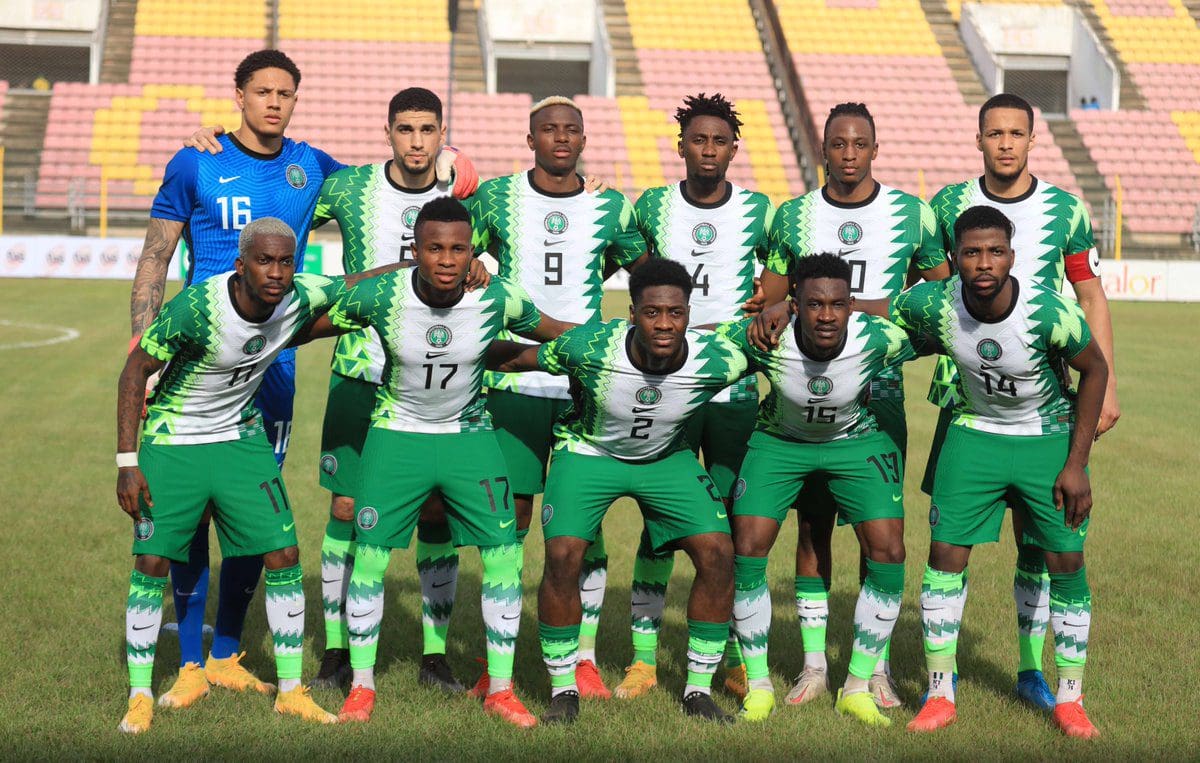

NIGERIA’s senior men’s national team will be playing two high-profile friendly matches in the summer in preparation for the World Cup billed for Qatar in November and December.
However, it is not the Super Eagles who are preparing for the World Cup; it is their opponents – Mexico and Ecuador, who Nigeria will face on 28 May and 2 June respectively in the United States of America.
For the first time since 2006, Nigeria will not be at the second biggest sporting event in the world (behind the summer Olympics), and the country has no one to blame but itself. Most of Nigeria’s previous successes in sports have been in spite of the often shoddy arrangements when preparing for these competitions.
There have been cases of unpaid allowances, substandard travel arrangements, inadequate accommodation and such inconveniences that hamper optimal performance from sportsmen and women. Sometimes, Nigerian sportsmen and women defied these unnecessary challenges to bring home medals and trophies.
The country paid the price for its ‘sins’ this time.
Just two months to the Africa Cup of Nations and three months to the World Cup playoffs, the Nigeria Football Federation finally disengaged Gernot Rohr as head coach and appointed Austin Eguavoen in his place on an interim basis. While it is not unusual for coaches to be fired and hired, there were two major flaws in the NFF’s decision.
First, they had apparently made up their mind that Rohr would be fired but they wasted about two months dragging their feet before making the call. Those two months would have been put to better use by the new coach.
Second, they made what turned out to be the wrong appointment as Rohr’s temporary successor. Those familiar with Austin Eguavoen’s previous work were skeptical about his ability to lead the Super Eagles to success. In his last coaching assignment with a national team, Eguavoen failed woefully with the Under-23s.
His tactics and selections were questionable, and the team could not qualify for both the 2011 African Games and the 2012 Olympics under his guidance. Besides, Eguavoen has not been in active, on-field coaching for around six years. He was clearly out of touch, but the NFF ignored wise counsel.
Even after Eguavoen’s tactical limitations were exposed in the round of 16 defeat to Tunisia at the Africa Cup of Nations, the NFF bowed to pressure from the sports ministry and retained him for the World Cup qualifiers.
It was clear to insiders that the NFF was more disposed to sticking to their plan of appointing Portuguese coach Jose Pereiro to lead the team after the AFCON, but they were overruled by the sports ministry who insisted on having a Nigerian in charge.
Even with a squad that was vastly superior, the Super Eagles could not beat Ghana’s Black Stars in the World Cup playoffs.
The Ghanaians were much lower ranked than Nigeria by FIFA – No.60 to No.30 – but they were more organised, more purposeful and better coached. They will be in Qatar while Nigeria has been left behind to count its losses.
Apart from the NFF’s culpability in the handling of Rohr’s sacking and Eguavoen’s initial interim appointment, the sports ministry did a great deal of damage with their interference.
Apparently, even with claims by Amaju Pinnick that his NFF is largely independent, much of their funding still comes from the ministry. And as the ministry pays the piper, it calls the tune. Like all of his predecessors, sports minister Sunday Dare has assumed the role of overlord when dealing with the different sporting federations and it is often his way or the highway.
None of the sporting federations are truly independent and the NFF is no different. Perhaps if they had not been forced to retain Eguavoen for the World Cup playoffs, the outcome might have been different.
And failure to qualify is not just about the World Cup alone; it is about much more.
For one, Nigeria would have earned a guaranteed $12.5m just for being one of the 32 teams in Qatar. They would earn much more if they made it out of the first round. That money which, if properly managed, would have made significant impact in the country’s football development at all levels, from the grassroots to the national level.
Beyond the money from FIFA, the Nigerian football ecosystem stood to make millions of dollars from sponsorship deals for media and sports marketing companies. Corporate organisations are always eager to jump on the World Cup bandwagon with the Super Eagles, and serious money has been lost with that failure to qualify for Qatar 2022.
Funds, or their paucity, are always a concern in Nigerian sports and the country blew the opportunity to make a huge chunk on the altar of poor planning and needless complication of simple processes.
The inability to qualify for the Qatar 2022 World Cup is also a big blow to the advocacy to give the biggest coaching jobs to Nigerians. There has been raging debate over the years about the competence of Nigerian coaches at the highest levels of football and other sports. The performance of Eguavoen and his consortium of compatriots at AFCON and in the World Cup playoffs against Ghana did Nigerian coaches no favours.
Although the late Stephen Keshi achieved some success as Super Eagles head coach with his AFCON triumph in 2013 and by reaching the second round of the World Cup in 2014, Nigerian coaches generally have failed in recent years.
Samson Siasia, Sunday Oliseh and Austin Eguavoen have all overseen failed bids to qualify for major tournaments in the last 10 years, and the failure to reach the 2022 World Cup has become another disincentive to engage Nigerian coaches.
Indeed, the immediate consequence of the World Cup failure was the insistence by the NFF that the next head coach for the Super Eagles has to come from abroad. The team could have a line-up of Nigerian assistant coaches, but the NFF has made it clear that a foreign coach will call the shots.
As a matter of fact, the NFF is in the final processes of appointing the same Jose Peseiro they were forced to ditch for Eguavoen, and indigenous coaches have once again been pushed to the back row.
As things stand, the four head coaches of the country’s most prominent national teams are foreigners. Along with Peseiro who is expected to be confirmed soon, three Americans head the coaching crews of the Nigerian women’s football national team, the men’s basketball national team and the women’s basketball national team: Randy Waldrum, Mike Brown and Otis Hughley respectively.
Having knowledgeable foreigners in charge of national teams is in itself not a problem, but it is important for national development to have Nigerians with enough capacity to successfully take up these jobs. This can only be achieved when young, gifted coaches are given opportunities to rise through the youth teams and build their competence.
However, it does appear as if the Nigeria Football Federation has not learned from the recent failure to follow the right path. Instead of taking a radical approach and installing a new generation of coaches in the youth teams with a view to developing them into top tacticians that can be trusted with the Super Eagles role, the NFF is stuck in the past.
The NFF named a rash of new coaches for the men’s national teams and most them are just recycled relics of the past who have failed the nation before. You begin to wonder what the NFF is up to as they have refused to learn any lessons.
Salisu Yusuf, who was in 2018 banned after being caught taking bribes in a sting operation by the BBC, has been rewarded with a triple role: head coach of the Super Eagles B team and the U-23 nation team, as well as one of the assistants to the yet-to-be-named Super Eagles head coach. He is 60 years old and his only claim to coaching success is winning the Nigeria Professional Football League title with Kano Pillars 14 long years ago.
Ladan Bosso, who is around Salisu’s age, has failed twice with the U-20 Flying Eagles, first in 2007, but he has been reappointed as the team’s head coach for a third spell. He will be assisted by Fatai Amoo, another old hand, who is being circulated around the national teams.
The NFF and the sports ministry must use this painful failure as inspiration to right some of the wrongs in Nigerian sports.

