

ON September 28, the much-awaited and highly-anticipated 2023 political campaign season will flag off in line with Section 94(1) of the Electoral Act 2022. Going by the schedule of the Independent National Electoral Commission (INEC), the presidential and national assembly elections will hold on Saturday, February 25, 2023. This will be followed by the governorship and state houses of assembly elections scheduled to be held on Saturday, March 11, 2023.
The governorship election will be held in 30 out of the 36 states. However, Kogi and Bayelsa states will hold theirs later in the year. Recall that off-season elections held previously in Edo, Anambra, Ekiti and Osun states.
Last Tuesday, INEC released the list of presidential candidates and their running mates in 18 political parties as well as those contesting for seats in the national assembly, signifying the countdown to the campaign season.
There is so much at stake in next year’s general election and it is perhaps the single most important election since 1999 when the country returned to multi-party democracy. A crucial election of this nature could be determined majorly by swing votes but this outcome will depend on the messaging and campaign strategy of the parties and their candidates. It explains why those vying for the highest office in the land and their spokespersons are engaged in unhelpful negative commentaries, divisive rhetoric and hate speeches to gain top-of-mind awareness among the voting public.
So far, we have witnessed name-calling and de-marketing efforts by political adversaries who are experts in identity politics. We appeal to all politicians not to make the 2023 general election a do-or-die affair during the campaign season. It is shameful and ironic that the dominant political parties cannot even put their houses in order due to dashed hopes and the fight for relevance by party members, yet they hope to unite and lead Nigerians.
What Nigerians want to hear is a debate of ideas, focusing on specific issues as they relate to the harsh economic environment, insecurity, unemployment, disappearing opportunities, mind-boggling oil theft, massive brain drain, etc. For example, the food inflation rate was over 23% last month amid worsening foreign exchange scarcity which is hurting manufacturers and business owners.
With one US Dollar exchanging for over N700 in the parallel market, it is not surprising that many sectors of the economy are in bad shape and struggling to survive. The continuous fall of the Naira is deeply troubling as it now ranks as one of the weak currencies in Africa.
Nigeria is one of the world’s biggest crude oil exporters. Sadly, at a time the price of crude oil is rising globally, this development has not translated into any benefit for Nigeria. Instead, the country is borrowing more money to service its debt. Nigeria’s debt, according to the latest information from the Debt Management Office (DMO), is N42.84 trillion. How will Nigeria be able to pay it back? How do we get out of the debt trap?
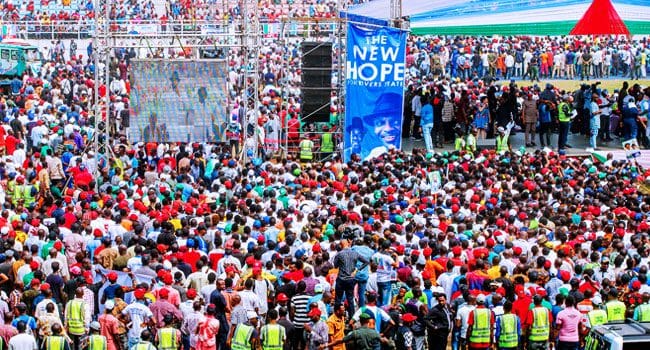
The rising debt burden is clearly the result of poor choices, fiscal indiscipline and the failure of policies. It should be prioritised as one of the serious issues that must be addressed by all the political parties and their presidential candidates during their electioneering campaigns. Staging political stunts and expensive rallies in colourful attires are not what will put food on the tables of hungry and angry Nigerians. They want concrete messages that will inspire hope and build trust. Every voter, more than ever before, is interested in knowing what the candidates will do for them.
To underscore the need for issue-based campaigns devoid of violent or fanciful rhetoric, the National Institute for Legislative and Democratic Studies (NILDS) in partnership with The Kukah Centre, last week, organised a forum in Abuja where the speakers urged political parties and their candidates to shun hate speech and focus on the key issues that will move Nigeria forward when the campaigns begin.
The speakers included Senate President Ahmed Lawan and House of Representatives Speaker, Femi Gbajagbiamila. “Rather than unite us, politics has become a tool for promoting our differences and further endangering national unity,” Lawan noted. On his part, Gbajabiamila said there was enough evidence to prove that legal provisions on political campaigns were already being violated – even before the campaign season formally begins.
From our experience, Nigerian politicians are generally bad losers and they deceive the electorate with promises that they never keep. But Nigerians are becoming wiser and there is a new awareness across the land that those who are seeking political offices must be competent and have a track record of performance.
As the campaign season begins, it is important that all the leading presidential candidates take part in live televised debates so that Nigerians who are eligible to vote will get the opportunity to assess the candidates and make their choices. No candidate should feel the debates are a waste of time; instead, they must be regarded as a great opportunity to showcase their talents, economic blueprint, management skills, and what they have to offer based on their manifestoes. These are necessary ingredients of the campaign trail, and must not be lacking this time around. In the past, this was the main reason for voter apathy.
Indeed, the electorate should do their homework ahead of the election. Complacency is unhelpful. They should interrogate the candidates beyond sentiments and assumptions. On election days, they should go out in great numbers to exercise their voting rights. In addition, they must defend their mandate at all the polling units across the country.
This is the time to reflect on the available choices before us and demonstrate the commitment to building a better Nigeria by voting the right leaders into office at all levels. When you sit on the fence and refuse to vote, then you cannot also complain when the political leaders begin to behave badly. Your voter card is your power and you should use it wisely.
With the evolving political conversation both at home and abroad, especially on social media, the political elite understand that it is no longer business as usual. They are now required to fight for every vote fairly and in a transparent manner but those who are desperate to win at all costs will always try to subvert the electoral process – even if it means resorting to violence. Unfortunately, this is an entrenched culture in Nigerian politics which must be rejected because it constitutes a major threat to our democracy.
Attempts at rigging or vote buying are classical examples of such threats and they will rear their ugly heads at the 2023 general elections. Similar concerns were expressed during the recent off-season elections in Ekiti and Osun states arising from vote buying incidents that were widely reported.
Fake news by mischievous social media activists and cyberbullies is yet another major threat to our democracy as noted by former president Goodluck Jonathan recently. All hands must be on deck to mitigate the rise of misinformation and disinformation.
INEC has continued to assure Nigerians that the 2023 general elections will be free, fair and credible. Based on their performance in Edo, Anambra, Ekiti and Osun gubernatorial elections, we should believe in INEC and expect improved performance at the general elections. In terms of logistics management, however, INEC must show that all would be well, especially with regard to the deployment of election materials nationwide.
Prof Mahmood Yakubu, Chairman of INEC, is confident that the use of the Bimodal Voter Accreditation System (BVAS) – an improvement on the Smart Card reader and Z-Pad tech platforms previously used – which captures three stages of the voting process will improve the integrity of the elections.
More than the use of technology, INEC has to also reassure Nigerians that after the last registration exercise, no one would be unduly disenfranchised. If those eligible voters who registered up to the end of July do not receive their PVCs, it simply means that they cannot cast their votes next year. This concern has led to a string of court cases that are piling on top of each other by aggrieved Nigerians aimed at undermining the role of INEC as an independent electoral umpire but it is a matter INEC must deal with immediately given the time available.
In the area of voter education, INEC should do more, but it must be actively supported by the National Orientation Agency (NOA) which has become almost moribund. It would appear that NOA has been non-existent in the scheme of things but this is the time for it to wake up from its slumber and embark on massive enlightenment campaigns ahead of the 2023 general election.
The security agencies also have their jobs well cut out for them by protecting lives and property during the period leading up to the election. We do not expect anything less and they should be neutral and earn the trust of all the political parties and Nigerians. More importantly, everyone must be vigilant at all times.
Between now and when the elections will hold next year, we expect the leading candidates to campaign with winning strategies without lying about their intentions. How the candidates present themselves during the electioneering period is as important as securing electoral victory. Their messages must be simple, clear, true and credible.

