

WHEN the recently discharged military service chiefs were sworn into office, in January 2021, then President Muhammadu Buhari told them that the country was literally in a state of emergency. He told them the government had made promises at inception in 2015 to secure the country, revive the economy, and fight corruption. He was honest enough to tell them then, that none of those promises had been easy, even though he also indicated that some progress had been made.
At the time President Bola Ahmed Tinubu took over the reins on May 29 this year, the situation was not significantly better. During his first meeting with security chiefs, he clearly indicated that a lot of work is still out there to be done; particularly in the area of securing the nation and ensuring peace in the sub-region. It was one of the areas he also touched in his inauguration speech. The service chiefs listened but they also knew that their days were numbered. New Presidents hardly inherit and sustain the security infrastructure of their predecessors.
During that meeting, the President pointed to the dire security situation in the country and was emphatic on a particular issue which has been identified as one of those that inhibit the effective clampdown and defeat of terrorists, bandits, ethnic militias, kidnappers and assorted violent criminals. He talked about sharing of intelligence among the services which the immediate past National Security Adviser (NSA), Col. Babagana Mungono (rtd) had repeatedly been pointing out.
It did not take long when the expected happened. The service chiefs were discharged of their responsibilities and new ones appointed to take over from them. In keeping with Section 18 (1) of the Armed Forces Act Cap A.20 Laws of the Federation of Nigeria, the President has communicated the appointments to the National Assembly and is awaiting their confirmation.
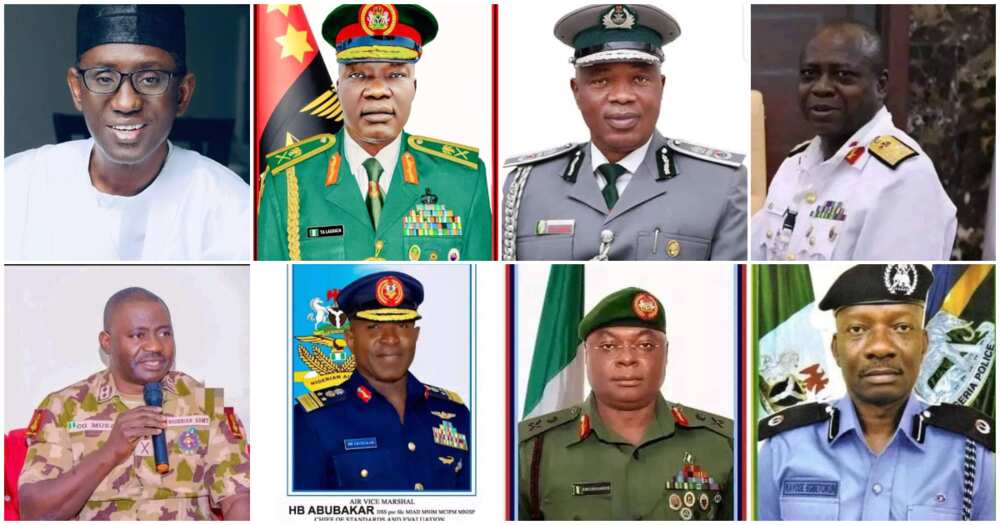
The new service chiefs include Major General C.G. Musa, Chief of Defence Staff; Major General T. A. Lagbaja, Chief of Army Staff; Air Vice Marshall H.B. Abubakar, Chief of Air Staff; Rear Admiral Emmanuel Ikechukwu Ogalla, Chief of Naval Staff; and DIG Kayode Egbetokun, acting Inspector-General of Police. Also appointed are Mallam Nuhu Ribadu, National Security Adviser and Major General EPA Undiandeye as Chief of Defense Intelligence.
The new helmsmen therefore have their jobs clearly cut out for them. Their seniors in service are also to go with the retiring service chiefs to make room for an effective command structure. That inhibition has been removed, and the new helmsmen have clear authority to exercise their mandates within the rank and file.
Like Buhari told the Major-General Leo Irabor-led service chiefs, there is nothing about the service that they do not already know, because they have been in it and therefore are part of it. They have received the assurance of support from the Commander-in-Chief. So, it is their job now to adopt a quick march approach to the discharge their duties. Their agenda should be very obvious – secure the country and ensure peace within the sub-region. Their loyalty should be to the country and they must be seen to exhibit an utmost sense of patriotism.
First, the service chiefs should know that there is already a baseline pedestal from which their tenure will be judged. Buhari had also pointed this to the immediate past service chiefs: “You know the stage we were in 2015, you know the stage we are now, and the undertakings we made.” President Tinubu has made similar assertions to the new team and has also promised his support. So, the service chiefs have a duty to defend their classification.
Secondly, they must avoid the pitfalls of the past. Individual services cannot do it all alone. There is serious need for inter-service collaboration. Mungono had complained severally about the attitude of service chiefs in the past who operated in silos, thereby prolonging efforts towards ridding the country of insurgents and violent criminals. Even when intelligence was available in some cases, they were not acted upon, resulting in avoidable fatal consequences, like the attack on the Correctional Centre in Kuje (Abuja) and the Abuja – Kaduna train attack.
Thirdly, they must appreciate the fact that economic growth and physical development are predicated more on peace and security of the country. The level of peace and security attained by the country determines the rate of citizen participation in developmental activities as well as inflow of foreign investments. These in turn improve the social life and welfare of the citizens.
These are not likely to be achieved if there are no well defined strategies and tactics. Questions are being asked as to whether service chiefs are appointed based on specific criteria or just as a matter of routine. What is the policy direction and what is the strategic agenda. In the case of the new dispensation, what is the agenda set for the service chiefs apart from the routine admonitions. Did the current appointees emerge from a rigorous interrogation of any defined agenda? Was their selection based on capacity to drive the agenda?
These interrogations are necessary because a generation of about 100 well-trained able-bodied Generals cannot be thrown out of service just for the sake of a routine exercise. Those for which they have to give way for must fit the bill, with the requisite capacity to achieve set objectives. It must not be business as usual; it should not be ‘the beat goes on’ kind of enterprise in the security domain. Failure must attract consequences!
The reason appointments of new service chiefs are often seen as routine is because the people hardly see any strategic agenda from the military point of view, whether in intelligence or tactical. New strategies in dealing with internal issues like insurgency, banditry, kidnapping, militancy, etc., are usually not available. It must however be acknowledged that the last administration made appreciable effort in the provision of weapons and logistics.
The president and his advisors must not simply wait for the service chiefs to design their strategy – Aso Rock itself must make clear: (1) what are the key objectives the military must achieve, and (2) what are the dates by which they expect these objectives to be achieved? If the service chiefs do not deliver on these plans by the dates in question, then the president can replace them for non-performance. This will also encourage inter-agency cooperation if the chiefs know they will sink or swim together.
The broad dimensions of this strategy should also be shared with the public in order to bolster confidence that the president is taking security seriously. These can be shared without fear of compromising the strategy, since Boko Haram and the kidnapping gangs already know they are in the crosshairs. In addition, knowledge that a reinvigorated military is coming for them may help to push them to the bargaining table to lay down their arms.
Although President Tinubu had told the last set of service chiefs when he came in, that he was not going to tolerate the different services working in silos or at cross-purposes, he needs to again drum it deeply into the ears of the new handlers that they have to work as a team, sharing intelligence and staying in unison if they are to achieve the goal of maintaining peace and securing the country.
The issue of non cooperation or rivalry between the different arms of the security architecture is something that the Commander in Chief will have to address immediately and seriously. Perhaps his choice of NSA, the coordinator of all the security arms, both intelligence and those exacting kinetic power, is of great importance. He has already appointed former Economic and Financial Crimes Commission (EFCC) chairman, Nuhu Ribadu to that office. We hope he will be up to the task given the issues that trailed his appointment.
The Chief of Defence Staff, acting the role of chairman Joint Chiefs of Staff, must also defend his classification in terms of coordination and supervision of the military arm, including information coordination, dissemination and other necessary logistics. The Chief of Defence Staff must be more visible in the coordination of operations, instead of floating as a General without troops. The situation the country is at the moment needs all hands on the artillery.
The agenda before any administration inheriting Nigeria at this moment are already clearly written. It is either it exacts all the resources available within the defence architecture to deal with the multifarious security challenges confronting the nation or risk going down the way of its predecessors. It needs emphasis here that there is not much anyone can achieve in terms of growth and development if the security situation is as nasty as it has been in the last one decade.
Without a doubt, the president must also be clear to the service chiefs that the corruption of the past will no longer be tolerated. Reports of high-level officers siphoning off military budgets while our brave soldiers are sent into battle without sufficient bullets have fostered mutinies in recent years and hobbled military effectiveness. Rising junior officer anger over senior officer corruption is extremely dangerous, and must be investigated. The National Assembly must also play its oversight role, and stop looking for kickbacks from the massive military budgets.
We must not, however, forget to commend President Tinubu as far as the appointment of service chiefs is concerned. He has been able to manage the country’s diversity, particularly when put side by side with the experience of the last eight years. The fact that he has appointed people from diverse sections of the country is an expression of the capacity to manage our diversity. It is now for the service chiefs to be on the quick march. They have a responsibility to help the President succeed; and the people also have a duty to support and encourage them to achieve peace, security and prosperity for all.

